Tuesday, 30 June 2015

Mersey Gateway (June update)

It has been 4 months since we last posted an update about the Mersey Gateway project which once complete will bridge the River Mersey. From a vantage point on the banks of Wigg Island Community Park (Runcorn) it's difficult to see if much progress has been made, but on further inspection is clear a lot has happened since February.

One of the key milestones that was finished in May 2015 was the completion of Halton's first new bridge over the Mersey in 54 years. The new trestle bridge which crosses the Mersey is a temporary structure which will be used as a platform from which workers will construct the new bridge.

Other work to construct the bridge has been ongoing inside 2 out of the 3 coffer dams constructed in the river, however progress has been out of sight for the most part. Work has been progressing within the walls of the north and south dams in order to excavate an enormous hole into which concrete will be poured. The concrete will act as foundations for the 3 large pylons from which the bridge will hang, the largest of which; the southern pylon will be 125m tall.

The central coffer dam is still under construction, after completion of small island which was built in the middle of the Mersey. The island has allowed for the safe construction of the coffer damn, which like the north and south dams will be excavated and then filled with concrete.

One visible aspect of the project which is taking shape on the northern bank is the construction of a massive 1500 tonne movable scaffold system or MSS, which once complete will construct the approach viaducts. The structure which will attach to the bridge piers will act as a mould into which concrete will be poured to form the approach viaducts. Once each section is complete the system will move along to attach to the next pier to repeat the process.

The actual bridge spans themselves will use separate cantilever system which will move out from each new completed section. Before each section is poured the movable system edges out from the completed section, a stay cable is then installed and attached to an anchor point at the base of the mould. Concrete is then poured into the mould and around the anchor point to form a strong connection between the span section and stay cable.

There is a full 3D fly through which shows how the systems will work.

With work progressing well the latest news from Mersey Gateway is that the project is on programme to have the bridge complete and operational by 2017. We hope to provide plenty of updates before that time. Our next Mersey Gateway blog will focus on the engineering taking place away from the bridge in order to upgrade the expressway which will connect the new bridge to the M56.


Wide shot of the temporary trestle bridge and the 3 coffer dams


Progress on the central coffer dam


Progress on the Southern (Runcorn Side) coffer dam

Progress on the Northern (Widnes Side) coffer dam

Construction of the 1500 tonne movable scaffold system on the Widnes side of the Mersey

Sunday, 28 June 2015

Stafford Area Improvemnet Programme (part 2)

Norton Bridge

In part one we looked in general at the Stafford Area Improvement Programme, in part two we will look in more detail at Norton Bridge. This part of the project involves constructing 6 miles of new railway and a new grade separated junction which will remove a key bottleneck.

Work to construct 6 miles of new 100mph railway and flyover at Norton Bridge began in spring 2014 and has been progressing well since with several key milestone complete.

3 high pressure gas mains and 1 aviation fuel pipeline have been moved, 4 out of 5 rail over river crossing have also been complete.

One of the key milestones which was completed earlier this month (June 2015) was the construction of bridge 5 which will eventually carry the diverted B5026 over the existing railway,

The completion of bridge 5 means that earth can be transported safely within the site by articulated haul trucks. Each 6 wheel haul truck can carry up to 30 tonnes of earth at a time from a large cutting to elsewhere within the site.

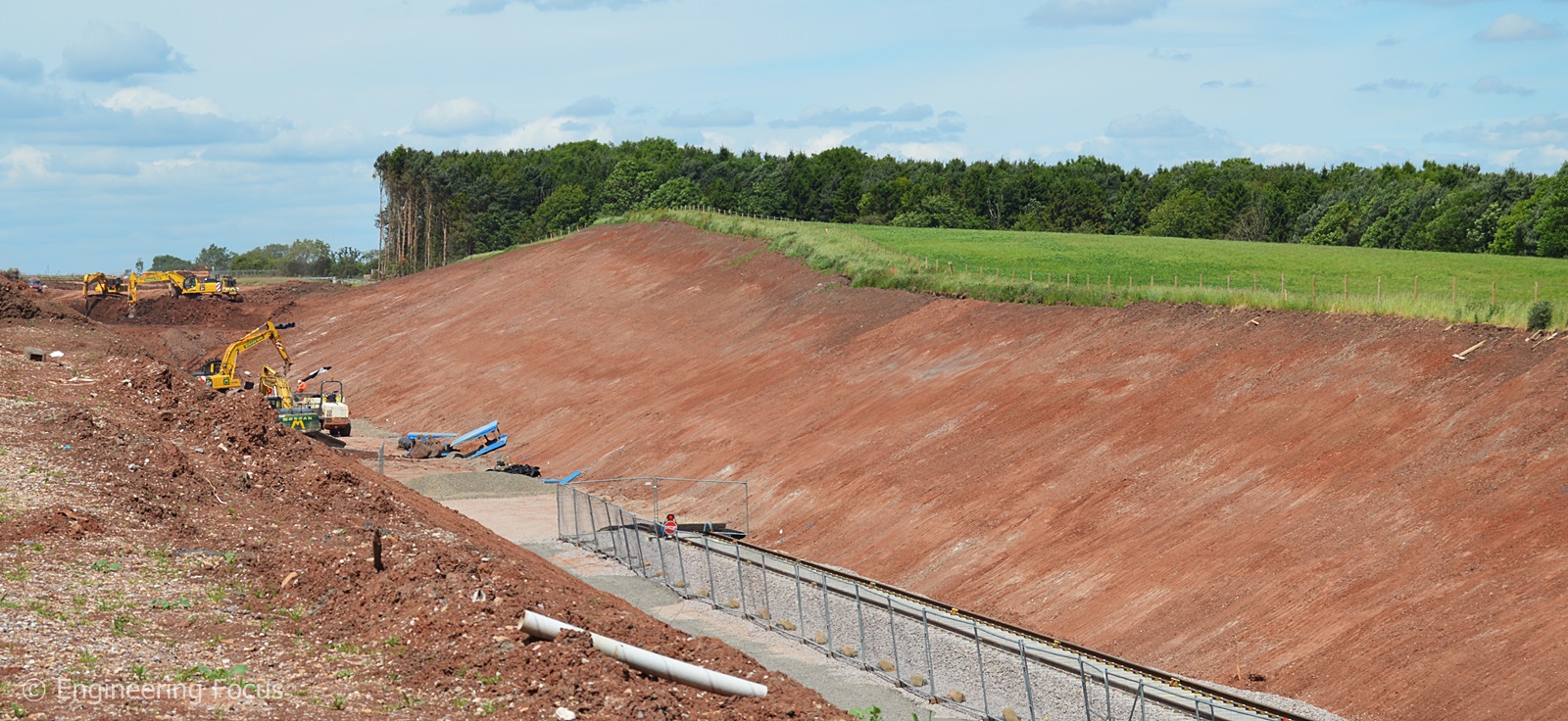
The excavation of the section of cutting for part of the 6 miles of new railway is one of the biggest aspects of the project. The cutting at its deepest section will be 15m deep with an embankment 80m wide at the widest point.

Excavating the cutting will involve moving 1 million tonnes of earth, or 650,000 cu metres all of which will be used on site. The works which are 'cut and fill neutral' will use all of the material excavated from the cutting to construct embankments and bunds elsewhere on the site, this mean that non of the material will have to leave the site; vastly reducing disruption for local residents.

One surprising aspect of the construction of bridge 5 and 5a is that they were constructed with minimal disruption to the existing railway. Bridge piles for bridges 5 and 5a were installed whilst the line remained live, this was achieved by using piling mats to help stabilise the piling rig and protective fencing along the line to protect passing trains and those working on site.

Pre cast concrete abutments were also used to minimise the construction that took place near the line. The railway only had to be closed overnight on two occasions in order for each of the bridge sections to be craned into place, with each bridge span only requiring one lift.

Construction of bridge 6/6a which will take rail and road over Meece Brook is well under way. The massive concrete structure which is currently exposed is mostly complete and waiting for earth to be built up around it to form embankments. The new bridges and embankments will carry the re-aligned B5026 and railway over  Meece Brook.

Work on this massive project is progressing well and should be complete and operational by mid 2016


Key Facts

  • 15 articulated dump tricks (ADTs) work 10 hours a day to move an average of 4000 cu metres of earth every day
  • 1.2km of new roads will be constructed
  • 11 Bridges constructed
  • 5 river diversions and 3 road diversions required 
  • Piling for bridges 5 and 5a took place just 6m away from the live railway
  • 650,000 cu metres of earth will have to be moved all together 


The cutting being excavated by a small army of 360 degree excavators

One of the ADTS trucks descends from the recently completed bridge 5 

 Bridges 6 and 6a share a single abutment, but have 2 separate spans. This is a stipulation by the environment agency in order to allow natural light to reach Meece Brook which will be re-diverted under the bridge once complete.

Bridge 5a, which is currently used to transport material over the railway.  

Bridge 5 which will take the new railway over the existing


Thursday, 25 June 2015

Stafford Area Improvemnet Programme (part 1)

The Stafford Area Improvement Programme (SAIP) is currently one of the largest single rail projects under construction outside of London. The £250m project which is split into 3 packages aims to remove a key bottleneck from a congested section of the WCML north of Stafford.

Package 1 which was completed in May 2014 increased the speed of a section of the down slow line between Crewe and Stafford from 75mph to 100mph. This package involved the installation of 4 new banner repeater signals, re-alignment of 5 miles of track and modification of 18 miles of over head line equipment.

Package 2 involves the renewal of signalling equipment on the route from Norton Bridge to Penkridge and Stafford. The re-signalling works involves installing 78 new signals, construction of a new 775m passing loop and complete re-signalling of signal boxed 4 and 5

Package 3 which is by far largest package will see the construction of a new grade separated junction, 6 miles of new railway, as well as 11 new bridge structures. The new flyover will remove the current bottleneck at Norton Bridge in order to release capacity for additional passenger and freight trains to operate.

The project has brought together 4 companies to form the Staffordshire Alliance. The decision was taken early during the development stage that an Australian "pure alliance" model would be used. The pure alliance model is an agreement in which employer and contractors sign a contract committing them to work closely together as an integrated team throughout the project.

After a 2 stage process 3 companies were chosen to work with Network Rail to deliver the project. Atkins, Laing O'rourke and Volker rail were chosen out of 28 pre qualified companies to work with Network Rail under the Staffordshire Alliance banner.

To facilitate the alliance a bespoke management system was designed which allows the 4 companies to work closely together, to further strengthen the alliance the 4 campaniles share 1 office which has been constructed on site.


In part 2 we will look in more detail at the construction of Norton Bridge, but for now here are a few key facts and images from a site visit on Wednesday 24th June.


The improvement programme will involve

  • Construction of 6 miles of new track, 11 new bridges and 1.2km of new roads
  • Movement of 1 million tonnes of earth or 650,000 cubic meters
  • Construction of a new 775m goods loop
  • Installation of 176 new axle counters and 78 new signals 
  • Relocation of 3 high pressure gas mains and 1 aviation fuel pipeline

The benefits of the project will include

  • Two extra off peak trains per hour between London and the North
  • One extra fast train per hour between Manchester and Birmingham
  • One extra freight train per hour in each direction through Stafford. 

Manchester bound Cross Country Voyager passes the southernmost section of the Norton Bridge site

 Cutting being excavated for the new 6 mile railway

Virgin Pendolino passes under the recently constructed rail over rail bridge. 

1 of 15, articulated dump trucks (ADTs) in use on site can carry up to 30 tonnes at a time


Much more to come in part 2......

Friday, 5 June 2015

Plantworx 2015

Plantworx is billed as "The UK's dedicated working construction exhibition" and it certainly lived up to it's billing. The event which is held once every two years hosts an array of live exhibits from the biggest names from the world of plant machinery. Not only could you see what's new, you could also try out a large array of machines in live demonstration plots.

Below are some of my highlights from this year's Plantworx.

Komatsu impressed the crowds with it's PC210 LCi paired with Komatsu's unique intelligent Machine Control. Here the operator was demonstrating the machine's automatic real time digging control, which allows the operator to set the dig depth.

Once the depth has been programmed, the machine will not allow the operator to dig below that depth. Komatsu claim that this system "improves site safety" and "drastically improves efficiency"


Wacker Neuson had on display innovative solutions for working on difficult terrain. The 50Z32 excavator shown below was displaying their vertical digging System (VDS) which enables tilting of the superstructure by up to 15° which in turn can compensate for slopes up to 27%.

Another piece of equipment that caught my attention was the  RTSC3 smart remote-controlled vibratory trench roller. This little machine is ideal for "the compaction of excavations and sub bases of foundations"


Speaking of little machines, the Giant SK251D on display is surely one of the smallest loaders you can buy. What the SK251D lacks in creature comforts and size it more than makes up for in versatility. On display were an number of attachments which make their range of small loaders incredibly useful and versatile pieces of kit. 


Amongst the larger machinery on display were the new Hyundai HL960 and HL970 range of wheel loaders, with the new 18 tonne HL960 making it's world debut. The new loader is powered by a Stage IV 168 kW Cummins QSB6.7 engine, has a new cabin and comes complete with a new electro-hydraulic joystick which replaces the hydraulic joystick fitted to previous loaders


Friday, 22 May 2015

Royal Liverpool Hospital development


Royal Liverpool Hospital situated to the east of the city centre is the largest and busiest hospital in Merseyside and Cheshire, it servers as an adult major trauma centre for the two counties. The current building was constructed in 1978 and replaced 3 other hospitals in the area.

The existing 11 story building is typical of 1970s brutalist structures, built largely out of concrete it has an utilitarian and austerer look. Hospitals cannot simply be judged on their appearance however, function has to be the most important aspect.

Only after options to refurbish the existing hospital had been assessed and evaluated was the decision taken to construct a completely new building to house the hospital. The existing structure itself was found to be in a relatively good state, however engineering services were found to be well past their 25 year life.

After assessing the options for refurbishment it was concluded that refurbishing the existing structure would cost considerably more, causing disruption for patients and take a lot longer to complete.

So in 2014 work started on the construction of a new £335m modern hospital, which will house 18 state of the art theatres and 23 wards and units. The 646 bed hospital will provide every patient with a a single bedroom with en-suite facilities.

The new hospital will also be home to a comprehensive cancer centre which willl work in collaboration with the Clatterbridge comprehensive cancer centre on the Wirral.

The new Royal is being funded in part by the Department for Health who are contributing £124m, the remaining funds will be provided by the private sector. The trust will make an annual payment of 6% which it is claimed is "one of the lowest in the NHS"

The Trust will also be investing a further £94m which will fund a multi storey car park, equipment and demolition of the existing structure.

Facts and figures

• The Royal treats 172,000 emergency case and 490,000 out patients each year

• The new Royal will contain 18 state of the art theatres

• 23 Wards and units

• 646 beds

• and cost £335m

• Construction started in 2014 and is expected to be complete by 2017

For more information visit the Liverpool Royal website


The exiting hospital constructed in 1978

Progress on the new hospital April 2015
 

The view from the junction of Edge lane and Low Hill
 

The view from West Derby St

Friday, 15 May 2015

Railtex 2015

On Wednesday (13th May) I visited Railtex which this year was held at the NEC in Birmingham. The event is an excellent opportunity to see what's new within the rail industry and a chance to catch up with how some of the largest rail infrastructure projects the UK are progressing.

On Wednesday there was an opportunity to see how the development of HS2 is progressing. With the passing of the HS2 paving Bill in 2013 ground work for the project can begin as early as next year, with initial preparatory work and detailed surveys taking place. Construction proper is due to begin in 2017, a mere 20 months away.

Unfortunately Andrew McNaughton who was originally billed to speak was unable to attend on the day and instead Jon Kerbey, Director of BIM at HS2 took his place. Although no new announcements were made, we did get an opportunity to see the work HS2 Ltd have been doing with BIM (Building information modelling) in order to design and model the line.

It was fascinating to see the level of detail that HS2 Ltd have gone into with the use of BIM, the audience was shown a detailed 3D fly though of the route modelled in BIM. 


However controversial HS2 may be it was clear to see that train manufacturers from around the world are certainly taking notice of the lines development. Siemens, Hitachi, Bombardier and China CNR corporation were all displaying the latest High-Speed trains that that they had to offer.

CNR had an impressive display of 5 High-Speed train variants on Display, whilst Siemens had a model of it's e320 train on display. it will soon be operating on HS1 between St Pancras and the Continent. Bombardier was displaying its Zefiro High-Speed train which is already in operating in China and Italy. Hitachi also launched its vision for a new High-Speed concept aimed at the UK market, as well as it's class 800 125mph IEP which will begin service in 2017.

China CNR corporation's display of High-Speed train variants


Siemens e320 High-Speed train 

Hitachi's class 800

As well as the latest High-Speed train technology, companies were also displaying their answers to the rolling stock shortage that the UK is facing, the design team behind Vivarail's D Train were in attendance while RVEL were showing their plans to extend the lives of the class 144 Pacers paster 2020 when new rules regarding accessibility come into effect.


The engine manufacturer MTU had their answer to new European emissions limits for non road vehicles on display. Their new hybrid propulsion system promises to provide a compact under floor power pack which can power DMUs whilst adhering to the latest EU IIIB emissions standards.

MTU will be supplying engines for the IEP Bi mode trains, with each power pack producing 940bhp. A smaller version of this could provide the power for new DMUs which the UK government say will replace Pacers in the North by 2020. 


The next Railtex event in 2017 promises to be even more fascinating, as construction of HS2 begins, the government seeks to introduce new rolling stock and decisions to be made regarding what to do with existing rolling stock once accessibility rules come into effect.


Tuesday, 28 April 2015

Western Link HVDC project

The Western Link HVDC (High Voltage Direct Current) project is a joint venture between National Grid and Scottish Power to create a High Voltage electricity transmission link between Scotland, England and Wales.

The link is required in order to increase transmission capacity between Scotland, England and Wales. The link will transmit power from renewable sources in Scotland to Deeside in North Wales, from where it can be distributed via high voltage overhead wires.

This £1bn project involves laying a 385km long High Voltage Direct Current cable under the sea between Scotland and the Wirral in the North West of England. Construction of the Western Link is being carried out by a consortium of Siemens and Prysmian

In Scotland the subsea cable will be connected to a converter station under construction at Hunterston on the Western coast. This is where alternating current will be converted to direct current for transmission along the subsea cable.

From Ardneil Bay in Ayrshire the cable will continue 385km by sea to the Wirral.

The cable will make landfall at Leasowe on the Northern tip of the Wirral peninsular, from there 2 33km long underground cables will transmit current the rest of the way to a converter station under construction in Deeside (North Wales).

The second converter station will convert the direct current back to alternating current. From there the electricity will be transmitted via underground AC cables from the converter station under the River Dee to connect to Deeside substation, from there the power will be distributed across England and Wales via overhead power lines.

Update 2015

Until now construction work on the Wirral has focused on building a 33km long construction corridor (or haul road) and crossing points where the cables must be laid under public roads and footpaths. Building the corridor has been a challenge in itself, requiring the construction of a 20m wide work site fenced on both sides stretching for 33km.

Although the corridor runs primarily though agricultural land, it does intersect with many public roads, some of which are important main roads and many public footpaths. The cable must also cross the main railway line to Wrexham 3 times on it's journey across the Wirral. 

Where the cable has to cross any roads, plastic ducting has been placed through which the cable will be pulled underneath the road. In many cases this was done under traffic light control simply by digging half of the trench at a time, in some cases road closures were required. In each case the process was the same. a trench was dug, ducting was placed, concrete poured over the top and then the road surface reinstated.

After a break over the winter period (2014/15) work has recommenced once again. There are still some sections of the corridor yet to be completed, with work continuing on the section from Mid Wirral to Deeside. The first visible sign of cable laying is currently at a main compound site at Arrowe Park. There it has been possible to see sections of cable being unspooled from large drums.

The underground cable itself will be made up of sections roughly 1km joined together. Each 1km section is transported on it's own drum which due it's weight and size is transported on a specialised low loader.

Cable laying will commence throughout 2015 and is hoped to be completed by mid 2016. Once cable laying has finished the temporary fences will be taken down, land returned to a previous state and any hedges that were removed will be replaced with appropriate species.

For more information visit the Western Link HVDC website 

Work continues on the haul road between the Wirral Way and Mill Lane Ness.


A section of the road between the Wirral Way and A540 Chester High Rd.


Here workmen supervise cable pulling as the cable is unspooled from it's drum seen below. 


Latest blog post

HS2 Bridges and Viaducts Engineering Challenges

A version of this article was published in RAIL Magazine issue 1040 Construction of the 220km (140 mile) long HS2 route between London and ...