Showing posts with label Stafford Area Improvement Progamme. Show all posts

Friday, 17 February 2017

Building a new North South railway - part 1 (update)

It is widely anticipated that the Bill giving the go ahead to construct the first phase of HS2 between London, Birmingham with a connection to the WCML at Rugeley will receive Royal Assent early this year (2017). So I thought now would be a good time to take a look at the methods that will likely be used to construct the new railway.

Update
The bill giving the go ahead to construct phase 1 of HS2 was given Royal Assent on Thursday 23rd of February.

This blog will focus solely on the construction and engineering involved, so I will leave a description of project and the political aspects of the planning to one side.

To begin with I want to explore how you go about altering the landscape in order to build a new high-speed railway that is as flat and straight as possible. With a maximum design speed of 400km/h (250mph) over the straightest sections of track it is important that the curve radius is long as possible, in the case of HS2 the minimum horizontal radius for 400km/h operation is 7200m.

Using knowledge gained from following other road and rail projects it's possible to examine how the new line will likely be built and the construction methods involved.

The closest recent parallel that I can draw upon is the construction of a new grade separated rail junction at Norton Bridge (Staffordshire), this project required the construction of 11 bridges and 9.6km of new railway.

Other parallels can be drawn from the construction of 7.5km of new dual carriageway connecting the M6 and M56 in Cheshire.

With both projects a large part of the work "simply" involved moving earth via moxy (articulated dump truck) from one part of the site to the other, although there was of course a systematic and very purposeful way in which this is done.

As with any large construction project the first stage will involve establishing compound sites along the route in which offices and staff facilities will be located and plant machinery stored.

Before any site clearance can commence the area within the site boundary must be free of protected species such as great crested newts for a number of weeks, during which time regular inspections must take place. 

Once the site boundary is established (and free of newts) and compounds complete the next task is to begin preparing the land through which the line will be built. In rural areas this will involve stripping and storing the initial layer of fertile earth. The earth is stored close to where it was originally excavated from, this is so it can be returned back to the land once final landscaping commences.

In built up areas the initial phase of construction will involve demolition and site clearance. For HS2 this demolition will mostly take place around the Euston terminus and Birmingham station. In this part though I'd like to focus on the groundworks required in rural areas.

In rural areas the fertile earth is stored close to where it was excavated from, by doing this much of the ecology can be retained, this will help with the process of reestablishing wildlife habitats and returning agricultural land back to use. 

A556 initial groundworks March 2015

The next phase of construction will involve deep excavation of cuttings and the building of embankments and structures. To do this excavators working in tandem with moxys will excavate and then move material from cuttings to areas where embankments will be built.

In this way it is possible to sculpt the landscape without having to move any earth off site by road or rail. Spoil from the excavation of tunnels can also be translocated to different parts of the site in this way.

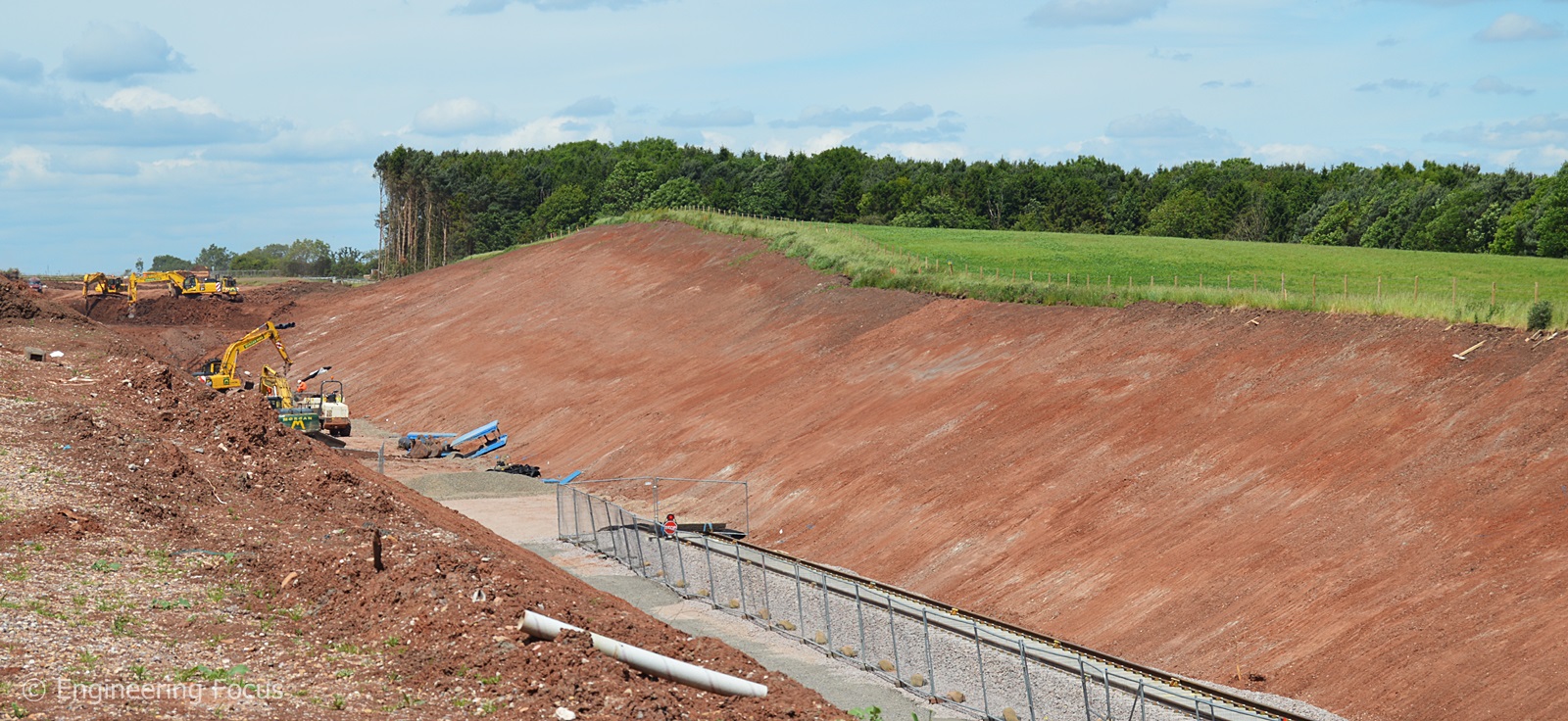
Stafford Area Improvement Programme ground works.

The construction of a new grade separated junction at Norton Bridge is a good example how vast quantities of earth can be moved without the need to take any off site. In all 1 million tonnes of earth was moved in order to construct the 7.5km track and 11 bridges required for the project, yet non had to be taken off site.

This was achieved by creating a temporary road which extended along the length of the site, this haul road was then used to transport the material from where it was being excavated to where it was required. With 11 bridges constructed a lot of material was required in order to build approaches to overbridges. Earth was also used for landscaping either side of the line in order reduce the impact of the line on the landscape.

Of course for HS2 there will not a be a single 100km haul road, a project of this scale will be split up into sections, however withing each section it is likely that the same method of moving material will be employed.

A556 overbridge

The image above of a new overbridge constructed for the A556 project demonstrates where material is required in order to build new approaches. Earth was eventually built up on either side in order to build approaches for a new road overbridge.

It was suggested by a rural campaign group that millions of lorry loads will be required to take material off site by road, however the A556 and SAIP projects show that this needn't and will more than likely not be the case.


In part two I will discus the construction of bridge structures and look at how the impact on the existing road network can be minimised.


You can read part two here


Follow us on Twitter - Facebook For more information e-mail Blog@EngineeringFocus.co.uk

Sunday, 28 June 2015

Stafford Area Improvemnet Programme (part 2)

Norton Bridge

In part one we looked in general at the Stafford Area Improvement Programme, in part two we will look in more detail at Norton Bridge. This part of the project involves constructing 6 miles of new railway and a new grade separated junction which will remove a key bottleneck.

Work to construct 6 miles of new 100mph railway and flyover at Norton Bridge began in spring 2014 and has been progressing well since with several key milestone complete.

3 high pressure gas mains and 1 aviation fuel pipeline have been moved, 4 out of 5 rail over river crossing have also been complete.

One of the key milestones which was completed earlier this month (June 2015) was the construction of bridge 5 which will eventually carry the diverted B5026 over the existing railway,

The completion of bridge 5 means that earth can be transported safely within the site by articulated haul trucks. Each 6 wheel haul truck can carry up to 30 tonnes of earth at a time from a large cutting to elsewhere within the site.

The excavation of the section of cutting for part of the 6 miles of new railway is one of the biggest aspects of the project. The cutting at its deepest section will be 15m deep with an embankment 80m wide at the widest point.

Excavating the cutting will involve moving 1 million tonnes of earth, or 650,000 cu metres all of which will be used on site. The works which are 'cut and fill neutral' will use all of the material excavated from the cutting to construct embankments and bunds elsewhere on the site, this mean that non of the material will have to leave the site; vastly reducing disruption for local residents.

One surprising aspect of the construction of bridge 5 and 5a is that they were constructed with minimal disruption to the existing railway. Bridge piles for bridges 5 and 5a were installed whilst the line remained live, this was achieved by using piling mats to help stabilise the piling rig and protective fencing along the line to protect passing trains and those working on site.

Pre cast concrete abutments were also used to minimise the construction that took place near the line. The railway only had to be closed overnight on two occasions in order for each of the bridge sections to be craned into place, with each bridge span only requiring one lift.

Construction of bridge 6/6a which will take rail and road over Meece Brook is well under way. The massive concrete structure which is currently exposed is mostly complete and waiting for earth to be built up around it to form embankments. The new bridges and embankments will carry the re-aligned B5026 and railway over  Meece Brook.

Work on this massive project is progressing well and should be complete and operational by mid 2016


Key Facts

  • 15 articulated dump tricks (ADTs) work 10 hours a day to move an average of 4000 cu metres of earth every day
  • 1.2km of new roads will be constructed
  • 11 Bridges constructed
  • 5 river diversions and 3 road diversions required 
  • Piling for bridges 5 and 5a took place just 6m away from the live railway
  • 650,000 cu metres of earth will have to be moved all together 


The cutting being excavated by a small army of 360 degree excavators

One of the ADTS trucks descends from the recently completed bridge 5 

 Bridges 6 and 6a share a single abutment, but have 2 separate spans. This is a stipulation by the environment agency in order to allow natural light to reach Meece Brook which will be re-diverted under the bridge once complete.

Bridge 5a, which is currently used to transport material over the railway.  

Bridge 5 which will take the new railway over the existing


Thursday, 25 June 2015

Stafford Area Improvemnet Programme (part 1)

The Stafford Area Improvement Programme (SAIP) is currently one of the largest single rail projects under construction outside of London. The £250m project which is split into 3 packages aims to remove a key bottleneck from a congested section of the WCML north of Stafford.

Package 1 which was completed in May 2014 increased the speed of a section of the down slow line between Crewe and Stafford from 75mph to 100mph. This package involved the installation of 4 new banner repeater signals, re-alignment of 5 miles of track and modification of 18 miles of over head line equipment.

Package 2 involves the renewal of signalling equipment on the route from Norton Bridge to Penkridge and Stafford. The re-signalling works involves installing 78 new signals, construction of a new 775m passing loop and complete re-signalling of signal boxed 4 and 5

Package 3 which is by far largest package will see the construction of a new grade separated junction, 6 miles of new railway, as well as 11 new bridge structures. The new flyover will remove the current bottleneck at Norton Bridge in order to release capacity for additional passenger and freight trains to operate.

The project has brought together 4 companies to form the Staffordshire Alliance. The decision was taken early during the development stage that an Australian "pure alliance" model would be used. The pure alliance model is an agreement in which employer and contractors sign a contract committing them to work closely together as an integrated team throughout the project.

After a 2 stage process 3 companies were chosen to work with Network Rail to deliver the project. Atkins, Laing O'rourke and Volker rail were chosen out of 28 pre qualified companies to work with Network Rail under the Staffordshire Alliance banner.

To facilitate the alliance a bespoke management system was designed which allows the 4 companies to work closely together, to further strengthen the alliance the 4 campaniles share 1 office which has been constructed on site.


In part 2 we will look in more detail at the construction of Norton Bridge, but for now here are a few key facts and images from a site visit on Wednesday 24th June.


The improvement programme will involve

  • Construction of 6 miles of new track, 11 new bridges and 1.2km of new roads
  • Movement of 1 million tonnes of earth or 650,000 cubic meters
  • Construction of a new 775m goods loop
  • Installation of 176 new axle counters and 78 new signals 
  • Relocation of 3 high pressure gas mains and 1 aviation fuel pipeline

The benefits of the project will include

  • Two extra off peak trains per hour between London and the North
  • One extra fast train per hour between Manchester and Birmingham
  • One extra freight train per hour in each direction through Stafford. 

Manchester bound Cross Country Voyager passes the southernmost section of the Norton Bridge site

 Cutting being excavated for the new 6 mile railway

Virgin Pendolino passes under the recently constructed rail over rail bridge. 

1 of 15, articulated dump trucks (ADTs) in use on site can carry up to 30 tonnes at a time


Much more to come in part 2......

Latest blog post

HS2 Bridges and Viaducts Engineering Challenges

A version of this article was published in RAIL Magazine issue 1040 Construction of the 220km (140 mile) long HS2 route between London and ...