Showing posts with label RailLive. Show all posts

Monday, 24 June 2019

Rail Live 2019: Highlights - IEPs, battery trains and induction welding

In my first RailLive 2019 post I wrote about the UK's first hydrogen powered train which caused quite a stir at this year's event. In this post I wanted to cover some of my highlights from the event. The site on which RailLive is held is enormous and there is a huge amount to see, so I chose before hand what I wanted to try to see in the limited time that I had

Mirage Rail induction welding

One of the first displays that I set time aside for was that of Mirage Rail who were demonstrating their mobile induction welding system. Using electromagnetic induction to weld sections of rail together is nothing new, however the mobile system developed by Mirage is unique.

The whole system which includes a generator, HIAB and induction welder can be mounted on a single rail trailer and towed by an RRV to wherever it may be required. The image below shows the entire system mounted on a rail trailer.


The induction welder which is manoeuvred over the rail using the HIAB, houses an induction coil which generates high-frequency electromagnetic fields to heat 2 sections of rail to 1300°C, the rails are then forced together using hydraulic rams which are clamped to the rails. As well as joining the rail, the system also has stressing capabilities built in. Some of the other benefits listed by Mirage rail include; “no operator exposure to molten metals, Reduced Operator risk, Automatic Shearing, No gas cylinders or hoses required for pre-heating and Low energy consumption (150KVa)

The video below shows the induction welder in action, from start to finish.


 LNER class 800 AZUMA

RailLive 2019 like previous years had a massive array of rail plant on display and I hope to cover more of that in a future blog.  The event isn't solely focused on rail engineering or rail plant however, it also provides train manufactures, ROSCOS and train operating companies (TOCs) the opportunity to show off the latest trains which are being delivered to the UK network.

This year LNER brought along one of their new class 800 AZUMAs and invited visitors to come on-board and take a look around. I didn't want to give this opportunity a miss as it's unlikely I'll be able to ride one any time soon. As someone who lives and works in the North West I don't often get the chance to head over to the east of England, or South West where class 800s are also in service.


Passengers who live along the west coast corridor had up until now benefited from  some of most modern intercity trains on the network. The class 390 Pendolinos which were introduced between 2001 and 2004 revolutionised intercity travel along the WCML and were in part responsible for the doubling of rail passenger numbers on the WCML. The sleek, modern and fast trains cut journey times and introduced passengers to a whole new world in terms of rail travel.

It is hoped that the class 800s will have a similar affect on ECML routes to London. The AZUMAs will provide more capacity, with an additional 100 seats per train and it is hoped that there will be journey time improvements with the new timetable in 2021. The journey time savings probably wont be as dramatic as those achieved on the WCML with the Pendolinos, however new more spacious trains with modern features is bound (hopefully) to persuade even more people living along the ECML corridor to take the train.

There is one subject that does keep cropping up, and that is the standard class seating. Having read and heard that the standard class seats are not particularly comfortable I had to try one out for myself. Straight away I understood what people have been saying, the seats are firm, very firm. On the plus side there is plenty of legroom, not something you get very much of in a Pendolino in standard class, believe me. So there are some pluses and minuses, and if you want to get the maximum number of seats in a train, all while providing good legroom, PRM toilets, luggage and bike storage and a cafe, then something does have to give (or not give, if you're talking about the seat padding) to make extra space. Reducing the thickens of each seat by a few centimetres soon adds up to a lot of space saved.


Innovation Hub


Over in the Innovation HUB there were seating solutions which did seem to save space but were actually comfortable to sit on. No I'm not talking about the ones pictured directly below, they are seating solutions for high capacity trains and are designed for short journeys. More of a perch than a seat, they offer maximum capacity whilst providing something which should be a lot more comfortable than just standing and the ones on the right had USB charging points. I'm not sure how popular they would be here in the UK, but I'm sure if people were given the choice between standing or perching on a metro or underground train, they would choose perching.


The picture below shows standard class (left) and first class (right) seating configurations fitted to the class 319 which was home to the Innovation Hub. I quipped we could do with some first class seating in Northern's class 319s, I don't think I was the first person to say that. More interesting though, keeping the AZUMA seating in mind, was the standard class seating arrangement. The seats appear to be light-weight and have minimal foam padding just like the AZUMAs, but these seats seemed so much more comfortable. So perhaps it is possible to design a space saving seat that isn't rock hard!


Class 230 D Train fast charging

Porterbrook with their HydroFLEX unit aren't the only company providing solutions to the 2040 deadline for the banning of diesel-only trains. Vivarail have been working on number of solutions which includes diesel electric hybrids, which will hopefully enter service with TfW Rail this year. Last year they also showcased a battery version of the class 230 D Train, the 2 car unit had 4 battery rafts each providing 106kw. This year Vivarail had a single car battery vehicle on display. The unit was at the event to promote a fast charging system developed by Vivarail which can charge a battery powered train in as little as 7 minutes, providing enough charge for a range of 60 miles.


The system comes in 2 part, first the static section which can be located at a terminus, consisting of short sections of 3rd and 4th rail which provides the charge. The other part is the carbon ceramic shoe gear which has been designed specifically to be able handle the high currents involved.

As well as providing hybrid and full battery versions of their class 230 D Train, Vivarial also announced in May this year that they have teamed up with Arcola to develop a hydrogen fuel cell variant. The hydrogen powered unit is still in the development stage, but Vivarail say the first prototype should enter the testing phase in early 2020.


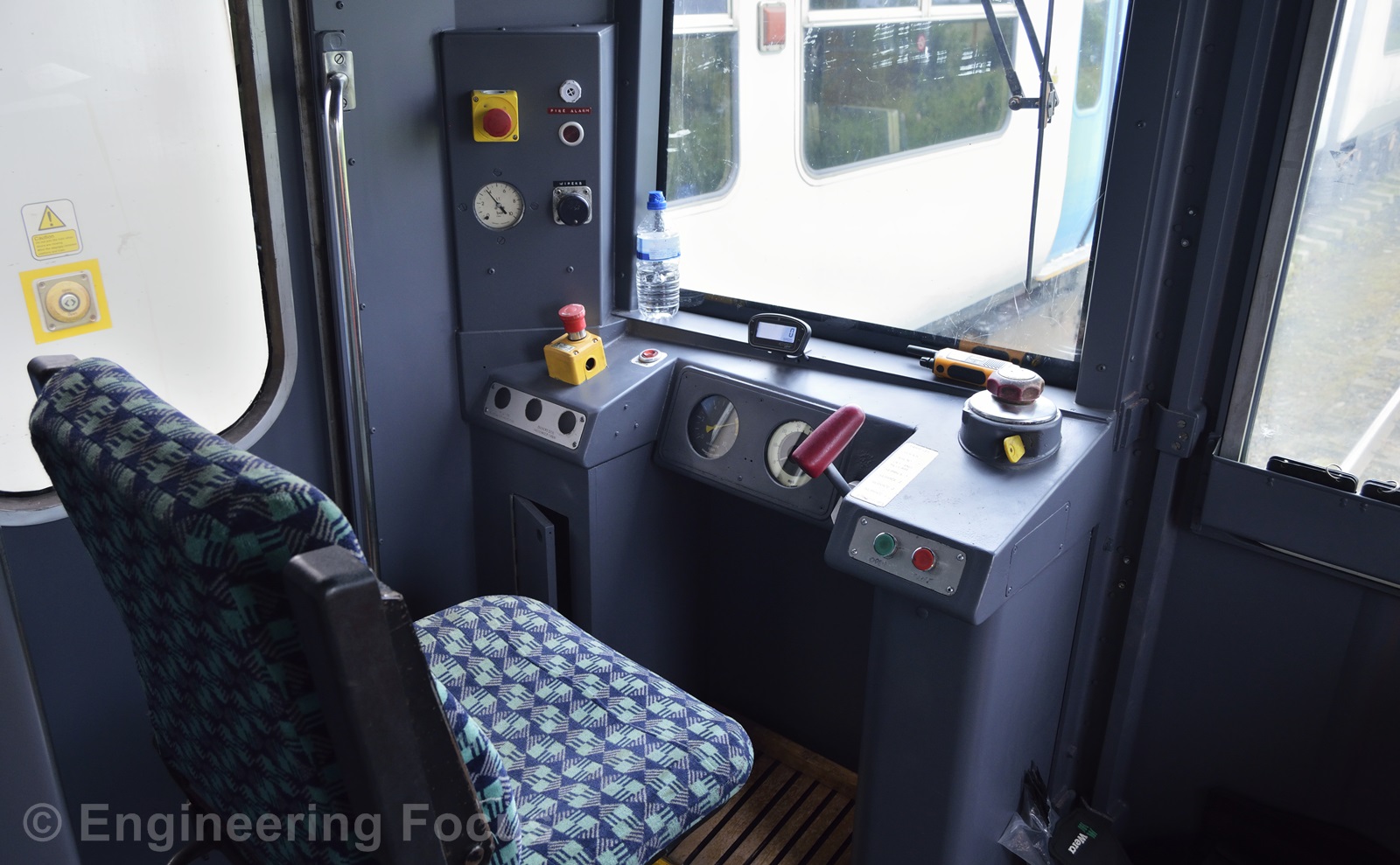
On a final note, I thought it was interesting being able to see inside the cabs of both the class 230, pictured below and the class 800, bottom image. The cabs are worlds apart, with the class 800 looking more like the controls of the Star Ship Enterprise. But the simple yet functional cab of the class 230 still gets the job done.


Thursday, 20 June 2019

RailLive 2019: UK's first passenger carrying hydrogen train

In 2018 the UK Government announced its intention to phase out “diesel-only” trains from the UK rail network by 2040. An ambitious target which would be nearly impossible to achieve through electrification of the rail network alone. According to the DfT in 2009 just over 5000km [1] or roughly 33% of the UK's rail network was electrified, since then, and despite a wide spread programme of electrification between 2014 and 2019, that figure has only increased by an estimated 1000km. Given that the length of the UK rail Network is 16,000km, Network Rail would have to electrify 500km of railway every year for the next 20 years to electrify the remaining network by 2040. Considering it has taken 5 years and cost in the region of £4-5bn to electrify just 1000km of railway you can see how this would be a challenge to say the least.

This means then, that the challenge to phase out diesel-only trains by 2040 has been passed to train manufacturers and rolling stock leasing companies (ROSCOs). I'm fairly certain there will be some diesel-only trains still in operation after 2040, as Northern's class 195s which are being delivered now and Transport for Wales' new units which wont be delivered until 2021 will be powered solely by diesel. It is inconceivable that the government would force ROSCOs to scrap or re-engineer rolling stock which will be 20 years old or less by 2040, that would be wasteful and expensive. However the challenge faced by ROSCOs and manufactures is to develop new ways to power trains between now and 2040.

Luckily it seems that companies and organisations in the UK are well on the way to developing new power technologies which will eventually put an end to diesel-only trains, whilst not requiring the electrification of the entire UK rail network. Vivarial displayed a battery version of their D-Train at RailLive last year and has since gone on to develop a fast charging solution, which can charge a set of batteries in 8 minutes, providing a range of 60 miles. I will be writing more about that in a future blog.

Porterbrook Leasing have also been developing their own upcycled, re-engineered rolling stock based on the class 319 of which 84 were built. Porterbrook already has orders for a tri-mode class 769 variant of what they call their “Flex” units, which are currently having diesel engines fitted, allowing them to switch between DC, overhead and no-electrified lines. Transport for Wales, Northern and Great Western Railway are expecting units, with a total of 38 units on order.

Not content with converting 319s to tri-modes, Porterbrook, working in collaboration with The University of Birmingham’s Centre for Railway Research and Education (BCRRE) have developed the UK's first hydrogen powered train. The first “HydroFLEX” unit was demonstrated at this year's RailLive event, taking passengers gingerly along a section of track at the Quinton Rail Technology Centre.

You can see a short video of the HydroFLEX in action below
 
The unit on display was powered by a singe 100kw hydrogen fuel cell combined with a 100kw battery and was carrying 20kg of hydrogen. The next step is to fit the unit with 2, 100kw fuel cells and 2, 100kw batteries, before beginning testing on the mainline. The unit will be able to hold 200kg of hydrogen in total, which it is estimated should be enough to power the unit for 1600km. The fuel cells and tanks, as well as the control systems are all housed in 1 of the 4 carriages.

Fuel delivery system

The first public outing for the HydroFLEX has caused quite a stir, with the BBC attending to film the train in action and to interview those involved. The team from Porterbrook, BCRRE and Fuel Cells Systems who supplied the hydrogen were busy ensuring that everything ran smoothly and were on hand to answer any questions.

Alex Burrows, Director at Birmingham Centre for Railway Research and Education, commented: “This is a great success story for the UK Rail Industry, which shows our capability and commitment to helping the government meet decarbonisation targets. Key to this success is the close partnership between academia and industry which has enabled us to pool the expertise needed to rapidly progress this technology from concept to full-scale working demonstrator.


The demonstration seems to have been a real boon for the UK rail industry, generating positive news for the industry which doesn't always get an easy ride from the mainstream media. The HydroFLEX demonstrates that the UK rail industry can deliver innovative solutions to looming challenges, and that the UK can be a world leader in the development of alternative power systems for rail vehicles.

The fuel cells and batteries themselves are based on tried and tested technology, and have been sourced from around the world. What makes the HydroFLEX innovative is the control system being developed by BCRRE. The complex control system must work seamlessly to balance fuel delivery and energy output, whilst monitoring the battery and energy recovery through regenerative breaking. The system is what brings everything together to make the HyrdoFLEX a unique and world leading train.

Although powering trains with hydrogen fuel cells may not be the only answer to removing diesel-only trains from the UK rail network, it is one solution that could help the government deliver its 2040 promise. Apart from the remaining class 195s and Civity based DMUs to be delivered to TfW, which should end their service some time around 2050. 

[1] https://webarchive.nationalarchives.gov.uk/20090805225151/http:/www.dft.gov.uk/pgr/rail/pi/rail-electrification.pdf 

Follow me on Twitter and Facebook

 For more information 
e-mail info@EngineeringBlog.co.uk


Thursday, 21 June 2018

RailLive special - A busy year for Vivarail (part 2)

Battery trains

In part one I wrote about the class 230 trains which have been ordered for the Wales and Borders franchise and for West Midlands Railway. But that's not all that has been happening at Vivarail over the past year. The engineering team has also been busy developing a battery-powered variant which has already carried its first passengers, all be it on a short run at Long Marston.

I was lucky enough to be amongst those to ride the train at RailLive 2018 along the 200 metres or so of track used to demonstrate the unit. The ride was smooth and quiet as you would expect from an all-electric vehicle, but with such a short section of track I wasn't able to get a feeling of performance. However what I could appreciate was how advanced the development was, this wasn't an unfinished prototype, it felt like a train that could already be working passenger services.


Vivarail engineers have developed a modular system which uses rafts to house the batteries similar to the system used for the diesel engines, they can be swapped relatively easily and a number of rafts can be installed under each carriage.  The 2 car test train has 4 rafts each providing 106kwh, but more rafts can be added.

It will be possible to charge the batteries through existing infrastructure such as overhead lines, 3rd rail or with static battery banks on non-electrified lines. In each case the train will be charged via a patented automatic charging point.


The image above shows one of the battery rafts which as well as providing power for the train can also be used to provide static charging points. Rather than relying on local services, a raft or number of rafts could be placed at railway stations to provide additional charging further increasing the range of the train. 

Vivarail hasn't released any figures on range yet, however it is thought that a 3 car battery unit could achieve a range of 80 miles and with new battery technology this will improve still further.


Hybrid trains 

The battery technology that has been developed isn't just being used to power all-electric units, the technology will also be used on the class 230 diesel-electric units destined for Wales and Borders. Hybrid technology will be used to further improve the environmental credentials and reduce operating cost of the diesel units by saving fuel.

Each class 230 will be fitted with 4 battery rafts, 2 underneath each of the driving cars, the diesel engines will be placed underneath the middle carriage and will be used to charge the batteries. This system will provide quicker acceleration whilst improving fuel economy through the use of regenerative braking and GPS controlled engine management. 

The engines will be controlled by a GPS system which will be able to switch the engines off when they are not required, or at stations where there may be environmental concerns. This system combined with regenerative breaking promises to deliver a 20% fuel saving compared to a unit powered by diesel engines alone. 

I have uploaded a short clip to Youtube of the battery train in action.

Apologies about the sound, it was a windy day in Warwickshire


I hope to provide further updates on the development of the battery train and deployment of the units that have been ordered in the not too distant future.


Wednesday, 20 June 2018

RailLive special - A busy year for Vivarail (part 1)

Wales and Borders

I have made no secret of my support for Vivarail and the D-train project and have followed its development closely since 2015 when I made the first brief reference to a Vivarail display at Railtex 2015. Since then I have had the pleasure of riding on the first test unit 230 001 at RailLive last year and have written extensively about the development.

So it was with some excitement that I read that Vivarail had been chosen by KeolisAmey to supply 5 class 230s for the Wales and Borders franchise. In particular they will operate on the line which serves the town in which I live. I can't claim to have played any part in this, however I have supported and lobbied for the introduction of the class 230 on the Wrexham to Bidston line for a number of years.

image courtesy of Vivarail


Some background:

I and others had thought that the Wrexham to Bidston line would be a perfect line on which to deploy class 230s units. The service is in desperate need of improvement; the line is somewhat isolated and there are no servicing facilities close by. This is where the class 230's unique design comes into its own.

The units will be upcycled from now redundant D78 stock from the London Underground, this means that they will be less expensive to introduce than new trains and will perhaps, be cheaper to operate than the class 150s that currently operate on the line. This is important as current passenger numbers on the Wrexham to Bidston line are comparatively low. This fact combined with the zero growth basis on which the outgoing Arriva Trains Wales franchise was based, has meant that there was no incentive to invest in improving the service beyond trying to improve reliability.

What is really needed on the Wrexham to Bidston line is a half hourly service which would provide good connectivity with services to Liverpool, Chester, North Wales, Manchester and further afield. This connectivity can only be achieved with the introduction of a reliable half hourly service connecting at Bidston for Merseyrail services to Liverpool and at Shotton for services to Chester, Manchester and North Wales.

A new half-hourly service will require an increase from 2 units which currently serve on the line, to 4 with 1 unit available at short notice on standby should one fail. This increase will require additional investment by Transport for Wales, so the lower cost of the class 230 will help improve the business case.

Another fact which favors the class 230 is the modular design of the power packs. Each engine sits within a raft which is slung underneath the carriage, this means each powerpack can be removed and replaced relatively easily without the need for specialist equipment or train lift. This should mean that the units would not need to travel to Cardiff for repairs and that they can be stabled locally.

The 60mph top speed of the units should provide no issue in the case of the Wrexham to Bidston line as the frequent stops and low track speed means that trains rarely if at all ever reach 60mph. However the class 230 could potentially outperform the current class 150s. This is due to the increased power (whilst complying with strict environmental regulations), the lightweight aluminium body shells and the fact that the units have a greater number powered axles, 2 per powered car for a class 150, versus 4 per driving car for the class 230.

Unit service and design:

The first of 5 class 230s to enter service should do so in the summer of 2019 and will be used on the Wrexham to Bidston, Conwy Valley and Chester to Crewe services. This will allow class 150s to be taken south to enable the withdrawal of Pacers. Once new CAF built trains begin to arrive entire fleet of class 230s will be released in time for the introduction of a half hourly service on the Wrexham Bidston line in December 2021.

The design for the 3-car trains which will feature universal access toilet, WiFi, air conditioning, USB ports and 3-pin sockets is well underway and it is expected that the units will move to Wales for final testing and commissioning in early 2019. The class 230s will be fitted with a range of seating layouts and there will be plenty of space for bikes and luggage.

CGI image of the proposed layout for the new W&B units
image courtesy of Vivarail


Marston Vale line

At the start of the year I reported on the announcement that Vivarail was chosen to supply 3 class 230s for West Midlands Trains to operate on the Marston Vale line. Work to build the trains is well underway and they are expected to enter sercice in December this year (2018)


Image captured in May 2018 shows of one of the units featuring MWT livery ready to be fitted out 
image courtesy of Vivarail

The units will enter service between Bedford and Bletchley and be the first trains to be introduced within the new West Midlands Trains franchise.

The first 2 confirmed orders are exciting news, but that is not all that has been happening at Vivarail this year. In part 2 I will be taking a closer look at the battery unit that has been in development for the last year, which I had the chance to ride on this morning at RailLive.


Thursday, 22 June 2017

RailLive 2017: Part 1 - D-Train review

My journey to RailLive this year started at 6:15am, took 4 hours and involved 4 changes of train just to get to small village called Honeybourne in Worcestershire, from there I would would catch the prototype D-train to RailLive. It was a long journey but ultimately worthwhile as I would be among the first passengers to ride VivaRail's prototype train.

D-Train waiting at a temporary platform built especially for RailLive at Honeybourne station. 
(click to enlarge)

Background

The D-Train or class 230 was the brainchild of Adrian Shooter who saw an opportunity to use rolling stock that was coming out of service and would have eventually been scrapped and instead give the stock a new lease of life, whilst at the same time providing much needed DMU (diesel multiple unit) rolling stock which the UK rail network is desperately short of.

In November 2014 Vivarail chaired by Mr Shooter purchased 150 driving motor cars and 300 carriages of London underground D78 stock which has since been replace by new S stock built by Bombardier. The idea being to combine these carriages to form 2 and 3 car trains, at the same time each of the drive motor cars would be fitted with diesel engines, converting them into self propelled DMUs.

When the project was first announced it faced heavy criticism from the media who labelled the trains as "London cast offs". It was to be expected with some of the trains dating back to 1978, it was never going to be popular idea with the mainstream media, who would need some convincing.

However from the moment I heard about this project I was a supporter, I'm a big believer in recycling (or in this case upcycling) and the UK was and still is facing a nation shortage of DMU rolling stock, a problem that will only get worse come 2020 when new rail vehicle accessibility standards come into force.

D-Train at the temporary platform at Long Marston


Technical information

The new class 230 units will come in either 2 or 3 car formations, each set fitted with 4 Ford Duratorq engines producing 200hp each, giving a power output of 400bhp per driving motor car. 

The 5 cylinder, 3.2 litre Duratorq engines which comply with IIIB emissions standards are fitted to commercial vehicles and Ford Ranger pickup trucks. By being "off the shelf" this helps to reduce costs and means the engines have a proven track record.

Each engine is married to a generator and placed into a cradle to form a powerpack. Each powerpack can be lifted in and out of place for maintenance, this helps to reduce maintenance cost and means the engines and generators can me maintained without the need for large depots or heavy lift facilities. 

The power output of 800ph per unit far outperforms a class 150 which only produces 572hp, in addition a 2 car class 150 weighs 70 tonnes, whilst a 2 car class 230 with its aluminium body weighs around 60 tonnes.

[update]

Since I wrote this article Vivarail have secured funding from the Government's accelerating innovation in rail competition, which aims to "support growth in national and international rail markets". The grant is in recognition of the developments the company has made in developing battery technology

VivaRail state that they are "on track to be the first UK manufacturer to build production battery trains." Which the company say are capable of operating for up to 120km between charge.

VivaRail hopes to produce the first fully certified battery train end of this year [2017].

For me information you can read VivaRail's press release here


The two powerpacks underneath each driving motor vehicle. 


Interiors

Each train is to be treated as an empty shell with train operating companies able to specify interiors which suits the particular needs of the routes which they will serve. The interiors will feature modem amenities like disable access toilets, charging points and wifi, and to the public will be no different to a brand new train. 

The prototype that was used on the shuttle between Honeybourne and RailLive had a number of seating configurations to show what is possible. 

Interior layouts, regional on the left high capacity commuter on the right

Verdict 

As a supporter of the projected since its inception you would expect a glowing report and yes that it was I am going to give this train. From a passenger perspective and having travelled on 6 production DMUs on that day alone I can honestly say you would not know you were on a train dating back to the 70s.

As someone who has been involved in campaigning for this train to provide a service on the line local to me, I can say that without doubt it would be far superior to the class 150s which currently serve on the line. 

The class 230 even with 2 engines per driving car was quiet and the acceleration was smooth. And even with the engines revving up to 3000 rpm under acceleration the sound was quieter and more refined than the tappety sounding engines fitted to 15Xs and even newer 170s and 185s.

Only slight niggles, perhaps the interior looked a bit bland, but its is only prototype and each train operating company is free specify any interior they wish. Also I could see daylight trough some of the door seals, but again this is a prototype and that could easily be fixed. 

Over all I am impressed with what has been achieved in such a short space of time and would be happy to be a regular passenger on this train.


These images and more are available by request, please e-mail Info@EngineeringFocus.co.uk


Follow us on Twitter and Facebook - For more information e-mail Blog@EngineeringFocus.co.uk


Latest blog post

HS2 Bridges and Viaducts Engineering Challenges

A version of this article was published in RAIL Magazine issue 1040 Construction of the 220km (140 mile) long HS2 route between London and ...