Showing posts with label Merseyrail. Show all posts

Thursday, 24 June 2021

Rail Live 2021; rolling stock highlights

Rail Live "The only exhibition to bring the entire rail industry together in a real railway environment" returned for 2021 after the pandemic forced organisers to cancel the event in 2020. It's no surprise then that Rail Live 2021 seemed bigger than ever, not only with the usual live demonstrations that visitors have come to expect, but this year the Honeybourne shuttle made a return courtesy of Vivarail, Transport for Wales and SLC Operations who operated the service on behalf of Vivarail. Another train that will also be serving on the Wirral was also on display, one of Merseyrail's Class 777 EMUs built by Stadler ran regular short trips carrying passengers during the two-day event. 

Class 230 010 at Rail Live 2021

As someone who will, as a passenger benefit from the introduction of both units, I was keen to step aboard and take a look. My first port of call was the Class 230 which I was especially keen to take a look at inside for the first time, as I have been involved in campaigning for their introduction on the Wrexham-Bidston line for since 2016. I have to say that on first impression I was genuinely impressed. A small number of detractors like to remind people that they are ex London underground stock dating from the late 70s, but honestly, sitting onboard the Class 230  you would never know their past. I think even those who were sceptical at first have been won over by the transformation. 

Below is a short video which shows the full interior of the Class 230


During the conversion from D78 stock to Class 230 the interiors were completely stripped back to the shell and the new high-quality fixtures and fittings installed. The two driving motor cars were very quiet, more akin to an electric train than a DMU, which isn't surprising as the Class 230s are diesel-electric hybrids. The middle trailer car under which the diesel gen-sets are housed was, if I'm being honest a little rattly whilst the engines were running, however nowhere near as noisy as the Class 150s which the 230s are set to replace. I was assured by Vivarail that they are working to address the rattle from the fixtures and fittings, but honestly, even with the engines on, the middle car is a lot quieter than a Class 150.

The interior of TfW's Class 230s


The Class 230s feature all the modern amenities that passengers now expect, such as charging points and an accessible toilet. In addition, the Class 230 also features air conditioning, something which even the fully refurbished Class 150s don't have.

For much more information about the Class 230 click here

There was so much to see and do at Rail Live I had to return for day 2 to step aboard Merseyrail's Class 777 built by Stadler. If I was impressed by the Class 230 then I think I was stunned by the Class 777. When you step onboard it truly is astounding, especially when, as a passenger you are more accustomed to Class 507/8s. The sense of space is something else, looking down all 4 carriages through the extra-wide gangways it feels almost like a TARDIS. Class 777s have 4 carriages but the units are only 4m longer than Class 507/8s, at 64.98mm, compared to 3 car 507/8s which are 60.7m long. The designers have cleverly used the space to increase the 333 maximum passenger capacity of the 507/8s, to 475 seated and standing for the 777s. There is also more legroom, passengers who travel on 507/8s will be familiar with the awkward angles at which you have to sit when there are passengers sat opposite, not with the 777, there is space to comfortably seat 2 adults opposite each other, without touching knees.

Below is a short video which shows the full interior of the Class 777


The Class 777 on display number 002 is a little bit different from the rest of the fleet, as it's fitted with a 67kwh hour battery, meaning that it can operate beyond the 3rd rail network. 002 is currently being tested on the Merseyrail network to see how well it can perform, to ensure that the added weight of the battery has no impact on its overall performance compared with the non-battery classmates, but also how well the battery itself can perform. So far 002 has been able to travel from Sandhills to Southport on battery power alone, a journey of approximately 20 miles. So far all indications are that 002 can perform just as well as units without batteries, so the added weight of the battery doesn't appear to cause any noticeable reduction in acceleration or braking performance.

The trial of 002 opens up the very real possibility of extending the Merseyrail network, or the reach of the 777s beyond the 3rd rail network and 777s fitted with batteries could potentially operate as far as Wrexham on the Wrexham-Bidston line, or from Ellesmere Port to Helsby. For the former to happen a number of 777s would likely have to be fitted with larger batteries with a short section of 3rd rail fitted at the Wrexham end for rapid charging. If you would like to know more about the possibilities that the battery variants offer click here.

Class 777 interior

Merseytravel is currently working on a business case that may see all 777s fitted with batteries, which would mean the planned extension of the network to a new station at Headbolt Lane would not require any further electrification. Fitting all 777s with batteries would also help balance the power from regenerative braking which would otherwise be sent directly back down the 3rd rail.
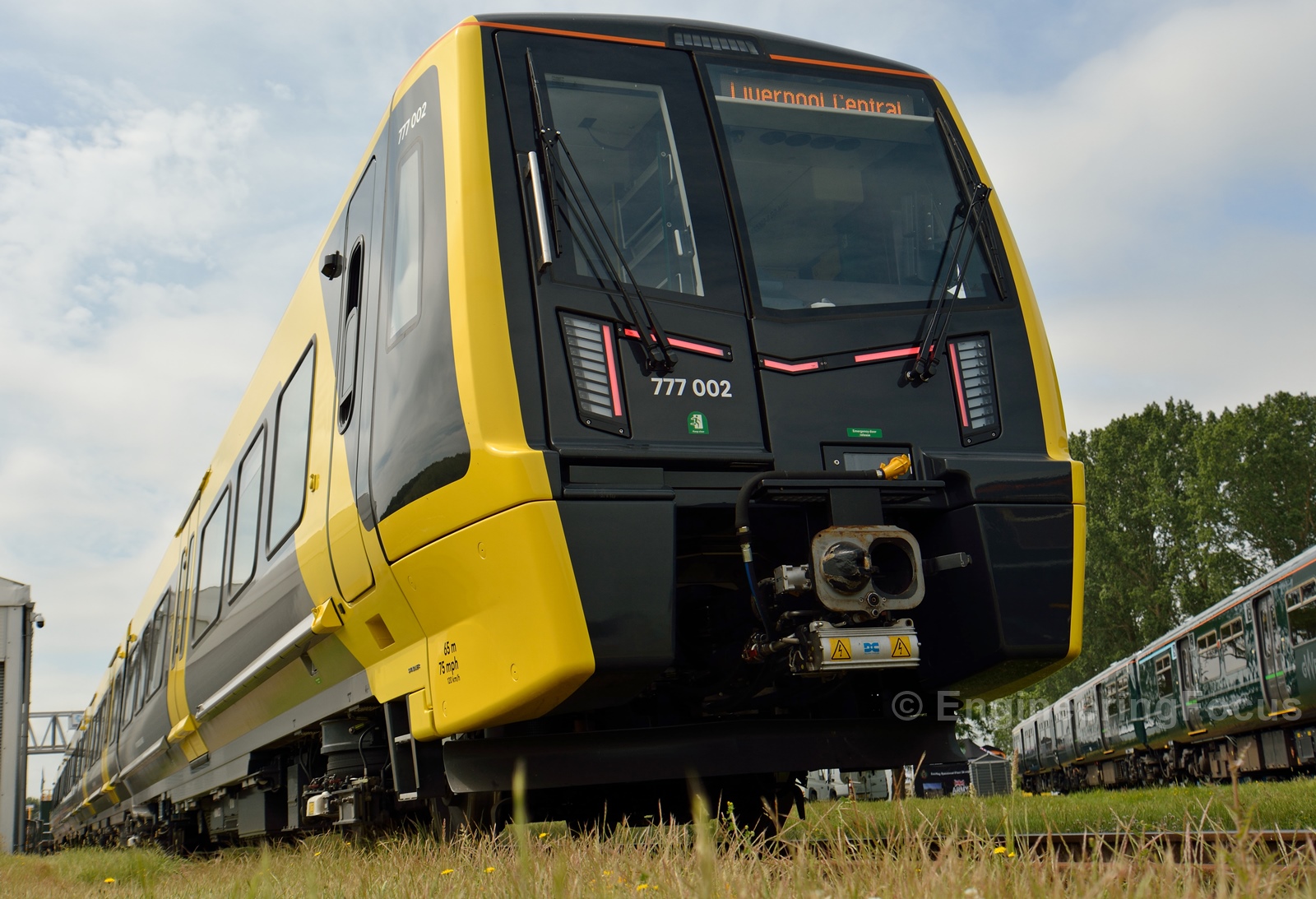
Class 777 002 at Rail Live 2021


One of the most anticipated features of the Class 777 is the step-free access that they will provide across the Merseyrail Network once in service. Merseytravel has had to make some modifications to platforms, which you can find more information about here, but the 777s themselves have been designed with step-free access in mind. The units have been designed so that the floor of the carriage is level with a UK platform set at 915mm, with an offset of 730mm. To ensure that there is a minimal gap the units are also fitted with a retractable step which has an infrared camera fitted inside. As the step extends the camera detects the platform edge and ensures that there is no more than a 35mm gap between the step and platform. The step, combined with the camera and the 4 slightly shorter carriages helps to ensure that the gaps are equally spaced even on curved stations.

Class 777 retractable step


Rail Live has become an event at which rolling stock manufactures want to show off their new units, but primarily the event provides infrastructure and services companies with an opportunity to display what they have to offer. In part 2 I will be taking a look at some of the plant and engineering that was also on display.


Twitter - Facebook - Youtube

Tuesday, 11 May 2021

Re-Blog: Merseyrail: Expanding the network

Originally published in Rail Magazine issue 920

The Merseyrail network currently consists of 75 miles of railway, 6.5 miles of which are underground, split between 2 lines serving a total of 68 stations. The line is electrified by means of 750v DC third-rail and is served by 56 Class 507 and 508 EMUs, however, these units are due to be replaced by new, Class 777 trains over the next couple of years.

Prior to the outbreak of Covid 19 the network carried 110,000 passengers per day and Central Station where the Wirral Line intersects with the Northern Line was the second busiest station in the North West with over 14 million entries and exits between 2018-2019.

Current extent of the Merseyrail network

The Merseyrail network is, in effect a self-contained network which has 8 termini, 6 of which join the national rail network where passengers can transfer on to services which operate beyond the Merseyrail network. These include Southport, Ormskirk, Kirkby, Ellesmere Port, Chester and Hunts Cross. Ellesmere Port currently only has a limited service beyond the Merseyrail Network with 1 arrival from Leeds at 18:08 and a service to Liverpool Lime Street via Warrington Bank Quay departing at 18:25.

The network also has a number of other stations which have connections to the national rail network. They include Liverpool Lime St, Liverpool South Parkway, and Bidston where passengers can join Wrexham-Bidston line services.

Outgoing Class 507/8s are due to be replaced by Class 777s over the next couple of years.


Currently, Merseyrail services are unable to travel beyond those 8 termini because that is the extent of the third-rail network. It is unlikely that the third-rail network will be extended, as the Department for Transport and Network Rail have little appetite for future expansion of the UK third-rail lines.

When compared to 25kv overhead electrification, 750v DC third-rail is less efficient, more expensive to install and maintain, and with a live conductor rail at ground level is also more dangerous. Having said that, in terms of efficiency, third-rail electrification is still vastly more efficent than diesel traction.

Taking this into account you could be forgiven for thinking it is unlikely that the Merseyrail network will be expanded in future and that services are destined to remain limited to third-rail lines. However, there is some good news on the horizon and Merseytravel which is the strategic transport advisor to the Liverpool City Region is certainly not content with terminating services at the current stations.

The Class 777 units being delivered to Merseyrail are set to provide serious opportunities for expansion beyond the third-rail network and Merseytravel is working with the train manufacture Stadler to investigate technologies that would allow just that. Firstly, units on which Class 777 are based can be constructed with a pantograph and transformer to take power from 25kv overhead wires. Or could be fitted with batteries, and in fact, one of the Class 777s which is being delivered to Merseyrail will be fitted with batteries and trialled on the Merseyrail Network.

Update. The first Class 777 fitted with batteries, 777 002 arrived in the UK last week and was spotted in Crewe on the 5th of May.

Merseytravel plans to test how well the battery-powered Class 777 can perform, initially limited to operating on the third-rail network to provide a fail-safe should the batteries fail. However, Merseytravel will be able to put the battery-powered unit to the test across the Merseyrail network. Particular attention will likely be paid to how the unit performs on the steep incline on either side of the tunnel underneath the Mersey. The standard Class 777 units will have much better acceleration characteristics when compared to the outgoing Class 507/8s, so much so, when all Class 777s are in service the timetable will be sped up. This will allow Merseyrail to provide the same level of service (pre Covid19) with fewer vehicles, the order for new units stands at 52, compared to the current 56 units. For the battery trail to be successful the unit must perform comparably under all conditions to the Class 777s which are not fitted with batteries.

Class 777s at Kirkdale TMD
 

Merseytravel isn't paying lip service to future expansion with this trial, they have serious ambitions to extend the network and are already working on plans for an initial modest extension from Kirkby to a new station to be constructed at Headbolt Lane, but they have more ambitious plans to extend services to Skelmersdale, which would require reinstating a former route which was closed in the 1960s and the construction of a new station. Plans for Skelmersdale link are currently at the GRIP 3 stage. The new Headbolt Lane station would become the new eastern terminus on the Kirkby branch, until such time that services can be extended further. The new station would require a short section of third-rail from Kirkby, although if the battery trial is successful the new station could instead be served by Class 777s fitted with batteries.

Merseytravel also has a long term goal to extend services from Ellesmere Port to Helsby or Warrington Bank Quay, they would also like to extend services from Ormskirk to Preston and from Bidston to Wrexham. In order to ensure that any further extensions can become a reality Merseytravel has an option to purchase a further 60 units from Stadler, should the need arise. These units could be fitted with either pantographs or batteries, depending on how further extensions are to be delivered.

Wrexham-Bidston Line extension 

Electrification of the Wrexham-Bidston line was discounted back in 2008 when Network Rail published a report which estimated the cost of electrifying 27 miles of railway with 750v DC third-rail to be £207m, a figure which was said to be 3 times higher than that estimated by Merseytravel. This meant that it seemed as if through services to Liverpool from Wrexham would be put on hold indefinitely. However, the introduction of Class 777s does provide a reason to be optimistic that, in the medium to long term services could operate from Wrexham Central through to Liverpool on the Wrexham-Bidston line.

One option that was investigated was electrifying the Wrexham-Bidston line with 25kv overhead wires, this was thought to be a cheaper option than third-rail electrification, and with the option for Class 777s variants to be constructed to take power from both third-rail and overhead wires, that could have been a real option. However, the publication Network Rail's traction decarbonisation network strategy suggests that the Wrexham-Bidston will not be electrified. The report now suggests that through services will be provided by battery-powered units.

It is likely that if the Class 777 battery trial is a success and proposals for the Wrexham-Bidston line are taken forward, that some infrastructure would be required at the Wrexham end of the line in order to re-charge the units. Vivarail which is currently delivering class 230 hybrid units to Transport for Wales for use on the Wrexham-Bidston line, has been working on battery technology for some time and they say one of their units fitted with batteries could travel as far as 60 miles on a single charge.

Class 230 diesel-electric hybrid built by Vivarail currently being tested on the Wrexham-Bidston line before their introduction later this year


If we assume that a Stadler unit could be fitted with enough batteries to travel up 60 miles between charge, whilst maintaining the same acceleration characteristics as the non-battery variants, it is still thought that the 54 mile round trip from Bidston to Wrexham and back on one charge would be difficult. This is due to the steep gradients on the route from Shotton towards Buckley and the frequent stops spaced closely together from Shotton to Wrexham Central. Therefore it is likely that a short section of third-rail would have to be installed leading into Wrexham Central.

Rapid charging via third-rail is another area in which Vivarail is leading the way. The system which Vivarail is developing has interim Network Rail approval and is set to become the UK standard system. Their system is capable of providing enough charge in just 8 minutes to power a class 230 battery variant for up to 60 miles. The system uses a short section of third-rail to charge the batteries via third rail shoe gear. This power can either be provided directly from the National Grid, or via stationary second-life batteries, which could be charged more slowly and then used to provide rapid charging to a unit.

Ormskirk to Preston and Ellesmere Port have been classified by Network Rail's report as “multiple (proposed battery)”, which could mean partial electrification with batteries being used to bridge the gap between electrified and non-electrified sections. This raises the question about which means of electrification would be used, as the DfT, Network Rail are against expansion of third-rail. Class 777 variants could only be built to take third-rail and 25kv overhead power, or third-rail and batteries. This is because the batteries would occupy the same space in which the transformers to convert the 25kv AC to 750v DC would. But Merseytravel is also investigating using 750v DC overhead, this means it could potentially be possible to produce units that could draw power from third-rail, overhead 750v DC and also be fitted with batteries.

So, whilst the expansion of the Merseyrail network isn't something that is going to happen in the short term, with new more adaptable units on the way and ever-improving battery technology, it is a real possibility that the network can be expanded in the medium to long term.

Friday, 26 February 2021

Reblog: D Train (Class 230), from passionate supporter to future passenger [2021 update]

First published in Rail magazine in 2019

In 2014 I become aware of an idea to fit diesel engines to redundant London Underground stock, an idea which if proposed by anyone else would have seemed, well a bit out-there. However this idea was proposed by Adrian Shooter, the highly respected ex chairman of Chiltern Railways, who decided to try to help solve the looming shortage of DMUs.

By November 2014 Vivarail chaired by Mr Shooter had begun purchasing ex LU D78 stock intended for conversion to DEMUs. In total 156 driving motor and 70 trailer vehicles were purchased and taken to Long Marston. Reaction from the industry was mixed and the mainstream media's response was harsh. I can remember it being said that "we don't want cast offs from the London" when it was suggested they could be used by Northern.

However, negative press reaction wasn't enough to deter Vivarail from pressing ahead with the project and by 2019 the fruits of their labour began to pay off. 3 class 230s entered passenger service on the Martson Vale line and 5 units were ordered by Transport for Wales Rail for use on the Wrexham-Bidston Line.

Around the time that I learned about the D-train project I became involved with the Wrexham-Bidston Rail Users' Association (WBRUA). The Association had been battling for improvements on the line for 3 decades with little success; but not through lack of trying. Throughout the 90s it seemed as if the line was being wound down and if it wasn't for the freight services that used the line it could of closed all together. 

In 2016/17 the WBRUA begin to actively support the introduction of class 230 on the line, with the proviso that the units were used in order to facilitate the introduction of a half hourly service. This would require 5 units and was at the time a big ask, however the WBRUA believed that a reliable half hourly service would unlock the potential of the line. 

The WBRUA was, and remains confident that 230s which have been delivered to TfW will outperform class 150s and provide a superior customer experience. In terms of performance, 4 diesel engines will provide 600kw of power to 4 rafts of batteries and with double the number of powered axles, will ensure the class 230s will be able to out-perform the class 150s. 

The WBRUA estimated that despite having 3 cars instead of 2, the class 230s with their all aluminium bodies will have a 30% better power to weight ratio than a 2 car class 150. 

 Class 230 vs Class 150 side by side comparison


 Now in 2021,

The class 230s were supposed to enter service on the line in early 2020, with 2 units intended for use on the Wrexham-Bidston line to maintain the hourly service, the other units were to be put to work on the Conwy Valley line, it was also suggested 1 unit could be used on the Chester-Crewe shuttle. However, it was soon established that a class 230 with a top speed of 60mph, despite its superior acceleration (when compared to class 150) would not be able to maintain the current Chester to Crewe journey time. It was intended that by December 2021 all 5 units would transfer to the Wrexham-Bidston line so that the half hourly services could commence.

In the end the first class 230 did not arrive in Wales until July 2020 owing to problems with the supply of crucial components and the added features stipulated by TfW such as wide gangways, for which parts had to be specially fabricated.


 230 006 at Wrexham General, having arrived from Long Martston that day.

230 006 was the first unit to arrive, it was driven from Long Marston to Wrexham General under its own power, with a Vivarail crew onboard. Soon after its arrival, 006 began testing on the line and completed between 2 and 3 runs each day from Wrexham General to Birkenhead North EMU Depot. Transport for Wales Rail had struck a deal with Merseytravel to use 1 of the roads at Birkenhead North EMUD to stable class 230s overnight. In August 2020 006 was joined by 007 and that same month 002, 006, 007 and 008 were authorised for passenger use by the ORR. 008 and 009 have now also arrived with 010 expected in the coming months.

There is currently no secure stabling provision for the class 230s at Wrexham, so all class 230s are being stabled at the Merseyrail EMUD overnight. Refuelling currently takes place at Chester TMD, which is used to maintain TfW's fleet of class 175s. On a handful of occasions 6 car class 230s have been seen making the journey from Birkenhead to Chester for refuelling. 

  230 008 approaching Neston station during testing

TfW have now taken ownership of a number of units and it appears as if they are gearing up to begin driver training. TfW staff members have been seen aboard class 230s making runs on the Wrexham-Bidston line and a class 153 has also been making a number of runs each day from Chester to Birkenhead North via Wrexham for route familiarise.  

A sufficient number of crews must be trained to operate the class 230s by December 2021 in order for the half hourly service to commence. Despite the outbreak of Covid19 and subsequent reduction to the services on the Wrexham-Bidston line, there has been no hint that the half hourly will be shelved. The half hourly service to be introduced from December 2021 was contractual agreement agreed by Transport for Wales and its private partner KeolisAmey when it took over operation of Wales and Borders services from Arriva Trains Wales in 2018. The Welsh Government through TfW has now taken over day to day running of the railway from KeolisAmey. However KeolisAmey still has a role to play in delivering the upgrade of the Valley Lines.  

There is no date yet for when the class 230s will enter service, however with the crews finally beginning familiarisation and training it is hoped that the first units could enter service by May this year (2021).


Tuesday, 22 September 2020

Railway maps on Redbubble

A series of railway network maps are now available on Redbubble. The stylised maps have been designed to fit perfectly on mugs, but also work well on a variety of other media such as t-shirts and prints.

The collection so far includes the Merseyrail network, West Coast Main Line and Great Wester Railway, but I will be adding to the collection over the coming weeks and months. If you'd like to suggest a network map then let me know in the comments below.

Don't see anything that takes your fancy? Let me know in the comments or e-mail Info@EngineeringFocus.co.uk and I'll consider making one of your choosing. New designs will be added, so keep checking back to see if there's the one you want.
CrossCountry


Great Western Railway


West Coast Mainline

 
Merseyrail Network


Tuesday, 18 August 2020

End of the line nearing for Merseyrail's 508s and 507s

On Sunday 16th of August, a pair of Merseyrail class 508s left Birkenhead North depot for the last time. The units were hauled by a class 57 operated by Rail Operations Group over the Wrexham-Bidston line, then on to Craven Arms, there they would remain overnight before being taken to Newport docks, where they are to be scrapped.

The scrapping of Merseyrail's fleet of class 508 and 507 units has been on the cards for some time, as they are to be replaced by new class 777 units built by Stadler. However, 110 and 134 have been retired much earlier than their classmates and months before the expected introduction of the first class 777.

It appears 110 and 134 had reached their mileage limit and were in need of an overhaul, therefore with new units on the way it wasn't deemed cost-effective to keep them in service. Space at Metseyrail's Birkenhead North and Kirkdale depots will also start to become limited as more class 777s arrive. 6 have arrived so far and are being stabled at the recently rebuilt Kirkdale depot. There is space for overnight stabling at some stations for 508/7s, but it is likely that depot space will still start to become constrained soon.

  
508 115 at Liverpool Lime Street

It is however unlikely that we will see more 508 or 507s being sent off-lease just yet, at least not until the first class 777s begin to enter service later this year. Before Covid-19, 52 class 508/7s were required to be in service each day. With 110 and 134 now sent for scrap, that leaves a total of 57 class 508s and 507s remaining in service. With the fleet approaching 40 years old it can be assumed that a number of the units will be out of service for maintenance or repair at any given time. 134 hadn't been used since January 2020, however 110 was in service as recently as Wednesday the 12th of August. 

507 003 at Chester Station

Merseyrail has ordered just 52 class 777s, with only 50 being required each day. This reduction in the requirement will be achieved through the speeding up of the timetable, which will reduce the number of diagrams. The new units should also be much more reliable and therefore fewer will be out of service each day for maintenance or repairs. Merseyrail does have the option to purchase a further 60 units, but this is on the basis that services are extended in future to places such as Helsby, Skelmersdale or Wrexham. With extension dependant on the success of a battery trial and or further electrification. One class 777 is to be fitted with batteries and tested on the Merseyrail network, this will be to test the feasibility of future extensions without the need for costly electrification. 


 507 001 alongside a Network Rail measurement train at Hooton Station

I posted a video to Youtube of the move on Sunday night and was surprised by the number of people who were saying that they will be sad to see the 508/7s go. I assumed that people would be glad to see the old making way for the new, but thinking about it, it is easy to see why people may think fondly of the old class 508s and 507s. They have served the Merseyrail network well for almost 40 years, with Merseyrail as an operator regularly sitting at or near the top of National Rail Passenger Survey. The refurbishment carried out between 2002 to 2004 also means that the units still look fairly modern to this day, both inside and out.


However, their days are numbered, so if you want to experience a Merseyrail class 508 or 507 you probably have about 18 months left in which to do so, before they're all sent off for scrap.


In 2019 I wrote about how Merseyrail are adapting station platforms to provide step-free access once the new 777s enter services, find out more: Paving the way for new trains


https://www.redbubble.com/people/engphotography/shop


Wednesday, 10 April 2019

Merseyrail - Paving the way for new trains

Work has been underway since Ocotber 2018 across the Merseyrail network in order to alter 100 platforms and realign the track at 58 stations. The work which has been split into 11 separate phases has meant that sections of the Merseyrail network have had to close completely for periods of between 2 and 3 weeks. This work is vital in order to allow step free access from the train to the platform when the new class 777 trains begin to enter service from next year.

The class 777s which are being constructed by Stadler will utilise a sliding step, which Merseyrail says will provide “unassisted access” for passengers with reduced mobility. In order for the sliding step to work correctly the platforms at all 68 of Merseyrail's stations must be set at an exact position in relation to the rail.

The first class 777s are currently going to Wildenrath in Germany for testing and it is hoped that the first units will arrive in Liverpool in the autumn. The units will then undergo testing on the Merseyrail network, with initial tests to check gauge clearances. The image below shows a mock up of a class 777 which went on display for the members of the public to view last year. It shows the sliding step which will allow unassisted access.

[click to enlarge]
 
Before work commenced the platform edges were, like many across the UK network set at different positions in relation to the rail. Sometimes it is possible to see the difference with the step down from the train being visibly higher at some stations than at others. This isn't a problem for most of the trains which currently operate on the UK network, as the step always rides higher than platform, so there are no instances of steps hitting platform edges. However the steps on the new 777s will slide out level with the platform edge. There will still be slight gap between the step and the platform, however if the platforms were left as they were, then often the step would not line up correctly or the step could come into contact with the edge of platform.

The 'GB Requirements for Platform Height' state that the height of the platform when measured from the top of the rail should be 915mm. While routes on which “legacy rolling stock” operate, a minimum of 890mm is permitted. The horizontal offset, which is the distance from the adjacent rail to the edge of the platform should be 730mm to 745mm. The diagram below should demonstrate more clearly the correct positioning in relation to the rail.

[click to enlarge]


Network Rail's task is to ensure that the platform height and offset across the whole Merseyrail network conforms to tolerances which are measured to the millimetre. This is vital as any variance would mean that the step would not line up correctly with the platform edge, which could represent a potential hazard to passengers.

In some cases all that was required to bring the platform height to the correct position was tamping of the track. This would have the effect of raising or lowering the track in relation to the platform edge. However in many cases the actual platforms had to be altered in order to bring them into the correct offset position.

The images below show the work which is currently underway at Bidston station on the Wirral line which serves West Kirby. They show how the original platform slabs have been removed and are being replaced with new slabs which will be set at the 730mm offset and 915mm height.


The work which is currently underway between Bidston and West Kirby forms phase 8 of 11. Phase 9 will see upgrades on the New Brighton line, 10 will focus on Overpool in Ellesmere Port and the final phase will focus just on Green Lane in Birkenhead. Green Lane according to the Merseyrail website will take almost 4 weeks to complete, this is probably due to the difficult location, with the platforms themselves being in a deep cutting with difficult access.

If all goes well the works should be fully complete by June this year (2019). And then in 2020 passengers should begin to see the benefits of the platform alterations as the new trains begin to enter service. As far as I'm aware the new trains, combined with platform alterations will make the Merseyrail network the only heavy rail network outside of London to have step free access from the train to the platform.

Further investment is expected to improve access at five train stations across the Liverpool City Region after it was announced at the beginning of April this year, that the region will benefit from part of a £300m national fund known as “Access for all”, which aims to improve station access for passengers with reduced mobility. Of the 5 stations announced, 4 are on the Merseyrail network, they are Birkenhead Park, Hillside, Hunts Cross and St Michaels. The 5th station is Broad Green which is served by Northern.


Follow me on Twitter and Facebook


 For more information 

e-mail info@EngineeringBlog.co.uk


Thursday, 2 August 2018

Liverpool Lime Street transformation


Liverpool Lime Street station fully re-opened on the 30th of July after an 8-week closure to allow for the upgrade of track and alterations to platforms to be made. The closure was the second phase of a major upgrade, with the first having taken place during the Autumn last year.


The upgrade of Liverpool Lime St is part of a larger £340m upgrade plan which will vastly improve rail services within the Liverpool City Region. The work undertaken at the station is an essential element of the scheme which will allow an additional 3 services per hour to call at Liverpool Lime St. The work will facilitate the introduction of 2 new services both of which are due to begin operating from December 2018.

A new hourly service to be operated by KeolisAmey (Wales and Borders) will serve Liverpool South Parkway, Helsby and Frodsham. This service which is due to begin in December 2018 is being made possible with the upgrade of Lime St and work to bring the Halton Curve back into full use. 

The other service operated by Trans Pennine Express is due to begin operating from December 2018 and will provide a direct service between Liverpool and Glasgow. 

The new services are being made possible with the construction of a brand new platform and upgrades to the track approaching the station. Control over signalling is also being diverted to a new central control centre.

Virgin Pendolino departing Platform 9

The most noticeable change for passengers will be the remodeled platforms. Platform 0 has now been removed, platforms 1 and 2 are still in the process of being extended, whilst platforms 3 and 4 have been widened. Platform 6 has been realigned and new platforms for 7 and 8 have been constructed. Lastly, platforms 9 and 10 have been extended, with 11 car Virgin Trains services now using platform 9.

Old meets new. Deliberate clear definition between old brickwork, repairs, new brickwork 

Another noticeable change for passengers using Virgin Trains services is the relocation of the First Class lounge and customer information desk. Currently both are located within a new structure located on the main concourse. However The White Star pub which was located above M&S Simply Food has now gone to make way for a new First Class lounge. It is not clear if the current structure on the main concourse is temporary or will be altered once the new lounge opens.


Key Facts:

1 million hours worked.
2.9km of new track installed.
16,000 tonnes of ballast used.
11km new overhead line wiring installed.
26 new signals installed.


Final works will take place on the 2nd of September and 14th of October and will see platforms 1 and 2 come into full use. Once complete the works will allow for new and more reliable services, the new and reconfigured platforms will also allow an increasing number of passengers to use the station more safely.


More information is available on the Network Rail website.


Follow on Twitter and Facebook

 For more information 
e-mail info@EngineeringBlogco.uk
Call: 07393 565 863


Friday, 12 May 2017

Railtex 2017, rolling stock highlights

2017 feels like and important year for the rail industry with the go ahead given to construct HS2 between London and the West Midland and the start of the procurement process for the trains that will eventually run at speeds of up to 360km/h between between Birmingham and London from 2026.

It is clear that most of the biggest train builders are vying for the valuable £2·75bn contract to build the trains for phase 1, not just for the monetary value but also for the prestige of building what will become iconic trains within the UK. 

Alstom was keen to highlight the fact that they already play a key roll within the UK rail industry and employ 3200 people in the UK. Alstom was also keen to demonstrate innovations such the tilting class 390 Pendolino which cut journey times on the WCML and the trainscanner technology being used to inspect and spot potential problems with the Pendolinos that Alstom maintains.

Alstom has installed 2 Trainscannes in the UK which can detect problems that may occur with the Pendolino fleet.

Alstom is not the only contender who can claim to have a UK workforce and provide innovative solutions. Hitachi who are a relative newcomer to the UK rail market already employ 1000 people within the UK and are themselves introducing innovations to the UK rail network.

In the coming years Hitachi's AT300 or class 800/01/02's will soon be a common sight on the East Coast and Great Western lines and Transpennine Express routes. The 800 and 802 units will be able to operate under electric power from 25kv overhead lines, but crucially will also be able to operate on non-electrified routes thanks to the powerful MTU diesel engines that will be installed underneath the carriages.

Keen to highlight their reputation as a "key player in the development of the Shinkansen", Hitachi had what it is calling "the British bullet train" on display which is aimed squarely at HS2.

Model of the AT400 "British bullet train" on display

Chinese CRRC Corporation had yet again brought it's own delegation to the UK with a wide array of rail vehicles on display, it is clear they are keen to enter the UK rail market. Although they have not yet sold any trains to the UK, I wouldn't rule them out for HS2, CRRC has experience building 380km/h trains for the extensive Chinese high-speed network. 

The CRRC display with an example of the high-speed EMU on offer

In non-HS2 related news, another relative newcomer the the UK rail market, Stadler had a number of trains on display, some that are already on test within the UK and others that we will soon see arriving into the UK.

As someone who frequently uses Merseyrail network I was excited to take a look at the new trains that will replace the ageing class 507/8 fleet. The new EMUs designed specifically for the Merseyrail network will provide step free access (a first for the UK classic network) and will be able to carry more passengers. The trains will also be lighter, more energy efficient and importantly more reliable. 

As well as providing 52 new trains Stadler will also be upgrading and refurbishing the maintenance facilities at Kirkdale and Birkenhead North.

Model showing the step free design used for the new Merseyrail units.


Stadler will also be providing 378 carriages for Abellio East Anglia based on the FLIRT multiple unit. The order includes 38 bi-mode units which will be able to operate on non-electrified lines.

FLIRT which was a big hit in Switzerland will soon be coming to the UK


The fact that a number of train builders are now keen to show what they can bring to the UK rail market shows that there is confidence in the UK that wasn't there perhaps 3 or 4 years ago. There are challenges ahead, especially surrounding the delayed electrification programme, but companies are willing to invest in solutions to meet those challenges. 

I am looking forward to getting a chance to ride and documenting the many new trains which will be coming to the UK over the next 5 years. 


Latest blog post

HS2 Bridges and Viaducts Engineering Challenges

A version of this article was published in RAIL Magazine issue 1040 Construction of the 220km (140 mile) long HS2 route between London and ...