Showing posts with label Rail. Show all posts

Tuesday, 21 June 2022

Re-blog: Nurturing the next generation of rail workers

A version of this article was originaly published in Rail Magazine in August 2021


A recent tweet commenting on what appears to be a new generation of young rail enthusiasts got me thinking about skills and how the industry can attract the next generation of railway workers. The skills gap within the rail industry seems to be a subject which comes up frequently and has been in part blamed for the difficulty the industry has had in delivering large infrastructure projects. GWML electrification and the Control Period 5 debacle highlighted the issues the industry has with a lack of skilled workers to undertake the monumental task of upgrading the UK's railway network. The CP5 debacle was in my opinion largely the fault of the Government, they simply asked the industry to do too much in such a short space of time, but it is clear that the rail industry must attract and retain skilled people if it is to continue to modernise.


I do think there may be a deep-rooted issue with encouraging young people to join the railway industry, or for them to even consider a career within the industry, and as it happens I do have some experience with interacting with young rail enthusiasts, as I have a small YouTube gaming channel. It's not something I often discuss openly beyond those who watch my channel and follow me on various social media platforms. But I have gotten to know a number of incredibly talented young railways enthusiasts, who would be a credit to the industry, should they decide to pursue a career within rail.


There is a small group of enthusiasts in particular who are incredibly talented and knowledgeable. They make 3D models of UK rolling stock for a game called Transport Fever 2, on which my own Youtube Channel is based. They are able to recreate these models in exquisite detail, which often include custom sounds and recreations of various iterations of locomotives in a variety of liveries. 


3D model of a Class 87 by a modder called Chris


I think it is these young people who really should be encouraged to take up a career within the railway industry. However, I do not think that the industry knows how to talk to these young individuals, who don't always use established social media platforms such as Twitter and Facebook to communicate. Many are active on an online platform called Discord, which is a chat room-style app that can be used to discuss a variety of subjects.


I know some Rail contributors are familiar with Discord and have their own, "servers" which are used to talk about railway subjects. I also know that this is where a large number of young rail enthusiasts are choosing to congregate online and discuss gaming, modding and railways in general. 


Example of an active Discord server

Now I'm not saying that it's the job of those within the railway industry to monitor these platforms or even to engage with young people on these platforms, but it does show that, what are considering relatively new platforms such as Twitter and Facebook, which the railway industry is now using with great effect to engage with passengers, are fast becoming almost, dare I say it, old-fashioned.


So it can become more difficult to engage with these new young rail enthusiasts and attract them into the railway industry. It may well be the case that they already have thoughts about joining the railway industry one day, but I think it's vital that the industry engages with these individuals and encourages them to peruse a career within the railway industry.


I myself through my YouTube channel have been, in my own small way trying to educate and garner interest from people who are interested in the railways. Throughout my videos I try and be as factual as possible and try and talk about different railway subjects, in fact during the last series that I recorded which was based in the north of the UK, I talk about HS2, discussing why it is needed, where it will serve and what it will do to improve the UK's rail network. Of course, I try to keep my videos light-hearted and entertaining, but I do also like to try and inform and encourage discussion.


Now, I do not pretend to have the answers on how to engage with young people, but I do think it's vital that the industry does engage with these young people. Whilst 3D modelling and coding may not, on the face of it sound like something that is directly transferable into rail. Clearly, not all young rail enthusiasts can become designers or architects working within the rail industry, but as the railways become increasingly digitised, it is these tech-savvy individuals with knowledge about coding who may well have the skills that the industry needs.


Network Rail already offers an IT and Business Services apprenticeship which it says “could involve anything from implementing cutting-edge, innovative technologies and applications like digital railway traffic management and accident prevention to playing a supporting role in the delivery of a significant business change initiative to working in one of our business as usual departments (Information Security, IT Support Services Programme Office)”. But are these opportunities being marketed widely enough to young people? Granted only a small number of such opportunities may be available each year, but are organisations doing enough to promote them to the right sort of young people?


Coding is an increasingly sought-after skill, so the rail industry can't just expect that rail enthusiasts who can code will pursue a career within the railway, so the industry must do all it can to make rail as attractive as possible, and as subsequent generations become increasingly diverse and socially aware the industry must also do all it can to show that it is open to and accepting of diversity.


Put simply, if these young people do have skills that the industry needs, then they must be made aware that the skills they have are transferable into the “real world” and also that they will be welcomed into the rail industry no matter their gender, sexual orientation or where they come from.


Twitter - Facebook - Youtube


Thursday, 24 June 2021

Rail Live 2021; rolling stock highlights

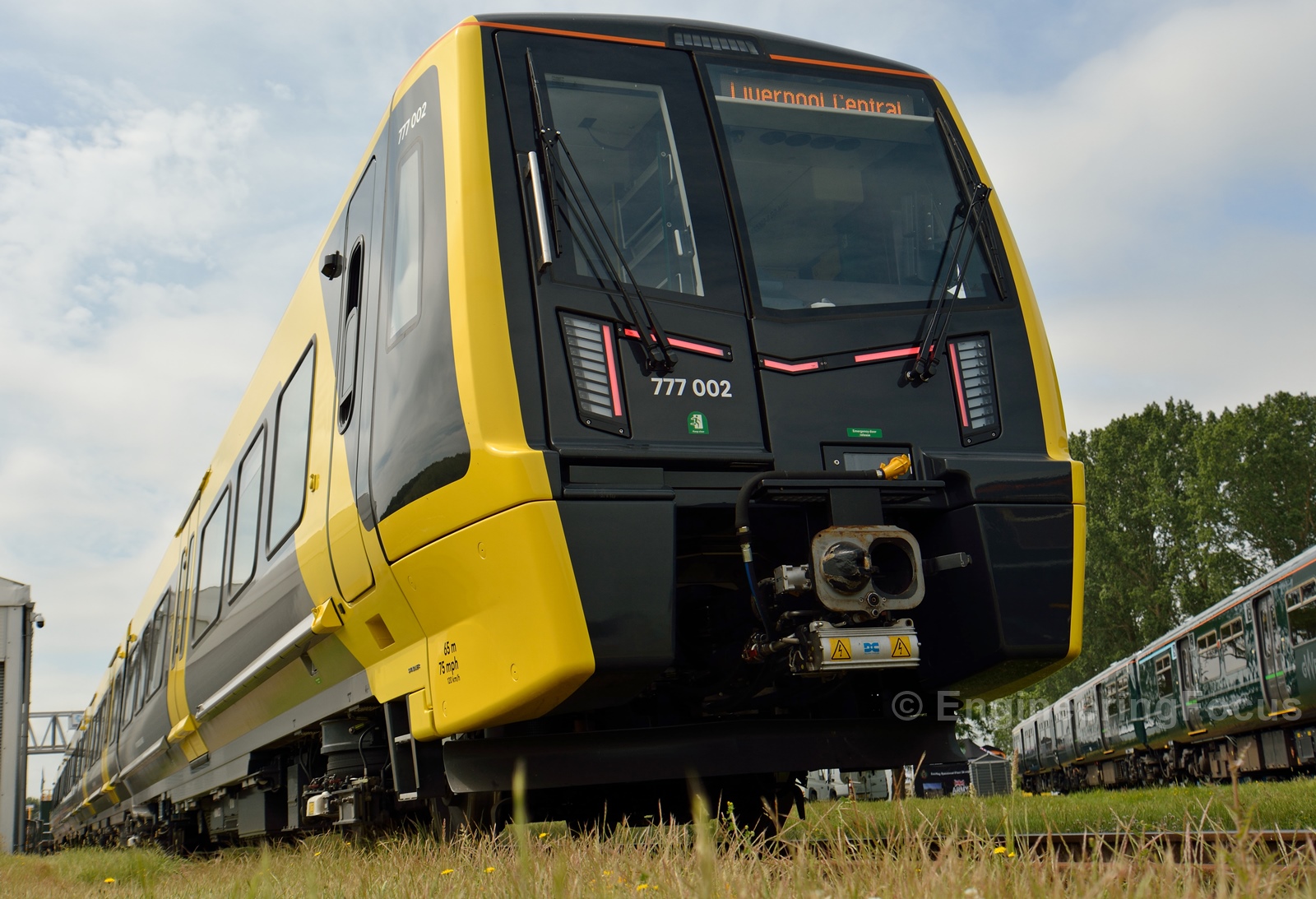
Rail Live "The only exhibition to bring the entire rail industry together in a real railway environment" returned for 2021 after the pandemic forced organisers to cancel the event in 2020. It's no surprise then that Rail Live 2021 seemed bigger than ever, not only with the usual live demonstrations that visitors have come to expect, but this year the Honeybourne shuttle made a return courtesy of Vivarail, Transport for Wales and SLC Operations who operated the service on behalf of Vivarail. Another train that will also be serving on the Wirral was also on display, one of Merseyrail's Class 777 EMUs built by Stadler ran regular short trips carrying passengers during the two-day event. 

Class 230 010 at Rail Live 2021

As someone who will, as a passenger benefit from the introduction of both units, I was keen to step aboard and take a look. My first port of call was the Class 230 which I was especially keen to take a look at inside for the first time, as I have been involved in campaigning for their introduction on the Wrexham-Bidston line for since 2016. I have to say that on first impression I was genuinely impressed. A small number of detractors like to remind people that they are ex London underground stock dating from the late 70s, but honestly, sitting onboard the Class 230  you would never know their past. I think even those who were sceptical at first have been won over by the transformation. 

Below is a short video which shows the full interior of the Class 230


During the conversion from D78 stock to Class 230 the interiors were completely stripped back to the shell and the new high-quality fixtures and fittings installed. The two driving motor cars were very quiet, more akin to an electric train than a DMU, which isn't surprising as the Class 230s are diesel-electric hybrids. The middle trailer car under which the diesel gen-sets are housed was, if I'm being honest a little rattly whilst the engines were running, however nowhere near as noisy as the Class 150s which the 230s are set to replace. I was assured by Vivarail that they are working to address the rattle from the fixtures and fittings, but honestly, even with the engines on, the middle car is a lot quieter than a Class 150.

The interior of TfW's Class 230s


The Class 230s feature all the modern amenities that passengers now expect, such as charging points and an accessible toilet. In addition, the Class 230 also features air conditioning, something which even the fully refurbished Class 150s don't have.

For much more information about the Class 230 click here

There was so much to see and do at Rail Live I had to return for day 2 to step aboard Merseyrail's Class 777 built by Stadler. If I was impressed by the Class 230 then I think I was stunned by the Class 777. When you step onboard it truly is astounding, especially when, as a passenger you are more accustomed to Class 507/8s. The sense of space is something else, looking down all 4 carriages through the extra-wide gangways it feels almost like a TARDIS. Class 777s have 4 carriages but the units are only 4m longer than Class 507/8s, at 64.98mm, compared to 3 car 507/8s which are 60.7m long. The designers have cleverly used the space to increase the 333 maximum passenger capacity of the 507/8s, to 475 seated and standing for the 777s. There is also more legroom, passengers who travel on 507/8s will be familiar with the awkward angles at which you have to sit when there are passengers sat opposite, not with the 777, there is space to comfortably seat 2 adults opposite each other, without touching knees.

Below is a short video which shows the full interior of the Class 777


The Class 777 on display number 002 is a little bit different from the rest of the fleet, as it's fitted with a 67kwh hour battery, meaning that it can operate beyond the 3rd rail network. 002 is currently being tested on the Merseyrail network to see how well it can perform, to ensure that the added weight of the battery has no impact on its overall performance compared with the non-battery classmates, but also how well the battery itself can perform. So far 002 has been able to travel from Sandhills to Southport on battery power alone, a journey of approximately 20 miles. So far all indications are that 002 can perform just as well as units without batteries, so the added weight of the battery doesn't appear to cause any noticeable reduction in acceleration or braking performance.

The trial of 002 opens up the very real possibility of extending the Merseyrail network, or the reach of the 777s beyond the 3rd rail network and 777s fitted with batteries could potentially operate as far as Wrexham on the Wrexham-Bidston line, or from Ellesmere Port to Helsby. For the former to happen a number of 777s would likely have to be fitted with larger batteries with a short section of 3rd rail fitted at the Wrexham end for rapid charging. If you would like to know more about the possibilities that the battery variants offer click here.

Class 777 interior

Merseytravel is currently working on a business case that may see all 777s fitted with batteries, which would mean the planned extension of the network to a new station at Headbolt Lane would not require any further electrification. Fitting all 777s with batteries would also help balance the power from regenerative braking which would otherwise be sent directly back down the 3rd rail.

Class 777 002 at Rail Live 2021


One of the most anticipated features of the Class 777 is the step-free access that they will provide across the Merseyrail Network once in service. Merseytravel has had to make some modifications to platforms, which you can find more information about here, but the 777s themselves have been designed with step-free access in mind. The units have been designed so that the floor of the carriage is level with a UK platform set at 915mm, with an offset of 730mm. To ensure that there is a minimal gap the units are also fitted with a retractable step which has an infrared camera fitted inside. As the step extends the camera detects the platform edge and ensures that there is no more than a 35mm gap between the step and platform. The step, combined with the camera and the 4 slightly shorter carriages helps to ensure that the gaps are equally spaced even on curved stations.

Class 777 retractable step


Rail Live has become an event at which rolling stock manufactures want to show off their new units, but primarily the event provides infrastructure and services companies with an opportunity to display what they have to offer. In part 2 I will be taking a look at some of the plant and engineering that was also on display.


Twitter - Facebook - Youtube

Thursday, 10 June 2021

Guest blog; Why it's a mistake to reduce HS2's Euston platforms from 11 to 10

Guest blog by Independent rail planning consultant William Barter

HS2’s 10 years of development, modelling and iteration with all engineering functions has been the best ever example of such a process in my experience. Timetable development has fed back into the infrastructure design and the train service specification, and even expanded our overall knowledge of how railways work. The outcome is that every bit of the physical system is necessary to fulfil the train service specification reliably, and the combination of all elements of the system is sufficient to do so.

In the 11-platform hybrid Bill scheme, Euston is not the constraint on HS2, for the simple reason that there is no one binding constraint on the operational capability. The London terminus, the main line headways, the intermediate stations, the junction working and the country-end termini are all in balance. But Euston would become that constraint if reduced to 10 platforms, and so prevent the rest of the system ever working to its full potential.

There is no ‘slack’ in the hybrid Bill scheme. There are however options for absorbing and mitigating delays, and the 11th platform at Euston is one of those – somewhere between a shock-absorber and a crumple zone. To suddenly suppose that the 11th platform can just be dumped, without a hit to either service reliability or service levels, is irrational, just as removing the shock absorbers from a coach to save weight would be, and those proposing the 10 platform solution need to come clean and say which will take the hit.

To illustrate this, take a look at the April 2021 edition of ‘Modern Railways’, where a specimen platform occupation plan for Euston station is given. In its detail, such as train formations, and origins and destinations, it almost certainly won’t be the one applying throughout the life of HS2. But the broad pattern, of 25-minute turnrounds locking together like atoms in a crystal, with just the longest-distance trains taking a double turnround, almost certainly will apply, in the way that the use of parallel moves at Borough Market Junction established by the South Eastern & Chatham Railway in 1922, to maximise use of the network’s most critical asset, could still be seen until the area was remodelled in 1975.

And clearly, in that plan, only 10 platforms are used. But that is just a plan! The question is – do we want to operate the railway like that, 18 trains per hour, 18 hours a day? And the answer is ‘No!’ 

Current illustrative service pattern proposed once the whole Y network opens

What happens when trains run late? They will, despite our best efforts. Whilst a very high level of reliability can be expected from the Curzon Street shuttles, Manchester and Leeds train will be mixing it with NPR, and about half the specified service actually originates on the conventional network - as it should. The ability to run trains beyond the new infrastructure is a strength of our approach. But it has implications. And trains turning up late at Euston is one of those implications. On pre-Covid PPM, you might expect a train to turn up more than 10 minutes late roughly hourly.

Up to 10 minutes late arrival isn’t too much of a problem. The 25-minute turnround could absorb up to 10 minutes, so the late arrival doesn’t turn into a late start. The longer turnrounds of the highest risk trains, from Glasgow/Edinburgh, can absorb more. But above 10 minutes, things start to go wrong.

The reoccupation interval between successive trains in the same platform allowed in the timetable is 5 minutes. Technically, it might be done in 4, depending on how well the p/way and signal engineers cooperate. But clearly a late start after a late arrival is very soon going to knock on to the next arrival in the same platform. Even so, Euston as designed for the hybrid Bill has a get-out – as trains alternate between the two sides of the station, and a 200m train can stand between the station pointwork and the King points separating the East and West throats, it’ll be six minutes before a 200m train ‘waiting platform’ delays another arrival. But from then on, it’ll only be another six minutes before the queue is back at Old Oak Common. And note this get out applies only with 200m trains – a 400m train, i.e. half the service at peak times, and probably more as the train service specification evolves, blocks the whole station to further arrivals immediately if it can’t run into its platform straight away.

Where does the 11th platform come in? Simply this – any train arriving more than 10 minutes late can be pointed there instead, and all other trains run as planned. Running into platform 11 is easy, as it is the ‘left hand down’ route that conflicts with nothing else; running out means finding a path amongst everything else, so you have to choose your moment carefully. Clearly if two trains in quick succession turn up more than 10 minutes late, the second has a problem, and here the more drastic option of terminating short at Old Oak Common and restarting from there comes into play. That is possible, but no easy matter – passengers have to be forwarded either by Crossrail which isn’t too good for those with heavy luggage, or on the next HS2 to Euston, which plays havoc with the dwell time. Unless the train crew are working back on the same set, their diagrams and breaks will be disrupted. And passengers for the departure have to be shipped to Old Oak, which means anyone turning up at Euston less than about 6 minutes before time will probably miss it.

And the point is this – without the 11th platform, when a train presents more than 10 minutes late, the choice will be either extensive knock-on delay at Euston, or terminating it at Old Oak. How often do you think the latter is acceptable? Hourly? Daily? Weekly?

And let’s be clear about one thing. It’s not the high speed plain line that will have the problems with late presentations. The feasible headway even at 360 kph is between 2 and 2.5 minutes. So there is between 1 and 0.5 minutes buffer (not ‘slack’, please) between trains, and even if a train turns up out of course and squeezes in, the resultant delay will decay over the next 5 or 6 trains at worst. That’s even before considering that 360 kph is just a ‘get out of trouble’ capability; the timetable works at 330 kph max, so that trains in front of the late one can actually speed up to create a gap for it. Most of all, the key risk on a mixed-use line arises when a fast train gets stuck behind a stopping or slow train. But that just won’t happen on HS2, as all trains are running at the same speed, and on the core route are all calling at Old Oak Common.

You don’t need ‘extensive modelling’ to see that running on 10 platforms with the same robustness as 11 means cutting the service. Plausibly, 16 trains per hour instead of 18 would do it, by freeing one of the 10 platforms for ‘events’. But if that’s the outcome, please take the train service specification given in the April 2020 business case and point at the trains – Stoke? Liverpool? Sheffield? Newcastle that you don’t want to run. Then go and tell the local representatives. I’ll hold your coat.

How else could you run the 18 tph on 10 platforms:

Shorter turnrounds so as to use less than 10 platforms in the plan? All that means is that trains turning up less than 10 minutes late, which will happen far more often, become a problem as well. So the shorter the turnrounds, the more contingency platforms you will need, and more trains will be departing off-pattern in throat, which isn’t pain free;

Run trains on time? Well yes. So why aren’t you doing it now? And it’ll cost you, as part of the solution would be infrastructure, such as on critical mixed use sections like Crewe – Carlisle – Scotland and York – Newcastle. Even to make termination at Old Oak no more frequent than daily, PPM would need to be 99%;

Make it 18 tph peak but less off-peak? Maybe. But you still need to tell someone they aren’t getting their off-peak service, whilst the risk persists in the peaks. And there’s almost no scope for keeping up the number of destinations by combining trains – look at that specification and ask which services you could combine. The only one I would suggest as even passingly realistic is to drop the fast Newcastles between the peaks, and extend the Leeds/York portions of the two Sheffield trains to Newcastle instead. But that’ll give you a radically different pattern on the conventional network which will probably come with an infrastructure cost, as well as a slower off-peak service. Besides, what, post-Covid, are the peak and off-peak anyway?

Technology? I was very interested in Roger Ford’s description of the Luminate TMS at Liverpool Street, re-planning trains away from a platform with defective OHLE. But it has to have somewhere to re-plan trains to, which without the 11th platform it hasn’t, and can no more do the impossible than a human can.

But I do not accept that loss of the 11th platform is necessary. The total of 26 platforms as now proposed is in fact more than the 24 offered by the hybrid Bill scheme. What is wrong is the split of those platforms between the conventional railway and HS2, bearing in mind that however integrated the stations are in terms of passenger facilities, the two railways at Euston are operationally as separate as are the Victoria and Northern lines. Rebuilding the station in one stage, instead of the two envisaged in the hybrid Bill, means that the conventional service needs 16 platforms up to completion when trains can transfer to HS2, but, despite then having no further need for 16 platforms, the 16 : 10 split becomes the end state.

The challenge, then, is to enable a different split, ideally 15 : 11, before completion (and I am conscious that this implies two side platforms which takes more space than one island). No doubt just reducing the over-site development would throw up space for, say 16 : 11, but construction periods, however nasty, finish, whilst the end state is for ever. First, I would ask whether the coincidence of the Covid effect is not in fact an opportunity for a slightly reduced service on the WCML, sufficient to operate on fewer than 16 platforms, until completion of the rebuild.

Then, although terminating HS2 trains at Old Oak is operationally messy and commercially neutral at best compared with the existing conventional service, the ‘one of these and one of those’ approach tabled by the DfT in the April 2020 Business Case is the worst of all worlds. Selecting a complete service group to be converted to HS2 despite terminating at Old Oak would at least enable passengers to plan around the London stations on offer, and permit full operation of all other service groups on the reduced conventional platforms.

Those are only my suggestions. Others may well have better ones. But the proponents of the 10-platform scheme must accept the challenge of finding them, as the end state inherent in the single-stage 10-platform scheme - for Network Rail, for HS2, and thus for the new Great British Railways - is wrong. 


If you have something you would like to say about transport or engineering planning why not get in touch? Guest articles are more than welcome, e-mail; Info@EngineeringFocus.co.uk


Tuesday, 22 September 2020

Railway maps on Redbubble

A series of railway network maps are now available on Redbubble. The stylised maps have been designed to fit perfectly on mugs, but also work well on a variety of other media such as t-shirts and prints.

The collection so far includes the Merseyrail network, West Coast Main Line and Great Wester Railway, but I will be adding to the collection over the coming weeks and months. If you'd like to suggest a network map then let me know in the comments below.

Don't see anything that takes your fancy? Let me know in the comments or e-mail Info@EngineeringFocus.co.uk and I'll consider making one of your choosing. New designs will be added, so keep checking back to see if there's the one you want.
CrossCountry


Great Western Railway


West Coast Mainline

 
Merseyrail Network


Friday, 11 September 2020

CP5 HLOS: "Not all doom and gloom"

This is article was originally published in Rail Magazine in 2019.

In 2012 the Department for Transport published its high-level output specification (HLOS) for control period 5 (CP5), covering the period from April 2014 to March 2019. The 5 year, £38bn plan promised to deliver 1,360 route km of electrification by 2019, and to transform rail travel across the length and breadth of the country. 4 months prior to the start of CP5 Rail magazine published a map created by Engineering Focus, which highlighted many of the schemes which were promised to be completed by 2019. Now that CP5 has come to an end and CP6 has begun, it is a good time to see what has been achieved, which schemes were postponed, which were cancelled and which schemes are behind schedule.

As work got underway at the start of 2014 passengers were reassured that any disruption between 2014 and 2019 would pay off, as new services, new trains and quicker journeys would be delivered once the work had been completed. Unfortunately only 1 year into CP5 it was clear that electrification of the GWML between London Paddington, Bristol, Cardiff and Swansea was not going to plan. By the summer of 2015 the original budget of £800m had more than tripled to £2.8bn, therefore in a bid to keep costs under control and to keep electrification of the GWML on track, the government announced that a number of electrification schemes would be "paused".

Initially, it was announced that Midland Main Line (MML) and Transpennine electrification would be paused, whilst electrification of a number of GWML routes would be deferred. The routes deferred included Didcot Parkway to Oxford, Bristol Parkway to Bristol Temple Meads, and lines to Henley and Windsor. The electric spine which promised to provide an electrified route for freight services from Southampton to the Midlands and across to the MML was also paused.

The pause was intended to allow the DfT and Network Rail to assess which schemes should receive priority and it was thought that some schemes would simply be pushed into CP6. However in 2017 the government made the announcement that the line between Cardiff and Swansea would not be electrified at all, and worst still electrification of the Valleys lines would also be cancelled altogether. Electrification of the Midland Main Line north of Kettering and Corby was also cancelled, as was the electrification of the line between the WCML and Windermere.

Funding for the electrification of the East-West route between Oxford and Bedford was withdrawn and electrification between Reading and Oxford was deferred. It is now unclear if any part of the proposed electric spine will be delivered. Conversion of the line between Basingstoke and Southampton from 3rd rail to overhead is also now off the table, so any hopes that freight operators had of an electrified link between Southampton and the North have been dashed.

It is now hoped that electrification between Bristol Parkway and Cardiff will be completed by January 2020, over a year behind schedule. Whilst passengers have benefited from the introduction of new class 800 bi-mode units which began to enter service in late 2017, those travelling from South Wales have yet to feel the full benefits of electrification, such as the promised reduction of the Cardiff to London journey time of 15 minutes. 


The original article was accompanied by a map which showed which projects were completed, delayed or cancelled. Correct as of spring/summer 2019. A full-size PDF can also be viewed here

The North West electrification programme (NWEP) also suffered a number of setbacks. Whilst Transpennine Express did begin to operate electric services between Manchester Airport and Scotland via Chat Moss/WCML from December 2013, electric services between Liverpool Lime St and Manchester Airport did not begin until March 2015, 3 months behind schedule. The 3 month delay although relatively modest, was a sign of further delays to come. As the NWEP progressed the timescale for the opening of subsequent phases began to slip. Poor ground conditions, known and unknown mine workings were blamed for the delays, which in August 2015 led to Balfour Beatty pulling out of the project after completing only 2 out of 7 phases. The route from Manchester to Preston via Bolton was originally scheduled to be complete by December 2016, however delays meant that class 319s did not begin to operate on the line until February 2019.


 319 362 stands at Liverpool Lime St before setting off for one of the first electric services between Liverpool and Manchester in March 2015.

A report by the Nation Audit Office published in November 2016 found that there were major failings by Network Rail which lead to the cost of electrification of the GWML between Maidenhead and Cardiff to rise to £2.8 billion. The NAO stated that Network Rail “was too optimistic about the productivity of new technology”, and that “It [NR] underestimated how many bridges it would need to rebuild or modify”. The report also highlighted the fact that NR failed to manage the challenges of using new electrification equipment, which had not been tried or tested previously anywhere in the world.


The NAO report acknowledged that electrification of the GWML was complex and the fact that the railway passed through heritage areas and areas of outstanding natural beauty, which provided additional challenges. The report also attributed some of the blame to the DfT, which it said: “did not produce a business case bringing together all the elements of what became the Great Western Route Modernisation industry programme until March 2015”. This was more than 2 years after placing the order for new trains and over a year after Network Rail began work to electrify the route.

So far, of the electrification schemes paused or deferred, announcements have only been made regarding Transpennine and MML electrification. Transpennine electrification will now take place during CP6, although NR is yet to release any concrete plans. As for the MML, it will now only be electrified as far north as Market Harborough, in order to provide a connection of the newly electrified sections between Kettering and Corbyn to the National Grid.

It wasn't only electrification schemes that faced cutbacks and delays, with the full Northern Hub programme yet to be realised and uncertainly remains over when or if key elements will be delivered. A crucial element of the Northern Hub project was to unblock the bottleneck between Manchester Piccadilly and Oxford Rd, this was to be achieved with the construction 2 new through platforms at Piccadilly and widening of the viaduct between Oxford Rd and Piccadilly, in addition, Oxford Rd station was to be substantially remodelled. Yet to date no work has taken place and there are questions over whether or not the proposal will ever commence.

The £85m Ordsall Chord which formed part of the Northern Hub project was complete in 2017, allowing trains to travel between Manchester Victoria and Manchester Piccadilly for the first time, and a number of smaller schemes have been completed or are underway across the Pennines, which seek to improve reliability and reduce East-West journey times.

It's impossible to talk about CP5 without mentioning Crossrail, although not strictly part of the CP5 HLOS, it was expected that trains would begin operating from Heathrow and Reading through central London to Shenfield and Abbey Wood by the end of 2018. However, just months before services were expected to begin it was announced that the opening date would be pushed back to autumn 2019. Now it is thought the section through central London will not be fully completed until 2020 or possibly 2021. The budget for the project has risen by £3bn, with the cost rising from £14.8bn to £17.6bn. 


(The central section of Crossrail is now not expected to open until 2020)


 The newly constructed Crossrail station at Canary Wharf pictured in 2015

It's not all doom and gloom however, the North West electrification programme was largely completed during CP5, with the exception of the line between the WCML and Windermere. Despite the delays, services across the North West have been transformed and now finally new trains are beginning to enter service.

In Scotland the Edinburgh Glasgow Improvement Programme (EGIP) saw the electrification of 150 route kilometres of railway between Cumbernauld and Newbridge Junction which allowed new class 385 EMUs to enter service between the 2 cities. Electric services between Edinburgh Waverley and Glasgow Queen Street via Falkirk High commenced in 2017, initially operated by class 365s and class 380s up until summer 2018, when class 385s built by Hitachi at Newton Aycliffe were finally signed off for passenger use.

Although improved East-West connections across London are delayed for now, North-South connectivity has been transformed, thanks to the £7bn Thameslink programme which had been underway since 2009 and was complete towards the end of CP5, allowing trains to operate from Bedford and Cambridge through the capital to Brighton and Gatwick Airport.

I think to say that CP5 didn't go to plan is somewhat of an understatement, however, whilst the updated version of the map does highlight those schemes which have been delayed or cancelled, it should also serve to highlight some of the great achievements accomplished during the 5 years between 2014 and 2019. And many passengers are starting to see the benefits, now that a large number of new trains are finally beginning to enter service.


https://www.redbubble.com/people/engphotography/shop

Wednesday, 22 July 2020

UK first, class 230 hybrid train arrives at Wrexham

It was 3years ago when I first took a ride on the first prototype class 230, since then things have certainly moved on. The diesel powered 3 car unit which shuttled people between Honeybourne and Rail Live in 2017 has been developed into a diesel electric hybrid with advanced power systems and has also had a striking facelift.

The new hybrid units, which are a first for the UK, are very much like self charging hybrid cars. The 4 diesel engines housed underneath the centre vehicle charge 4 battery rafts, 2 under each driving vehicle. Power to drive the traction motors is taken directly from the batteries, with the motors able to return power back to the batteries using a regenerative braking system.

[update] I was made aware that the traction motors can take power directly from the engines, this is something didn't know before. But thought it is an important piece of information to share. I wasn't informed when the traction motors would likely need to take power directly from the engines, but the ability is there if needed, perhaps if the unit was full and making its way up the steep incline from Shotton towards Hawarden, or in the event one class 230 is required to rescue another.

 Class 230 006 at Wrexham General

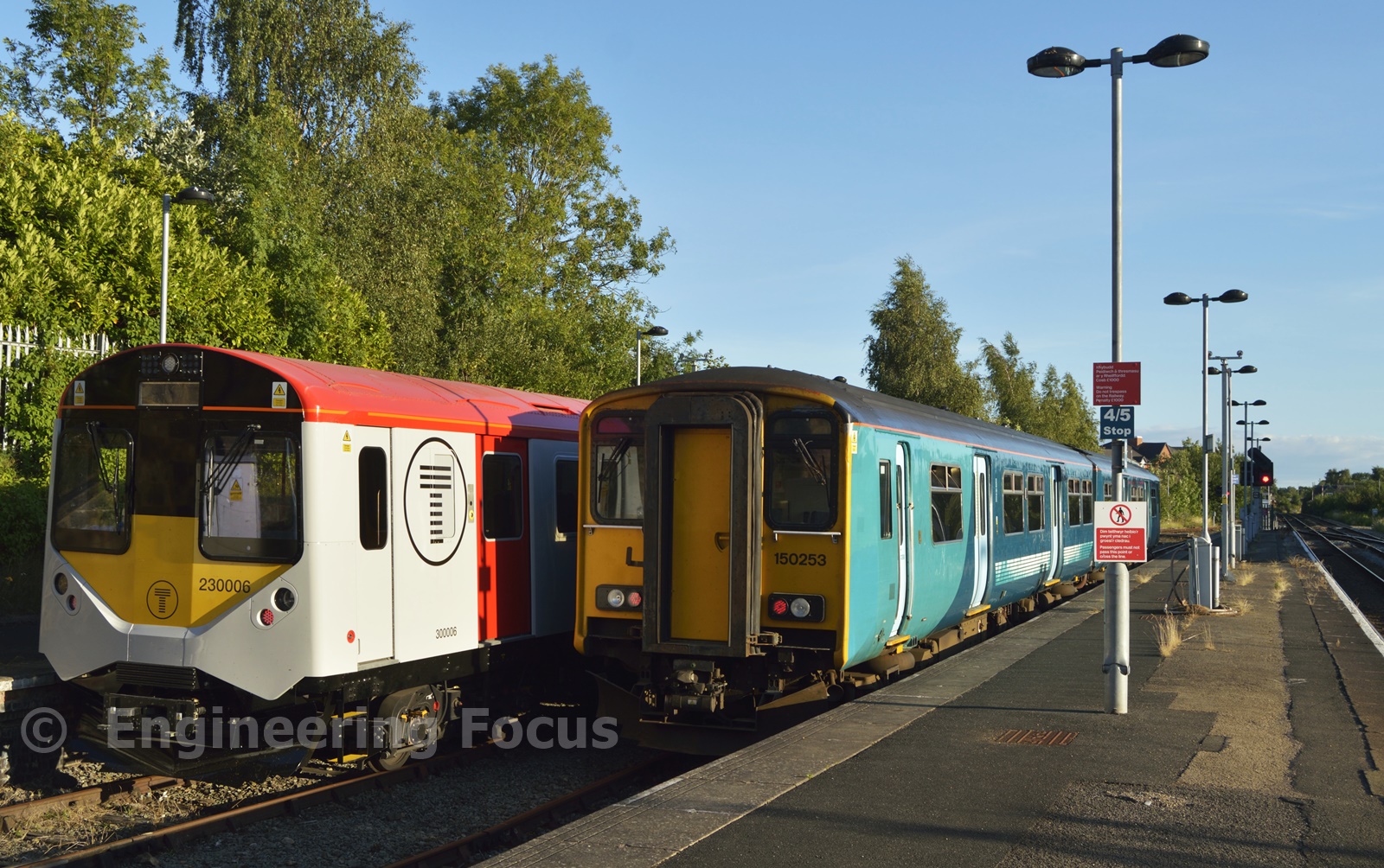
The class 230s which have been built for Transport for Wales Rail are fitted with a 2 stage wheel slip protection system, with 1 stage able to precisely control the power being delivered to the wheels in order to prevent the wheels from slipping. This system will prove useful on the Wrexham Bidston line for which the units are intended. The line has many station stops, some spaced closely together along the 30 miles route, with a steep incline from Shotton up to Buckley which provides a challenge for train and the driver in wet conditions and during the autumn leaf fall season.

So far only 230 006 has made the journey north from Long Marston (where it was constructed and tested) to Wrexham. 006 is due to commence line specific testing once a second class 230 becomes available. Having 2 units stabled locally will mean that should a unit fail whilst out on the line for whatever reason, either one could recover the other.

007 is currently undergoing mileage accumulation on the Cotswolds line, as is 008, with 009 nearing completion. In total Transport for Wales Rail has ordered 5 units from Vivarail which, once delivered and sufficient drivers have been trained, will enable TfW to increase the service frequency on the Wrexham Bidston line from hourly to half hourly, starting from December 2021.

Having supported the D Train project from the very beginning and being part of the campaign for them to operate on the Wrexham Bidston (Borderlands) line, I must admit to being more than a little excited to hear 006 was making the journey to Wrexham on Monday (20th July). Having only seen pictures of the unit on the Cotswolds line it was good to finally get a chance to see the unit up close. It really does look fantastic, almost completely unrecognisable from the D 78 stock on which it is based.

The best bits of the stock such as aluminium body shells and recently replaced bogies have been kept, but almost all of the rest of the unit is brand new. The insides have been completely striped back to metal and new fixtures and fittings installed. Heavy structural work has taken place to reinforce the drivers cab and the gangways between carriages have been widened.

 Class 230 006 along side a class 150 which are set to be replaced on the Borderlands Line.

A small minority bemoan the use of the word "new" to describe the 230s, but given the work that has been carried out I think it's fair to call them new. The D78 stock on which the class 230 is based may
technically be older than the class 150s they're set to replace, but the difference in look and passenger facilities between the 2 units is night and day. Hopefully passengers will be able to judge for themselves soon, but I'm certain when the the 230s do enter service, the average passenger will have no idea that the train they are traveling on has its basis on a train dating from 1978.

[update] Since this blog was published, 230 006 has completed a number of test runs from Wrexham to Bidston and back again. During each run the unit has stopped briefly at each station along the line. Below is a video which compares the class 230 to the class 150 from a standing start, departing Neston station.


Update: side by side class 230 vs class 150 from a standing start.

More videos of 230 006 available here.


Sponsored link
https://www.redbubble.com/people/engphotography/shop/?collections=723725
 

Thursday, 20 June 2019

RailLive 2019: UK's first passenger carrying hydrogen train

In 2018 the UK Government announced its intention to phase out “diesel-only” trains from the UK rail network by 2040. An ambitious target which would be nearly impossible to achieve through electrification of the rail network alone. According to the DfT in 2009 just over 5000km [1] or roughly 33% of the UK's rail network was electrified, since then, and despite a wide spread programme of electrification between 2014 and 2019, that figure has only increased by an estimated 1000km. Given that the length of the UK rail Network is 16,000km, Network Rail would have to electrify 500km of railway every year for the next 20 years to electrify the remaining network by 2040. Considering it has taken 5 years and cost in the region of £4-5bn to electrify just 1000km of railway you can see how this would be a challenge to say the least.

This means then, that the challenge to phase out diesel-only trains by 2040 has been passed to train manufacturers and rolling stock leasing companies (ROSCOs). I'm fairly certain there will be some diesel-only trains still in operation after 2040, as Northern's class 195s which are being delivered now and Transport for Wales' new units which wont be delivered until 2021 will be powered solely by diesel. It is inconceivable that the government would force ROSCOs to scrap or re-engineer rolling stock which will be 20 years old or less by 2040, that would be wasteful and expensive. However the challenge faced by ROSCOs and manufactures is to develop new ways to power trains between now and 2040.

Luckily it seems that companies and organisations in the UK are well on the way to developing new power technologies which will eventually put an end to diesel-only trains, whilst not requiring the electrification of the entire UK rail network. Vivarial displayed a battery version of their D-Train at RailLive last year and has since gone on to develop a fast charging solution, which can charge a set of batteries in 8 minutes, providing a range of 60 miles. I will be writing more about that in a future blog.

Porterbrook Leasing have also been developing their own upcycled, re-engineered rolling stock based on the class 319 of which 84 were built. Porterbrook already has orders for a tri-mode class 769 variant of what they call their “Flex” units, which are currently having diesel engines fitted, allowing them to switch between DC, overhead and no-electrified lines. Transport for Wales, Northern and Great Western Railway are expecting units, with a total of 38 units on order.

Not content with converting 319s to tri-modes, Porterbrook, working in collaboration with The University of Birmingham’s Centre for Railway Research and Education (BCRRE) have developed the UK's first hydrogen powered train. The first “HydroFLEX” unit was demonstrated at this year's RailLive event, taking passengers gingerly along a section of track at the Quinton Rail Technology Centre.

You can see a short video of the HydroFLEX in action below
 
The unit on display was powered by a singe 100kw hydrogen fuel cell combined with a 100kw battery and was carrying 20kg of hydrogen. The next step is to fit the unit with 2, 100kw fuel cells and 2, 100kw batteries, before beginning testing on the mainline. The unit will be able to hold 200kg of hydrogen in total, which it is estimated should be enough to power the unit for 1600km. The fuel cells and tanks, as well as the control systems are all housed in 1 of the 4 carriages.

Fuel delivery system

The first public outing for the HydroFLEX has caused quite a stir, with the BBC attending to film the train in action and to interview those involved. The team from Porterbrook, BCRRE and Fuel Cells Systems who supplied the hydrogen were busy ensuring that everything ran smoothly and were on hand to answer any questions.

Alex Burrows, Director at Birmingham Centre for Railway Research and Education, commented: “This is a great success story for the UK Rail Industry, which shows our capability and commitment to helping the government meet decarbonisation targets. Key to this success is the close partnership between academia and industry which has enabled us to pool the expertise needed to rapidly progress this technology from concept to full-scale working demonstrator.”


The demonstration seems to have been a real boon for the UK rail industry, generating positive news for the industry which doesn't always get an easy ride from the mainstream media. The HydroFLEX demonstrates that the UK rail industry can deliver innovative solutions to looming challenges, and that the UK can be a world leader in the development of alternative power systems for rail vehicles.

The fuel cells and batteries themselves are based on tried and tested technology, and have been sourced from around the world. What makes the HydroFLEX innovative is the control system being developed by BCRRE. The complex control system must work seamlessly to balance fuel delivery and energy output, whilst monitoring the battery and energy recovery through regenerative breaking. The system is what brings everything together to make the HyrdoFLEX a unique and world leading train.

Although powering trains with hydrogen fuel cells may not be the only answer to removing diesel-only trains from the UK rail network, it is one solution that could help the government deliver its 2040 promise. Apart from the remaining class 195s and Civity based DMUs to be delivered to TfW, which should end their service some time around 2050. 

[1] https://webarchive.nationalarchives.gov.uk/20090805225151/http:/www.dft.gov.uk/pgr/rail/pi/rail-electrification.pdf 

Follow me on Twitter and Facebook

 For more information 
e-mail info@EngineeringBlog.co.uk


Latest blog post

HS2 Bridges and Viaducts Engineering Challenges

A version of this article was published in RAIL Magazine issue 1040 Construction of the 220km (140 mile) long HS2 route between London and ...