Showing posts with label Class 777. Show all posts

Wednesday, 15 February 2023

Re-blog: Improving links between North West England and North Wales

A version of this article was published in Rail Magazine in December 2021

As someone who lives on the Wirral and frequently travels to North Wales via the A494 through Queensferry, and has been a committee member of the Wrexham-Bidston Rail User's Association for a number of years, I'm well aware of current poor transport connections between North West England and North Wales. The bridge which carries the A494 over the River Dee and on to the A55 was used by 60,000 vehicles a day before the Pandemic. So, knowing how busy the A494 can get, particularly during school holidays and on Fridays before bank holidays when people flock to North Wales, I supported a proposal to build a new link road from the A548 Flintshire bridge to the A55, a proposal known as the "Red Route".

You may be wondering what if anything roads have to do with railways? Well, recently my support for the "Red Route" has started to wane, especially as awareness of the climate emergency has grown. However despite the pandemic, the A494 often still gets incredibly congested and in 2020 particularly with many people holidaying in the UK, it seemed as if the A494/A55 was busier than ever. Even so, the Welsh Government may be right to cancel the "Red Route". But it does beg the question, how are the aims of the Union connectivity review which was published in December 2021 going to be delivered if not by upgrading road connections? The report led by Sir Peter Hendy sought to identify ways of improving connectivity between the 4 UK nations and recommended that the Westminster works “with the Welsh Government to undertake a multimodal review of the North Wales transport corridor”

The four-lane bridge which carries the A494 over the River Dee is set to be replaced, with work due to begin in 2024/25 and as the proposal falls under renewals is not subject to the same environmental review as the Red Route. The bridge replacement will see an additional lane in each direction added to the A494 which may relieve congestion in the short term. However, the only long-term solution to improve links would be to build the new link road to the A55.

Map showing the road and rail links between England and North Wales

If new roads aren't the answer then the only other alternative is to improve rail links between the two nations, which are the North Wales Coast Line, the Wrexham-Bidston (Borderlands) Line and Shrewsbury-Chester Line. The latter was recently partially re-double between Chester and Wrexham General, however, the Wrexham-Bidston and North Wales Coast Line are in dire need of upgrades and are currently underutilised. The hourly Transport for Wales service from Manchester to North Wales is often crowded and fares are relatively expensive, also the hourly service on the Borderlands Line isn't viewed as a reliable means of travelling between North East Wales and Liverpool.

North Wales Coast services will be given a boost in December 2023 when TfW plans to introduce an hourly Liverpool to Llandudno service which will use new Class 197 DMUs that are now being introduced. The CAF-built units are being introduced on TfW's long-distance service, such as Manchester to Llandudno Junction and Manchester to South Wales. The introduction of Class 197s and rakes of Mk4 carriages will allow TfW to operate five-car trains between Manchester and South Wales, but TfW is yet to decide if the new stock will allow the operator to improve capacity between Manchester and North Wales. If passengers travelling between Manchester and North Wales are to benefit from the introduction of new units then TfW must operate more four-car (2x2) or three-car services as a minimum. Even in this post-pandemic era, operating two-car trains between Manchester and North Wales is simply unacceptable.

Class 197 002 on display at Chester Station

TfW also plan to introduce a new Liverpool to Shrewsbury via Wrexham General service from December 2024, which will be extended to Cardiff every two hours. The Liverpool to Shrewsbury will be an extension of the current Liverpool to Chester via Halton Curve service and be coupled to the Llandudno service as far as Chester, where the two units will split, with one unit going to Llandudno, whilst the other travels to Shrewsbury/Cardiff. The Llandudno service is set to begin in December this year (2023), whilst the Shrewsbury/Cardiff service isn't due to commence until December 2024 and is subject to capacity improvements being completed between Wrexham and Shrewsbury.

As well as improved connectivity between Liverpool and North Wales the new service to Llandudno will also improve connectivity at Shotton, as currently, only one North Wales Coast service per hour calls at Shotton low-level and one Borderlands Line train per hour calls at high-level. With two trains per hour calling at both high-level and low-level the interchange possibilities between the two lines will be vastly improved.

Whilst the Borderlands line isn't currently viewed as a reliable means to travel between Liverpool and NE Wales, the line will hopefully see improvements as the delayed increase in the frequency of the service from one, to two trains per hour is finally set to begin this year. Thankfully the ORR has settled the dispute between TfW who wanted to increase the frequency and GBRf who wanted more freight paths into the cement works at Padeswood. However, a proposed compromise will see gaps in the half-hourly service during the day to allow freight movements into and out of Padeswood. 

The only thing holding up the half-hourly service now is the entry into service of the much-delayed Class 230s, which have been dogged by technical issues, the Pandemic and last year the unit's manufacturer going into administration. However, TfW who owns the Class 230s seems to have come to an agreement regarding maintenance and Class 230s which have once again started driver training on the line. In addition to the gaps during the day, the additional service will be a skip-stop service and will cut out a number of stations between Gwersyllt and Shotton. This isn't to do with freight however, but based on concerns about hitting a specific reliability target, as the turnaround of the current service is already very tight.

The interior of Class 230 which was converted from redundant D78 stock

In the long term groups such as the WBRUA and Growth Track 360 would like to see four trains per hour operating from Wrexham directly through into Liverpool and if the trial of the battery variant of the Class 777 is successful, then this may be a real possibility. This could be quite expensive, as it would require additional infrastructure, such as rapid charging via 3rd rail at the Wrexham end of the line, the installation of additional block sections, particularly between Penyffordd and Dee Marsh and of course additional battery Class 777s IPEMUs (independently powered electrical multiple units) to be ordered.

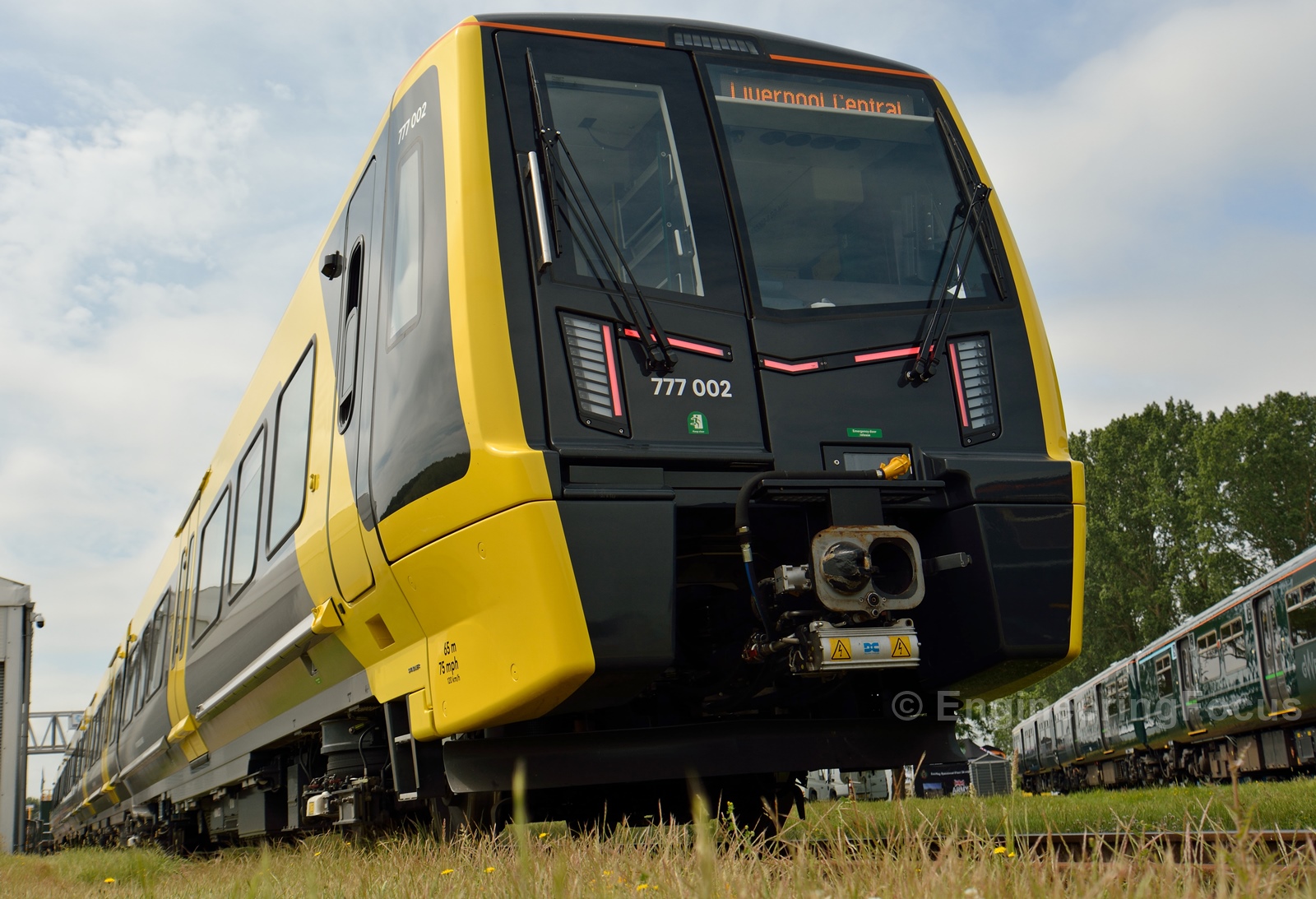
Class 777 002 on display at Rail Live

Providing additional capacity is one thing, but fare prices may also be a barrier for many people and there does seem to be a disparity between the cost of fares offered by TfW and other TOCs, and between North and South Wales. In 2019 a BBC investigation found that it cost 41p per mile to travel from Flint to Bangor, in contrast, it cost just 27p per mile to travel from Swansea to Cardiff Central. I believe strongly that somehow prices need to be reduced and simplified for passengers travelling between NW England and N Wales in order to drive any meaningful modal shift from road to rail.

Returning to the UCR, the document itself seems to be lacking in detail and there doesn't appear to be any concrete plans for improving cross-border links, instead, it suggests that Westminster and the Welsh Government should investigate ways of improving connectivity. Very little attention is given to freight but does recognise the importance of the M56, A494 and A55 and the link they provide to the port of Holyhead, which moved 5.3 million tonnes of freight and 1.9 people between the mainland and Dublin in 2019.

Brexit will undoubtedly continue to have an impact on EU freight travelling between ports in the east of England to Dublin via Holyhead, but the port will remain an important and heavily used link between the mainland and Ireland. In my view, the DfT should explore options for providing container handling facilities near to the port to reduce HGV traffic travelling from England to Holyhead. That way at least freight could be transported to Holyhead by rail and then transferred to HGVs which can then be loaded onto ferry services. Building a container port at Holyhead would possibly be a better solution, but ultimately not easily achievable.

One thing is clear if more capacity is to be provided for passenger and freight services then the North Wales Mainline should be electrified and signalling upgraded. It's unlikely that there would be much capacity for additional services beyond those already proposed by TfW and Avanti. Electrification also provides the potential for HS2 classic compatible services to use the North Wales Coast Line, rather than the current proposals which would see passengers from North Wales having to change trains at Crewe to access HS2 services heading to the capital. Although it should be pointed out that even with the interchange at Crewe passengers from North Wales could still see a significant reduction in journey times for N Wales to London when compared to direct services via the WCML.

It does finally appear as if improved rail links between NW England and N Wales are on the horizon, but I do not believe the current pipeline of improvements on their own will be enough to have any meaningful impact on thousands of daily trips made by car between the two nations. I believe that much more investment will be needed to further improve rail links combined with a review of fares to try to simplify and bring down the costs in order to drive the considerable shift from road to rail that is needed if the UK is to achieve its net-zero goals.

Thursday, 24 June 2021

Rail Live 2021; rolling stock highlights

Rail Live "The only exhibition to bring the entire rail industry together in a real railway environment" returned for 2021 after the pandemic forced organisers to cancel the event in 2020. It's no surprise then that Rail Live 2021 seemed bigger than ever, not only with the usual live demonstrations that visitors have come to expect, but this year the Honeybourne shuttle made a return courtesy of Vivarail, Transport for Wales and SLC Operations who operated the service on behalf of Vivarail. Another train that will also be serving on the Wirral was also on display, one of Merseyrail's Class 777 EMUs built by Stadler ran regular short trips carrying passengers during the two-day event. 

Class 230 010 at Rail Live 2021

As someone who will, as a passenger benefit from the introduction of both units, I was keen to step aboard and take a look. My first port of call was the Class 230 which I was especially keen to take a look at inside for the first time, as I have been involved in campaigning for their introduction on the Wrexham-Bidston line for since 2016. I have to say that on first impression I was genuinely impressed. A small number of detractors like to remind people that they are ex London underground stock dating from the late 70s, but honestly, sitting onboard the Class 230  you would never know their past. I think even those who were sceptical at first have been won over by the transformation. 

Below is a short video which shows the full interior of the Class 230


During the conversion from D78 stock to Class 230 the interiors were completely stripped back to the shell and the new high-quality fixtures and fittings installed. The two driving motor cars were very quiet, more akin to an electric train than a DMU, which isn't surprising as the Class 230s are diesel-electric hybrids. The middle trailer car under which the diesel gen-sets are housed was, if I'm being honest a little rattly whilst the engines were running, however nowhere near as noisy as the Class 150s which the 230s are set to replace. I was assured by Vivarail that they are working to address the rattle from the fixtures and fittings, but honestly, even with the engines on, the middle car is a lot quieter than a Class 150.

The interior of TfW's Class 230s


The Class 230s feature all the modern amenities that passengers now expect, such as charging points and an accessible toilet. In addition, the Class 230 also features air conditioning, something which even the fully refurbished Class 150s don't have.

For much more information about the Class 230 click here

There was so much to see and do at Rail Live I had to return for day 2 to step aboard Merseyrail's Class 777 built by Stadler. If I was impressed by the Class 230 then I think I was stunned by the Class 777. When you step onboard it truly is astounding, especially when, as a passenger you are more accustomed to Class 507/8s. The sense of space is something else, looking down all 4 carriages through the extra-wide gangways it feels almost like a TARDIS. Class 777s have 4 carriages but the units are only 4m longer than Class 507/8s, at 64.98mm, compared to 3 car 507/8s which are 60.7m long. The designers have cleverly used the space to increase the 333 maximum passenger capacity of the 507/8s, to 475 seated and standing for the 777s. There is also more legroom, passengers who travel on 507/8s will be familiar with the awkward angles at which you have to sit when there are passengers sat opposite, not with the 777, there is space to comfortably seat 2 adults opposite each other, without touching knees.

Below is a short video which shows the full interior of the Class 777


The Class 777 on display number 002 is a little bit different from the rest of the fleet, as it's fitted with a 67kwh hour battery, meaning that it can operate beyond the 3rd rail network. 002 is currently being tested on the Merseyrail network to see how well it can perform, to ensure that the added weight of the battery has no impact on its overall performance compared with the non-battery classmates, but also how well the battery itself can perform. So far 002 has been able to travel from Sandhills to Southport on battery power alone, a journey of approximately 20 miles. So far all indications are that 002 can perform just as well as units without batteries, so the added weight of the battery doesn't appear to cause any noticeable reduction in acceleration or braking performance.

The trial of 002 opens up the very real possibility of extending the Merseyrail network, or the reach of the 777s beyond the 3rd rail network and 777s fitted with batteries could potentially operate as far as Wrexham on the Wrexham-Bidston line, or from Ellesmere Port to Helsby. For the former to happen a number of 777s would likely have to be fitted with larger batteries with a short section of 3rd rail fitted at the Wrexham end for rapid charging. If you would like to know more about the possibilities that the battery variants offer click here.

Class 777 interior

Merseytravel is currently working on a business case that may see all 777s fitted with batteries, which would mean the planned extension of the network to a new station at Headbolt Lane would not require any further electrification. Fitting all 777s with batteries would also help balance the power from regenerative braking which would otherwise be sent directly back down the 3rd rail.

Class 777 002 at Rail Live 2021


One of the most anticipated features of the Class 777 is the step-free access that they will provide across the Merseyrail Network once in service. Merseytravel has had to make some modifications to platforms, which you can find more information about here, but the 777s themselves have been designed with step-free access in mind. The units have been designed so that the floor of the carriage is level with a UK platform set at 915mm, with an offset of 730mm. To ensure that there is a minimal gap the units are also fitted with a retractable step which has an infrared camera fitted inside. As the step extends the camera detects the platform edge and ensures that there is no more than a 35mm gap between the step and platform. The step, combined with the camera and the 4 slightly shorter carriages helps to ensure that the gaps are equally spaced even on curved stations.

Class 777 retractable step


Rail Live has become an event at which rolling stock manufactures want to show off their new units, but primarily the event provides infrastructure and services companies with an opportunity to display what they have to offer. In part 2 I will be taking a look at some of the plant and engineering that was also on display.


Twitter - Facebook - Youtube

Tuesday, 11 May 2021

Re-Blog: Merseyrail: Expanding the network

Originally published in Rail Magazine issue 920

The Merseyrail network currently consists of 75 miles of railway, 6.5 miles of which are underground, split between 2 lines serving a total of 68 stations. The line is electrified by means of 750v DC third-rail and is served by 56 Class 507 and 508 EMUs, however, these units are due to be replaced by new, Class 777 trains over the next couple of years.

Prior to the outbreak of Covid 19 the network carried 110,000 passengers per day and Central Station where the Wirral Line intersects with the Northern Line was the second busiest station in the North West with over 14 million entries and exits between 2018-2019.

Current extent of the Merseyrail network

The Merseyrail network is, in effect a self-contained network which has 8 termini, 6 of which join the national rail network where passengers can transfer on to services which operate beyond the Merseyrail network. These include Southport, Ormskirk, Kirkby, Ellesmere Port, Chester and Hunts Cross. Ellesmere Port currently only has a limited service beyond the Merseyrail Network with 1 arrival from Leeds at 18:08 and a service to Liverpool Lime Street via Warrington Bank Quay departing at 18:25.

The network also has a number of other stations which have connections to the national rail network. They include Liverpool Lime St, Liverpool South Parkway, and Bidston where passengers can join Wrexham-Bidston line services.

Outgoing Class 507/8s are due to be replaced by Class 777s over the next couple of years.


Currently, Merseyrail services are unable to travel beyond those 8 termini because that is the extent of the third-rail network. It is unlikely that the third-rail network will be extended, as the Department for Transport and Network Rail have little appetite for future expansion of the UK third-rail lines.

When compared to 25kv overhead electrification, 750v DC third-rail is less efficient, more expensive to install and maintain, and with a live conductor rail at ground level is also more dangerous. Having said that, in terms of efficiency, third-rail electrification is still vastly more efficent than diesel traction.

Taking this into account you could be forgiven for thinking it is unlikely that the Merseyrail network will be expanded in future and that services are destined to remain limited to third-rail lines. However, there is some good news on the horizon and Merseytravel which is the strategic transport advisor to the Liverpool City Region is certainly not content with terminating services at the current stations.

The Class 777 units being delivered to Merseyrail are set to provide serious opportunities for expansion beyond the third-rail network and Merseytravel is working with the train manufacture Stadler to investigate technologies that would allow just that. Firstly, units on which Class 777 are based can be constructed with a pantograph and transformer to take power from 25kv overhead wires. Or could be fitted with batteries, and in fact, one of the Class 777s which is being delivered to Merseyrail will be fitted with batteries and trialled on the Merseyrail Network.

Update. The first Class 777 fitted with batteries, 777 002 arrived in the UK last week and was spotted in Crewe on the 5th of May.

Merseytravel plans to test how well the battery-powered Class 777 can perform, initially limited to operating on the third-rail network to provide a fail-safe should the batteries fail. However, Merseytravel will be able to put the battery-powered unit to the test across the Merseyrail network. Particular attention will likely be paid to how the unit performs on the steep incline on either side of the tunnel underneath the Mersey. The standard Class 777 units will have much better acceleration characteristics when compared to the outgoing Class 507/8s, so much so, when all Class 777s are in service the timetable will be sped up. This will allow Merseyrail to provide the same level of service (pre Covid19) with fewer vehicles, the order for new units stands at 52, compared to the current 56 units. For the battery trail to be successful the unit must perform comparably under all conditions to the Class 777s which are not fitted with batteries.

Class 777s at Kirkdale TMD
 

Merseytravel isn't paying lip service to future expansion with this trial, they have serious ambitions to extend the network and are already working on plans for an initial modest extension from Kirkby to a new station to be constructed at Headbolt Lane, but they have more ambitious plans to extend services to Skelmersdale, which would require reinstating a former route which was closed in the 1960s and the construction of a new station. Plans for Skelmersdale link are currently at the GRIP 3 stage. The new Headbolt Lane station would become the new eastern terminus on the Kirkby branch, until such time that services can be extended further. The new station would require a short section of third-rail from Kirkby, although if the battery trial is successful the new station could instead be served by Class 777s fitted with batteries.

Merseytravel also has a long term goal to extend services from Ellesmere Port to Helsby or Warrington Bank Quay, they would also like to extend services from Ormskirk to Preston and from Bidston to Wrexham. In order to ensure that any further extensions can become a reality Merseytravel has an option to purchase a further 60 units from Stadler, should the need arise. These units could be fitted with either pantographs or batteries, depending on how further extensions are to be delivered.

Wrexham-Bidston Line extension 

Electrification of the Wrexham-Bidston line was discounted back in 2008 when Network Rail published a report which estimated the cost of electrifying 27 miles of railway with 750v DC third-rail to be £207m, a figure which was said to be 3 times higher than that estimated by Merseytravel. This meant that it seemed as if through services to Liverpool from Wrexham would be put on hold indefinitely. However, the introduction of Class 777s does provide a reason to be optimistic that, in the medium to long term services could operate from Wrexham Central through to Liverpool on the Wrexham-Bidston line.

One option that was investigated was electrifying the Wrexham-Bidston line with 25kv overhead wires, this was thought to be a cheaper option than third-rail electrification, and with the option for Class 777s variants to be constructed to take power from both third-rail and overhead wires, that could have been a real option. However, the publication Network Rail's traction decarbonisation network strategy suggests that the Wrexham-Bidston will not be electrified. The report now suggests that through services will be provided by battery-powered units.

It is likely that if the Class 777 battery trial is a success and proposals for the Wrexham-Bidston line are taken forward, that some infrastructure would be required at the Wrexham end of the line in order to re-charge the units. Vivarail which is currently delivering class 230 hybrid units to Transport for Wales for use on the Wrexham-Bidston line, has been working on battery technology for some time and they say one of their units fitted with batteries could travel as far as 60 miles on a single charge.

Class 230 diesel-electric hybrid built by Vivarail currently being tested on the Wrexham-Bidston line before their introduction later this year


If we assume that a Stadler unit could be fitted with enough batteries to travel up 60 miles between charge, whilst maintaining the same acceleration characteristics as the non-battery variants, it is still thought that the 54 mile round trip from Bidston to Wrexham and back on one charge would be difficult. This is due to the steep gradients on the route from Shotton towards Buckley and the frequent stops spaced closely together from Shotton to Wrexham Central. Therefore it is likely that a short section of third-rail would have to be installed leading into Wrexham Central.

Rapid charging via third-rail is another area in which Vivarail is leading the way. The system which Vivarail is developing has interim Network Rail approval and is set to become the UK standard system. Their system is capable of providing enough charge in just 8 minutes to power a class 230 battery variant for up to 60 miles. The system uses a short section of third-rail to charge the batteries via third rail shoe gear. This power can either be provided directly from the National Grid, or via stationary second-life batteries, which could be charged more slowly and then used to provide rapid charging to a unit.

Ormskirk to Preston and Ellesmere Port have been classified by Network Rail's report as “multiple (proposed battery)”, which could mean partial electrification with batteries being used to bridge the gap between electrified and non-electrified sections. This raises the question about which means of electrification would be used, as the DfT, Network Rail are against expansion of third-rail. Class 777 variants could only be built to take third-rail and 25kv overhead power, or third-rail and batteries. This is because the batteries would occupy the same space in which the transformers to convert the 25kv AC to 750v DC would. But Merseytravel is also investigating using 750v DC overhead, this means it could potentially be possible to produce units that could draw power from third-rail, overhead 750v DC and also be fitted with batteries.

So, whilst the expansion of the Merseyrail network isn't something that is going to happen in the short term, with new more adaptable units on the way and ever-improving battery technology, it is a real possibility that the network can be expanded in the medium to long term.

Tuesday, 18 August 2020

End of the line nearing for Merseyrail's 508s and 507s

On Sunday 16th of August, a pair of Merseyrail class 508s left Birkenhead North depot for the last time. The units were hauled by a class 57 operated by Rail Operations Group over the Wrexham-Bidston line, then on to Craven Arms, there they would remain overnight before being taken to Newport docks, where they are to be scrapped.

The scrapping of Merseyrail's fleet of class 508 and 507 units has been on the cards for some time, as they are to be replaced by new class 777 units built by Stadler. However, 110 and 134 have been retired much earlier than their classmates and months before the expected introduction of the first class 777.

It appears 110 and 134 had reached their mileage limit and were in need of an overhaul, therefore with new units on the way it wasn't deemed cost-effective to keep them in service. Space at Metseyrail's Birkenhead North and Kirkdale depots will also start to become limited as more class 777s arrive. 6 have arrived so far and are being stabled at the recently rebuilt Kirkdale depot. There is space for overnight stabling at some stations for 508/7s, but it is likely that depot space will still start to become constrained soon.

  
508 115 at Liverpool Lime Street

It is however unlikely that we will see more 508 or 507s being sent off-lease just yet, at least not until the first class 777s begin to enter service later this year. Before Covid-19, 52 class 508/7s were required to be in service each day. With 110 and 134 now sent for scrap, that leaves a total of 57 class 508s and 507s remaining in service. With the fleet approaching 40 years old it can be assumed that a number of the units will be out of service for maintenance or repair at any given time. 134 hadn't been used since January 2020, however 110 was in service as recently as Wednesday the 12th of August. 

507 003 at Chester Station

Merseyrail has ordered just 52 class 777s, with only 50 being required each day. This reduction in the requirement will be achieved through the speeding up of the timetable, which will reduce the number of diagrams. The new units should also be much more reliable and therefore fewer will be out of service each day for maintenance or repairs. Merseyrail does have the option to purchase a further 60 units, but this is on the basis that services are extended in future to places such as Helsby, Skelmersdale or Wrexham. With extension dependant on the success of a battery trial and or further electrification. One class 777 is to be fitted with batteries and tested on the Merseyrail network, this will be to test the feasibility of future extensions without the need for costly electrification. 


 507 001 alongside a Network Rail measurement train at Hooton Station

I posted a video to Youtube of the move on Sunday night and was surprised by the number of people who were saying that they will be sad to see the 508/7s go. I assumed that people would be glad to see the old making way for the new, but thinking about it, it is easy to see why people may think fondly of the old class 508s and 507s. They have served the Merseyrail network well for almost 40 years, with Merseyrail as an operator regularly sitting at or near the top of National Rail Passenger Survey. The refurbishment carried out between 2002 to 2004 also means that the units still look fairly modern to this day, both inside and out.


However, their days are numbered, so if you want to experience a Merseyrail class 508 or 507 you probably have about 18 months left in which to do so, before they're all sent off for scrap.


In 2019 I wrote about how Merseyrail are adapting station platforms to provide step-free access once the new 777s enter services, find out more: Paving the way for new trains


https://www.redbubble.com/people/engphotography/shop


Wednesday, 10 April 2019

Merseyrail - Paving the way for new trains

Work has been underway since Ocotber 2018 across the Merseyrail network in order to alter 100 platforms and realign the track at 58 stations. The work which has been split into 11 separate phases has meant that sections of the Merseyrail network have had to close completely for periods of between 2 and 3 weeks. This work is vital in order to allow step free access from the train to the platform when the new class 777 trains begin to enter service from next year.

The class 777s which are being constructed by Stadler will utilise a sliding step, which Merseyrail says will provide “unassisted access” for passengers with reduced mobility. In order for the sliding step to work correctly the platforms at all 68 of Merseyrail's stations must be set at an exact position in relation to the rail.

The first class 777s are currently going to Wildenrath in Germany for testing and it is hoped that the first units will arrive in Liverpool in the autumn. The units will then undergo testing on the Merseyrail network, with initial tests to check gauge clearances. The image below shows a mock up of a class 777 which went on display for the members of the public to view last year. It shows the sliding step which will allow unassisted access.

[click to enlarge]
 
Before work commenced the platform edges were, like many across the UK network set at different positions in relation to the rail. Sometimes it is possible to see the difference with the step down from the train being visibly higher at some stations than at others. This isn't a problem for most of the trains which currently operate on the UK network, as the step always rides higher than platform, so there are no instances of steps hitting platform edges. However the steps on the new 777s will slide out level with the platform edge. There will still be slight gap between the step and the platform, however if the platforms were left as they were, then often the step would not line up correctly or the step could come into contact with the edge of platform.

The 'GB Requirements for Platform Height' state that the height of the platform when measured from the top of the rail should be 915mm. While routes on which “legacy rolling stock” operate, a minimum of 890mm is permitted. The horizontal offset, which is the distance from the adjacent rail to the edge of the platform should be 730mm to 745mm. The diagram below should demonstrate more clearly the correct positioning in relation to the rail.

[click to enlarge]


Network Rail's task is to ensure that the platform height and offset across the whole Merseyrail network conforms to tolerances which are measured to the millimetre. This is vital as any variance would mean that the step would not line up correctly with the platform edge, which could represent a potential hazard to passengers.

In some cases all that was required to bring the platform height to the correct position was tamping of the track. This would have the effect of raising or lowering the track in relation to the platform edge. However in many cases the actual platforms had to be altered in order to bring them into the correct offset position.

The images below show the work which is currently underway at Bidston station on the Wirral line which serves West Kirby. They show how the original platform slabs have been removed and are being replaced with new slabs which will be set at the 730mm offset and 915mm height.


The work which is currently underway between Bidston and West Kirby forms phase 8 of 11. Phase 9 will see upgrades on the New Brighton line, 10 will focus on Overpool in Ellesmere Port and the final phase will focus just on Green Lane in Birkenhead. Green Lane according to the Merseyrail website will take almost 4 weeks to complete, this is probably due to the difficult location, with the platforms themselves being in a deep cutting with difficult access.

If all goes well the works should be fully complete by June this year (2019). And then in 2020 passengers should begin to see the benefits of the platform alterations as the new trains begin to enter service. As far as I'm aware the new trains, combined with platform alterations will make the Merseyrail network the only heavy rail network outside of London to have step free access from the train to the platform.

Further investment is expected to improve access at five train stations across the Liverpool City Region after it was announced at the beginning of April this year, that the region will benefit from part of a £300m national fund known as “Access for all”, which aims to improve station access for passengers with reduced mobility. Of the 5 stations announced, 4 are on the Merseyrail network, they are Birkenhead Park, Hillside, Hunts Cross and St Michaels. The 5th station is Broad Green which is served by Northern.


Follow me on Twitter and Facebook


 For more information 

e-mail info@EngineeringBlog.co.uk


Latest blog post

HS2 Bridges and Viaducts Engineering Challenges

A version of this article was published in RAIL Magazine issue 1040 Construction of the 220km (140 mile) long HS2 route between London and ...