Showing posts with label Rail Live. Show all posts

Wednesday, 30 June 2021

Rail Live; plant and engineering innovation [part 2]

In the first part of my Rail Live special I looked at some of the rolling stock that was on display, but primarily the event is intended to bring together a wide variety of railway infrastructure and service providers from across the sector, from specially designed rail plant to railway specific services. 


FLOW bridge


One of the first stands I visited was that of FLOW Bridge, this innovative curved, modular bridge has been developed by Network Rail to provide a cost-effective and visually striking alternative to traditional foot crossings.


The bridge was developed in just 11 months and is made out of lightweight fibre-reinforced polymer (FRP), which at 20 tonnes is half the weight of an equivalent steel or concrete bridge. 


FLOW bridge at Rail Live 2021


FLOW stands for;


  • F – Fibre Reinforced Polymer, incorporating natural and sustainable materials.
  • L – Lower cost and lighter weight, in comparison to traditional steel bridges.
  • O – Optimised design to incorporate both architectural forms and functional needs to maximise operational use.
  • W – ‘Working’ bridge with monitoring built in to support asset management.


The bridge is very much still in the development phase with work continuing to develop a fully accessible version, but it is hoped that bridges based on this design could be used as a cost-effective way for Network Rail to eliminate level (foot) crossings. It is estimated that FLOW could be delivered for just half the cost of a steel or concrete bridge. 


Not only is the bridge visually striking but it also has some clever features which set it apart from other bridges. One feature is the concrete-less foundation, which could save on cost and Co2. The bridge instead uses a steel pad (the only steel used in the whole structure), to spread the load of the bridge. 


People have commented that this isn't the first polymer-based bridge, but I think what makes this different is how it looks. Steel and concrete bridges often look unattractive and out of place within their surroundings, whereas I think this bridge looks attractive and could be adapted to fit within rural or urban environments and would be an asset to a community rather than just a functional amenity. It will be interesting to see what the ramp version looks like, as current ramp designs often look oversized and out of place.


Coombes wood chipper


The day before the event Nigel Harris tweeted an image of a giant piece of equipment which piqued my interest. I had a vague idea of what could it be, but wanted to check it out for myself to see what it was. 


It turned out to be an enormous wood chipper, but not an ordinary wood chipper. This 500hp beast is powered by an engine from a Scania truck mounted on John Deere 1510 E foresty forwarder, the largest forwarder John Deere manufactures. 


Coombes wood chipper at Rail Live 2021


Whilst the mammoth machine wasn't designed specifically with rail in mind it is currently being used during the construction of HS2 and can be used to clear vegetation from railway sites. The chipper itself can chip trees up to 85cm in diameter, with the chips fed into a 28m³ bin. Once full the harvester can be driven to a nearby access road to discharge the chips into a waiting high-volume walking floor biomass trailer. To discharge the chips the entire bin is lifted to the height of the top of the trailer and then tips the entire 28m³ contents directly into the trailer.


Chipping trees or vegetation on-site or directly onto railway embankments is becoming less of a common practice nowadays for several reasons. For one, wood chips are an increasingly valuable commodity, the representative from Coombes was keen to say that the chips don't simply go to waste, they can be sent off to the energy industry, to power stations such as Drax, or to the wood processing industry. Another reason why it's no longer desirable to chip onto embankments in particular, is because wood chips can make embankments unstable and as they rot down can encourage further vegetation growth.


The representative from Coombes was also keen to stress that they're not just aimlessly cutting down trees and that a lot of planning has gone into deciding which trees to cut down. Coombes have their own team of ecologists to ensure that they're following all current guidelines and laws designed to protect wildlife. Unfortunately, it's simply a fact that to build any new infrastructure such as a new railway or road, that some trees will have to cut down. I know that felling to make way for HS2 has caused a lot of anger which is being targeted at HS2 contractors, I also know that misinformation is playing a big part in that anger. But it should be pointed out that HS2 Ltd and contractors working on HS2 are going to great lengths to ensure that they're removing trees and vegetation only where necessary.


QTS group vegetation management 


QTS Group also had a range of specially designed vegetation management equipment on display. The QTS range is designed more with trackside vegetation clearance in mind and the company has a wide range of road-rail vehicles at its disposal. Equipment such as the 460hp "Mega Chipper" which can chip trees up to 60cm in diameter. The chipper can propel itself overground on caterpillar tracks or rail via hydrostatically driven rail wheels. 


QTS vegetation compactor (left) and "Mega chipper" (right)


If it's not possible to chip on the railway then QTS can use its one of a kind rail-mounted vegetation compactor to remove material for disposal off-site. The compactor is designed to work alongside one of their Liebherr road-rail excavators fitted with a tree shear. The trailer can hold up to 10 times the volume of a traditional trailer providing substantial efficiency savings. Also, the Liebherr RR-excavator and compactor only requires a 2 person crew which increases safety and productivity.  


JCB material handling


Working on the UK's rail network is becoming increasingly challenging, especially in urban areas where space may be at a premium or where noise and vehicle emissions may be an issue.


With this in mind, JCB has been leading the way in providing innovative solutions for the movement of materials on site. Pictured below is the JCB ROTO which is a telescopic handler with a difference. It can be used as a standard telehandler with forks to move materials around, working in this mode it has a 2.5-tonne capacity and a reach of 5.5m. But the ROTO is a rotating telehandler which means the body can rotate independently, making the placement of materials much easier in confined spaces. The ROTO can also be fitted with a winch and used as a 5.5-tonne crane with a 20m lift height. In addition, the ROTO can be fitted with a remote-controlled access platform, which means workers can take control of the ROTO from within the platform. 


JCB ROTO at Rail Live 2021


JCB also has solutions if noise or emissions are an issue and is leading the way when it comes to battery-powered equipment. Also on display at the VP plc stand was a JCB 525-60E, which is a compact electric telehandler. The 525-60E has a 2.5-tonne lifting capacity with a lift height of 6m. It's fitted with a 24kwh battery which can provide a full days operation on a single charge. Being electric makes it perfect for working indoors or in confined spaces. 


JCB 520 60 E


Working to maintain and upgrade the UK's railways may be increasingly challenging, but it's clear from the equipment and services on display at Rail Live 2021 that companies are always looking for innovative solutions meet those challenges.


 Twitter - Facebook - Youtube


Thursday, 24 June 2021

Rail Live 2021; rolling stock highlights

Rail Live "The only exhibition to bring the entire rail industry together in a real railway environment" returned for 2021 after the pandemic forced organisers to cancel the event in 2020. It's no surprise then that Rail Live 2021 seemed bigger than ever, not only with the usual live demonstrations that visitors have come to expect, but this year the Honeybourne shuttle made a return courtesy of Vivarail, Transport for Wales and SLC Operations who operated the service on behalf of Vivarail. Another train that will also be serving on the Wirral was also on display, one of Merseyrail's Class 777 EMUs built by Stadler ran regular short trips carrying passengers during the two-day event. 

Class 230 010 at Rail Live 2021

As someone who will, as a passenger benefit from the introduction of both units, I was keen to step aboard and take a look. My first port of call was the Class 230 which I was especially keen to take a look at inside for the first time, as I have been involved in campaigning for their introduction on the Wrexham-Bidston line for since 2016. I have to say that on first impression I was genuinely impressed. A small number of detractors like to remind people that they are ex London underground stock dating from the late 70s, but honestly, sitting onboard the Class 230  you would never know their past. I think even those who were sceptical at first have been won over by the transformation. 

Below is a short video which shows the full interior of the Class 230


During the conversion from D78 stock to Class 230 the interiors were completely stripped back to the shell and the new high-quality fixtures and fittings installed. The two driving motor cars were very quiet, more akin to an electric train than a DMU, which isn't surprising as the Class 230s are diesel-electric hybrids. The middle trailer car under which the diesel gen-sets are housed was, if I'm being honest a little rattly whilst the engines were running, however nowhere near as noisy as the Class 150s which the 230s are set to replace. I was assured by Vivarail that they are working to address the rattle from the fixtures and fittings, but honestly, even with the engines on, the middle car is a lot quieter than a Class 150.

The interior of TfW's Class 230s


The Class 230s feature all the modern amenities that passengers now expect, such as charging points and an accessible toilet. In addition, the Class 230 also features air conditioning, something which even the fully refurbished Class 150s don't have.

For much more information about the Class 230 click here

There was so much to see and do at Rail Live I had to return for day 2 to step aboard Merseyrail's Class 777 built by Stadler. If I was impressed by the Class 230 then I think I was stunned by the Class 777. When you step onboard it truly is astounding, especially when, as a passenger you are more accustomed to Class 507/8s. The sense of space is something else, looking down all 4 carriages through the extra-wide gangways it feels almost like a TARDIS. Class 777s have 4 carriages but the units are only 4m longer than Class 507/8s, at 64.98mm, compared to 3 car 507/8s which are 60.7m long. The designers have cleverly used the space to increase the 333 maximum passenger capacity of the 507/8s, to 475 seated and standing for the 777s. There is also more legroom, passengers who travel on 507/8s will be familiar with the awkward angles at which you have to sit when there are passengers sat opposite, not with the 777, there is space to comfortably seat 2 adults opposite each other, without touching knees.

Below is a short video which shows the full interior of the Class 777


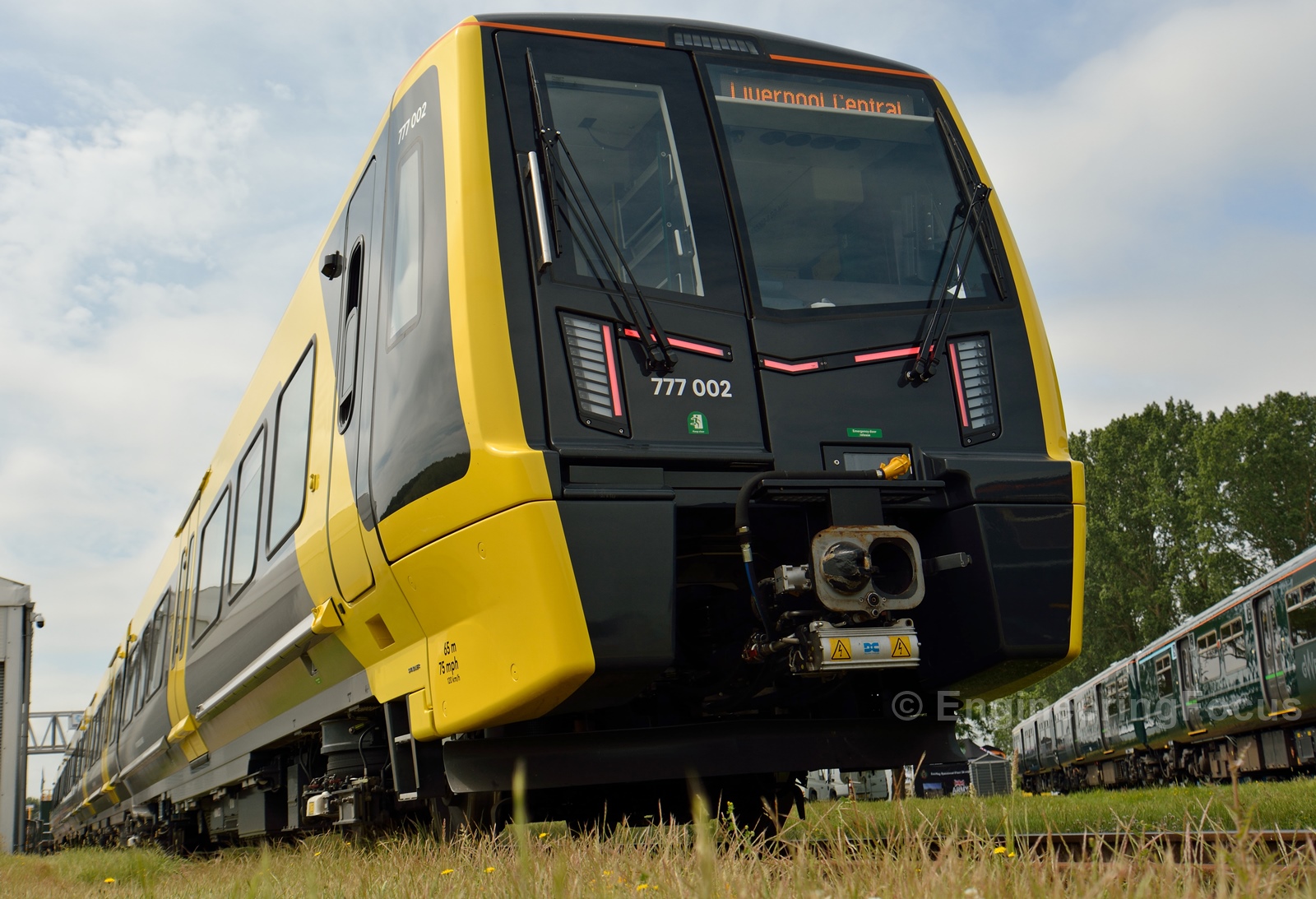
The Class 777 on display number 002 is a little bit different from the rest of the fleet, as it's fitted with a 67kwh hour battery, meaning that it can operate beyond the 3rd rail network. 002 is currently being tested on the Merseyrail network to see how well it can perform, to ensure that the added weight of the battery has no impact on its overall performance compared with the non-battery classmates, but also how well the battery itself can perform. So far 002 has been able to travel from Sandhills to Southport on battery power alone, a journey of approximately 20 miles. So far all indications are that 002 can perform just as well as units without batteries, so the added weight of the battery doesn't appear to cause any noticeable reduction in acceleration or braking performance.

The trial of 002 opens up the very real possibility of extending the Merseyrail network, or the reach of the 777s beyond the 3rd rail network and 777s fitted with batteries could potentially operate as far as Wrexham on the Wrexham-Bidston line, or from Ellesmere Port to Helsby. For the former to happen a number of 777s would likely have to be fitted with larger batteries with a short section of 3rd rail fitted at the Wrexham end for rapid charging. If you would like to know more about the possibilities that the battery variants offer click here.

Class 777 interior

Merseytravel is currently working on a business case that may see all 777s fitted with batteries, which would mean the planned extension of the network to a new station at Headbolt Lane would not require any further electrification. Fitting all 777s with batteries would also help balance the power from regenerative braking which would otherwise be sent directly back down the 3rd rail.

Class 777 002 at Rail Live 2021


One of the most anticipated features of the Class 777 is the step-free access that they will provide across the Merseyrail Network once in service. Merseytravel has had to make some modifications to platforms, which you can find more information about here, but the 777s themselves have been designed with step-free access in mind. The units have been designed so that the floor of the carriage is level with a UK platform set at 915mm, with an offset of 730mm. To ensure that there is a minimal gap the units are also fitted with a retractable step which has an infrared camera fitted inside. As the step extends the camera detects the platform edge and ensures that there is no more than a 35mm gap between the step and platform. The step, combined with the camera and the 4 slightly shorter carriages helps to ensure that the gaps are equally spaced even on curved stations.

Class 777 retractable step


Rail Live has become an event at which rolling stock manufactures want to show off their new units, but primarily the event provides infrastructure and services companies with an opportunity to display what they have to offer. In part 2 I will be taking a look at some of the plant and engineering that was also on display.


Twitter - Facebook - Youtube

Friday, 22 June 2018

RailLive Special - Class 769 Flex by Porterbrook

This third in a series of "RailLive special" posts features yet more recycling or what could be more accurately described as upcycling, as Vivarail is not the only company to have seen the benefits of converting redundant electric trains to run on other forms of power.

Porterbrook has been developing its own bi-mode (or in fact tri-mode) units for a number of years and last year it was announced that Arriva Rail North (Northern) had ordered 8 of what were branded "Flex" trains, which now have a TOPS classification of 769

The Flex units are being converted from class 319s all which have been sent off lease from Thameslink and Southern. Some 319s  were sent north to operate on recently electrified lines between Manchester, Liverpool and Preston, with the first refurbished 319 entering service between Liverpool and Manchester in 2015. However the majority of the 319s are now surplus to requirements.

769 000 already painted in Northern colours 

The Flex units are being described as "Tri-mode" as they will be able to draw power from 750v DC third rail and 25kV overhead lines whilst also being able to operate under their own power on non-electrified lines.

Each 4 car train will have 2 6 cylinder diesel engines provided by MAN placed underneath each driving vehicle, the engines will be used to generate electricity to power traction motors. Each horizontal 6 cylinder engine will produce 390kw and will comply with the latest EU Stage IIIB emission standards.

The horizontal 6 cylinder 13 Litre engine provided by MAN

Since the initial order of 8 units for Northern was confirmed a further 24 units have been ordered, 19 for Great Western Railway and 5 for Arriva Trains Wales. The 5 units originally ordered by ATW were destined for South Wales and despite the announcement that KeolisAmey will take over the Wales and Borders franchise the current plans do not seem to have changed. 

It is understood that GWR will use 769s on Reading - Gatwick Airport and Reading - Oxford routes. This will allow GWR to re-deploy class 165/166s to the Bristol area.

5 years ago it was thought that demand for diesel multiple units (DMUs) would decrease rapidly and that the routes on which the class 796s will operate would be electrified. But with cancellations and delays to electrification schemes the rail industry found itself with a potential shortage of rolling stock and crucially DMUs.

Whilst it is true to say that train operating companies have suffered from a shortage of DMUs for a number of years, the problems facing the rail industry over the next 1 to 3 year could have been much worse. With public pressure to remove Pacers from service completely, electrification woes and new disability standards which mean many DMUs will have to be modified by 2020 to comply with PRM TSI standards all having an affect on the availability of units. 


That is if companies such as Porterbrook and Vivarail hadn't spotted the potential problems facing the industry and decided to take a risk and invest in developing solutions which could be deployed relatively quickly and were cost-effective in the short to medium term. 

The class 769s and 230s will allow class 15Xs to be sent off lease to be modified to comply with PRM TSI standards and will fill a gap left by the delays and cancellation of electrification schemes. Both trains will be able to operate on electrified and non-electrified lines so no services will have to terminate where electrification ends or mean that DMUs are running for long periods along sections of railway that have been electrified. 

It is hoped that passengers will see the benefits of these new units within the next 12 months and I'm fairly certain they will not notice that they will be riding on upcycled trains. 


There was a huge amount to see at year's RailLive organised by Rail magazine so I have a number of posts planned covering innovation and technology. This year in particular there seemed to be a lot of innovative products on display and brand new never before seen technology. So if you follow Engineering Focus on social media or click the "subscribe by e-mail" link you won't miss out on any of the latest content over the next week. 


Follow on Twitter and Facebook

 For more information 
e-mail Blog@EngineeringFocus.co.uk
Call: 07393 565 863


Wednesday, 28 June 2017

Rail Live 2017: Part 2 - Highlights

Rail Live is billed as "one of the largest outdoor rail exhibitions in Europe. Based in the Rail Live offers companies the unique opportunity to showcase products and services in a real rail setting". And it certainly doesn't disappoint, with over 300 exhibitors spread over a 120 acre site.

With so many exhibitors it could be easy to get overwhelmed if you're not sure what you're looking for and with the sweltering heat of the day exploring the event wasn't easy. All I knew was I wanted to find the new, unusual and the impressive.

First stop though (for a good 10 minutes) was RVT Group's stand, talking to one of their representatives was a perfect excuse to cool off in front of one of the powerful fans that they had switched on. A perfect demonstration of how powerful and effective the ventilation systems they provide are.


After cooling off I didn't have to travel far to find "the impressive". Sonic Rail Services certainly had one of the most impressive displays at the event. SRS who provide permanent way works and electrical track maintenance, boast their own fleet of HGVs and plant machinery which they themselves maintain. What better way to demonstrate their capabilities than by hoisting a 30 tonne road rail excavator 2 to 3 meters in the air.


Keeping with the plant machine theme, Ground Control had one of their unique Menzi Muck machines on display. This wheeled excavator is able to access sites than would stop other excavators in their tracks (excuse the pun).

Each wheel is attached to an independently controlled arm, allowing the Menzi Muck walking excavator to operate safely on steep inclines and on uneven terrain making it ideal for works involving embankments and difficult to reach locations.


I think the usual title has to go to Searchwise Ltd who were demonstrating underwater equipment with the help of a container full of water and diver, who was probably happy to be inside the tank for change (given the heat outside


On the rails, two impressive rail machines were on display.

Balfour Beatty had brought along its High Output wiring train which they say is "capable of installing a full tension length of 2,000m of catenary and contact wire simultaneously under differing tensions in around four hours" [1]

The train is able to travel to and from possessions at a top speed of 50mph and once on site the train can operate whilst the adjacent line is open.


At the other side of the site S&C North Alliance a partnership of Amey, Rhomberg Sersa and Network Rail were demonstrating a machine which will be used for the excavation, transportation and distribution of ballast. 

On track was a specialised conveyor system which can dispense ballast between the rails or to the side of the track. This conveyor system works in tandem with MFS (Materialförder- und Siloeinheit, or material conveyor and storage) wagons. The MFS wagons on display at the event had the ability to travel both on and off the rails thanks to two pairs of crawler tracks.

The off rail capability allows the MFS wagons to transport and dispose of spoil from excavations. The MFS wagons are also designed to work in conjunction with an inline conveyor excavator which will be delivered to the UK in July.

Video of the conveyor in action

Conveyor system. here being propelled by a Unimog road rail vehicle

An MFS wagon being demonstrated off the track

Finishing where I ended my visit, with a stand that caught my eye just as I was making my way back for the return shuttle. It was hard to ignore the ordnance that First Line Defence had on display, a reminder of German bombing campaign during WWII, which has left thousands of un-exploded shells scattered across Britain.

First Line Defence are there to help identify potential risks and locations where un-exploded bombs may still remain. If shells are identified FLD can direct the MOD to dispose of them safely.


These images and more are available by request, please e-mail Info@EngineeringFocus.co.uk


Follow us on Twitter and Facebook - For more information e-mail Blog@EngineeringFocus.co.uk

Latest blog post

HS2 Bridges and Viaducts Engineering Challenges

A version of this article was published in RAIL Magazine issue 1040 Construction of the 220km (140 mile) long HS2 route between London and ...