Showing posts with label Transport for Wales. Show all posts

Thursday, 24 June 2021

Rail Live 2021; rolling stock highlights

Rail Live "The only exhibition to bring the entire rail industry together in a real railway environment" returned for 2021 after the pandemic forced organisers to cancel the event in 2020. It's no surprise then that Rail Live 2021 seemed bigger than ever, not only with the usual live demonstrations that visitors have come to expect, but this year the Honeybourne shuttle made a return courtesy of Vivarail, Transport for Wales and SLC Operations who operated the service on behalf of Vivarail. Another train that will also be serving on the Wirral was also on display, one of Merseyrail's Class 777 EMUs built by Stadler ran regular short trips carrying passengers during the two-day event. 

Class 230 010 at Rail Live 2021

As someone who will, as a passenger benefit from the introduction of both units, I was keen to step aboard and take a look. My first port of call was the Class 230 which I was especially keen to take a look at inside for the first time, as I have been involved in campaigning for their introduction on the Wrexham-Bidston line for since 2016. I have to say that on first impression I was genuinely impressed. A small number of detractors like to remind people that they are ex London underground stock dating from the late 70s, but honestly, sitting onboard the Class 230  you would never know their past. I think even those who were sceptical at first have been won over by the transformation. 

Below is a short video which shows the full interior of the Class 230


During the conversion from D78 stock to Class 230 the interiors were completely stripped back to the shell and the new high-quality fixtures and fittings installed. The two driving motor cars were very quiet, more akin to an electric train than a DMU, which isn't surprising as the Class 230s are diesel-electric hybrids. The middle trailer car under which the diesel gen-sets are housed was, if I'm being honest a little rattly whilst the engines were running, however nowhere near as noisy as the Class 150s which the 230s are set to replace. I was assured by Vivarail that they are working to address the rattle from the fixtures and fittings, but honestly, even with the engines on, the middle car is a lot quieter than a Class 150.

The interior of TfW's Class 230s


The Class 230s feature all the modern amenities that passengers now expect, such as charging points and an accessible toilet. In addition, the Class 230 also features air conditioning, something which even the fully refurbished Class 150s don't have.

For much more information about the Class 230 click here

There was so much to see and do at Rail Live I had to return for day 2 to step aboard Merseyrail's Class 777 built by Stadler. If I was impressed by the Class 230 then I think I was stunned by the Class 777. When you step onboard it truly is astounding, especially when, as a passenger you are more accustomed to Class 507/8s. The sense of space is something else, looking down all 4 carriages through the extra-wide gangways it feels almost like a TARDIS. Class 777s have 4 carriages but the units are only 4m longer than Class 507/8s, at 64.98mm, compared to 3 car 507/8s which are 60.7m long. The designers have cleverly used the space to increase the 333 maximum passenger capacity of the 507/8s, to 475 seated and standing for the 777s. There is also more legroom, passengers who travel on 507/8s will be familiar with the awkward angles at which you have to sit when there are passengers sat opposite, not with the 777, there is space to comfortably seat 2 adults opposite each other, without touching knees.

Below is a short video which shows the full interior of the Class 777


The Class 777 on display number 002 is a little bit different from the rest of the fleet, as it's fitted with a 67kwh hour battery, meaning that it can operate beyond the 3rd rail network. 002 is currently being tested on the Merseyrail network to see how well it can perform, to ensure that the added weight of the battery has no impact on its overall performance compared with the non-battery classmates, but also how well the battery itself can perform. So far 002 has been able to travel from Sandhills to Southport on battery power alone, a journey of approximately 20 miles. So far all indications are that 002 can perform just as well as units without batteries, so the added weight of the battery doesn't appear to cause any noticeable reduction in acceleration or braking performance.

The trial of 002 opens up the very real possibility of extending the Merseyrail network, or the reach of the 777s beyond the 3rd rail network and 777s fitted with batteries could potentially operate as far as Wrexham on the Wrexham-Bidston line, or from Ellesmere Port to Helsby. For the former to happen a number of 777s would likely have to be fitted with larger batteries with a short section of 3rd rail fitted at the Wrexham end for rapid charging. If you would like to know more about the possibilities that the battery variants offer click here.

Class 777 interior

Merseytravel is currently working on a business case that may see all 777s fitted with batteries, which would mean the planned extension of the network to a new station at Headbolt Lane would not require any further electrification. Fitting all 777s with batteries would also help balance the power from regenerative braking which would otherwise be sent directly back down the 3rd rail.
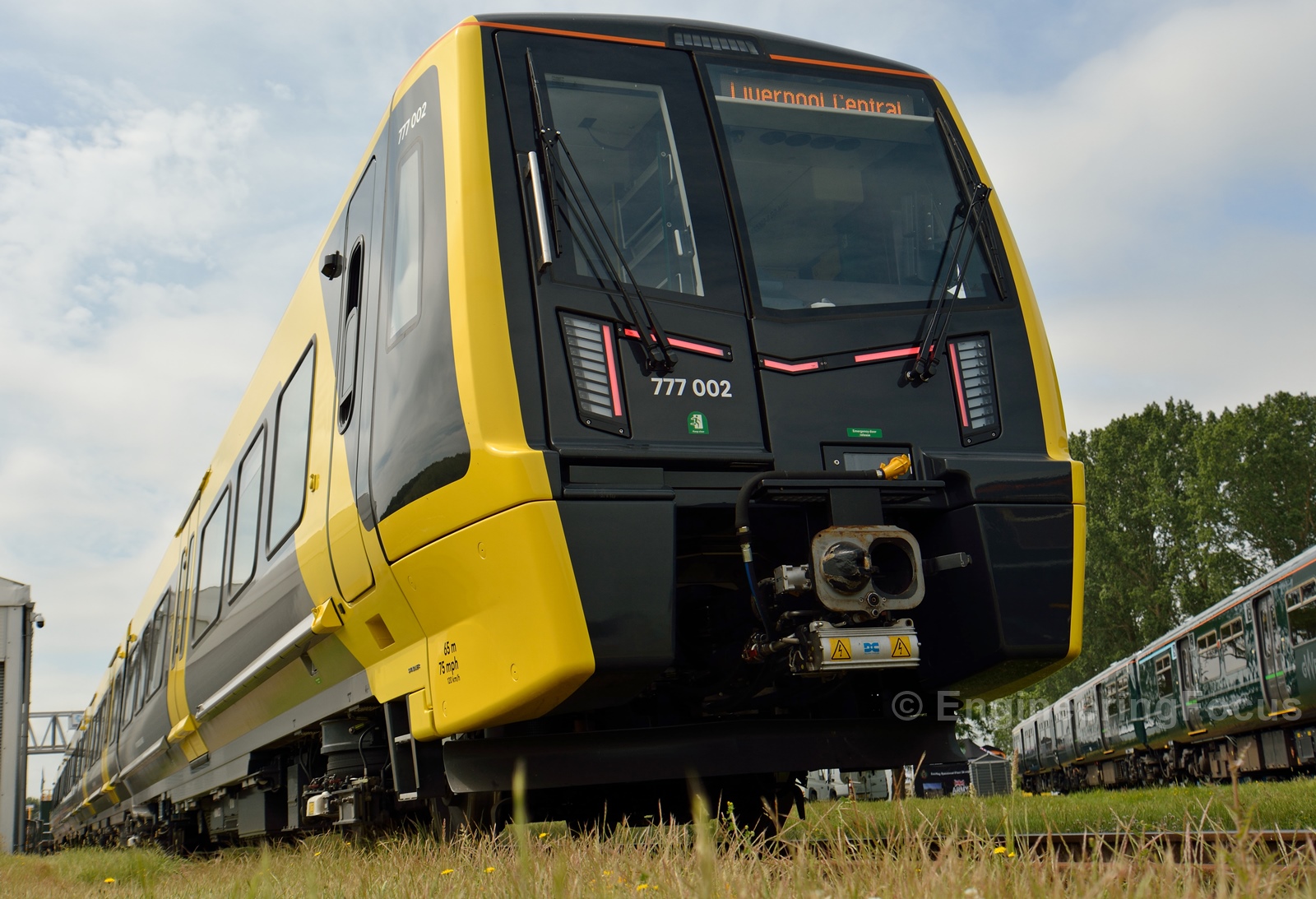
Class 777 002 at Rail Live 2021


One of the most anticipated features of the Class 777 is the step-free access that they will provide across the Merseyrail Network once in service. Merseytravel has had to make some modifications to platforms, which you can find more information about here, but the 777s themselves have been designed with step-free access in mind. The units have been designed so that the floor of the carriage is level with a UK platform set at 915mm, with an offset of 730mm. To ensure that there is a minimal gap the units are also fitted with a retractable step which has an infrared camera fitted inside. As the step extends the camera detects the platform edge and ensures that there is no more than a 35mm gap between the step and platform. The step, combined with the camera and the 4 slightly shorter carriages helps to ensure that the gaps are equally spaced even on curved stations.

Class 777 retractable step


Rail Live has become an event at which rolling stock manufactures want to show off their new units, but primarily the event provides infrastructure and services companies with an opportunity to display what they have to offer. In part 2 I will be taking a look at some of the plant and engineering that was also on display.


Twitter - Facebook - Youtube

Friday, 19 March 2021

Will Transport for Wales deliver for North Wales and Borders?

In 2018 Transport for Wales Rail Services took over the franchise to operate Wales and Borders services, which were previously operated by Arriva Trains Wales. Transport for Wales Rail Services the company initially owned by a Keolis Amey joint venture managed day-to-day running of rail services, as well as overseeing the development of South Wales Metro and the introduction of new trains. Transport for Wales was established as the government body to oversee road and rail transport, whilst TfWRS would have been best described as a railway company owned and operated by KeolisAmey.

When TfWRS took over the franchise, several promises were made, including the introduction of new trains, investment in existing rolling stock, as well as service improvements and station upgrades. On the face of it, TfWRS has so far appeared to have started to come good on some of its promises. £700m has already been spent or earmarked for the South Wales Metro scheme and orders for new trains have been placed, although it looks as if the class 197s ordered from CAF will not start to arrive by 2021 as originally planned and the 769s Flex units, which were intended as a stop-gap measure to release Class 150s so that they could be refitted to comply with accessibility standards are 2 years late, although some are now finally beginning to enter service.

Original timeline for rolling stock replacement 

As far as North Wales and the Borders goes, very little has happened. In fact, one of the first things TfWRS attempted to do was cut the first AM off-peak service calling at Gobowen, Chirk and Ruabon. The decision was made in an attempt to ensure the Cardiff-Holyhead express service could achieve the journey in under 4 and a half hours. A BBC article written at the time stated "A TfW spokesman said: "We have made a commitment to introduce a new Cardiff-Holyhead service departing from Cardiff Central with a total journey time of under four hours 30 minutes, using better trains to provide an improved service."

Such a move would have breached the terms that Welsh ministers had agreed with the Department for Transport when they were given powers to control Wales and Borders services. The agreement states "they shall not act in a manner that directly or indirectly unfairly prejudices the interests of passengers using English services in favour of the interests of passengers using the Welsh component of a Welsh service or a Wales only service" [1]. In the end, TfWRS reversed the decision, but it was a worrying proposal, especially for passengers in England who rely on Wales and Borders services.

 Holyhead-Cardiff loco haued "WAG Express" service in ATW colours at Chester Station

The outbreak of Covid19 has, of course, had an impact on the rail network as a whole and the industry remains in a precarious position. The dramatic fall in passenger numbers combined with poor service performance prior to the pandemic forced the Welsh Government to change the nature of the agreement with KeolisAmey and decide to take control of the day-to-day running of rail services. KeolisAmey will still oversee the development of South Wales Metro, but the Welsh Government has taken ownership of TfWRS in order to manage the day-to-day operation of rail services.

Of course, the dramatic decline in passenger numbers means that the Welsh Government now has less money to play with and has already spent or earmarked £700m of the funding initially granted by the DfT to TfW to transform rail services.

But it does appear that TfW has started to quietly cancel or curtail plans instigated before the pandemic to improve services and stations. One such promise which was made in 2019, was to install ticket machines "to all stations that do not have one by 2022". Now in 2021 this has been curtailed to just a few key stations, with busier stations seeing upgraded machines, whilst older machines will be moved to a few select stations based on passenger estimates.


TfW Class 230 on test on the Wrexham-Bidston line

This may seem on the face of it to be a minor issue, but for rural lines which are perceived to serve relatively few passengers, the installation of ticket machines was seen as a way to boost revenue. For example, ticket sales on the Wrexham-Bidston line have for years been relatively low and as such, it is has been assumed that the line serves a small number of passengers. However the sale of tickets is also low because passengers cannot buy tickets at the majority of stations, and yet whilst it is true that conductors can sell tickets onboard (although they have not done so since the outbreak of Covid), it was never always the case that a conductor checked or issued tickets. Often during the morning and evening commute with stations stops spaced closely together, particularly towards Wrexham, conductors are not able to issues tickets to all passengers whilst remaining in charge of the safe operation of the doors. So many passengers get a free ride, TfW loses vital revenue and passenger numbers go under-reported.

On the left a tweet from TfW regarding ticket machines from 2019, on the right a tweet from 2021

Sticking with the Wrexham-Bidston line, TfW decided after the second lockdown that passenger services should be reduced to 2 hourly until further notice, and be served by a single Class 150. Hopefully, services will quickly revert to hourly as restrictions ease and, by December 2021 service frequency should increase to half-hourly, as this was another key promise made by TfW when they took over. It was also promised that class 230s constructed by Vivarail would begin to enter service by 2020.

Granted the late delivery of class 230s was for the most part out of TfW's control. Several factors including Covid19 resulted in it taking longer than originally hoped to manufacture the units. Covid has also meant that crew training is taking longer than expected. The delivery of Class 769s in South Wales has also run late for similar reasons.

But the key promise of a half-hourly service by Dec 2021 will not, in the end, be entirely what was expected. Whilst there is no hint yet that TfW is going to reverse plans for a half-hourly service, the service itself will not be implemented in full. Instead one of the additional services per hour will not stop at every station and therefore some communities will miss out on the benefit of the new service. In an open letter to the Prime Minister calling for more investment, Minister for the Economy Ken Skates said a half-hourly service “will only be delivered by skipping stations along the route”. He explained that the full half-hourly service cannot be implemented because of “capacity and signalling constraints”. Certainly, the current service turnaround is tight, with trains taking an hour to get from Wrexham to Bidston and there are a limited number of freight movements per day which use the line between Deeside and Wrexham.

Those who have campaigned for improvements to be made to the Borderlands Line argue that the improved performance of the Class 230s compared to Class 150s, combined with speed improvements between Shotton and Bidston means that valuable minutes can be saved to provide a timetable buffer, without the need to miss stops. They are also willing to accept that a short break in the half-hourly service may have to operate when freight paths are needed, but there are currently usually only 2 freight movements each way during the daytime between Dee Marsh and Wrexham.

Ken Skates has gone on to say that full implementation of what is being called the "North Wales Metro" will require funding from the DfT. Initially, it was suggested that an additional block section would need to be installed by Network Rail in order to implement a full half-hourly service. But now Mr Skates along with Liverpool City Region Metro Mayor Steve Rotheram are asking for £100m worth of investment to introduce 4 trains per hour from Wrexham directly into Liverpool. Now, of course, calls for investment are welcome and I like many other passengers would like to see services operating directly into Liverpool. But what hope is there really of this happening if relatively modest improvements such as a half-hourly service and ticket machine installation cannot be delivered in full?

I realise I'm talking a lot about the Wrexham-Bidston line, it is the line that is local to me and it is one that I have actively been involved in calling for improvements for almost 7 years! Some people have been calling for improvements for over 30 years. And just as it seems that improvements are beginning to happen TfW could be about to backtrack on some of its promises.

I understand the initial funding provided to TfW to improve rail services did not stretch to improving Wales and Borders services. But as TfW now has full control of services that serve both England and Wales it only seems reasonable that passengers should expect that some of the money be invested in Borders services and not just South Wales Metro. Some English towns and cities will benefit from new Class 197 DMUs and the Wrexham-Bidston line will hopefully one day soon benefit from Class 230s. But with South Wales benefiting from £700m worth of investment and a raft of new bespoke trains, passengers could easily be forgiven for thinking that the "Borders" part of Wales and Borders has been forgotten about.


[1] page 6 https://assets.publishing.service.gov.uk/government/uploads/system/uploads/attachment_data/file/737916/180531-ageny-agreement-number-3.pdf


Twitter - Facebook - Youtube


Friday, 26 February 2021

Reblog: D Train (Class 230), from passionate supporter to future passenger [2021 update]

First published in Rail magazine in 2019

In 2014 I become aware of an idea to fit diesel engines to redundant London Underground stock, an idea which if proposed by anyone else would have seemed, well a bit out-there. However this idea was proposed by Adrian Shooter, the highly respected ex chairman of Chiltern Railways, who decided to try to help solve the looming shortage of DMUs.

By November 2014 Vivarail chaired by Mr Shooter had begun purchasing ex LU D78 stock intended for conversion to DEMUs. In total 156 driving motor and 70 trailer vehicles were purchased and taken to Long Marston. Reaction from the industry was mixed and the mainstream media's response was harsh. I can remember it being said that "we don't want cast offs from the London" when it was suggested they could be used by Northern.

However, negative press reaction wasn't enough to deter Vivarail from pressing ahead with the project and by 2019 the fruits of their labour began to pay off. 3 class 230s entered passenger service on the Martson Vale line and 5 units were ordered by Transport for Wales Rail for use on the Wrexham-Bidston Line.

Around the time that I learned about the D-train project I became involved with the Wrexham-Bidston Rail Users' Association (WBRUA). The Association had been battling for improvements on the line for 3 decades with little success; but not through lack of trying. Throughout the 90s it seemed as if the line was being wound down and if it wasn't for the freight services that used the line it could of closed all together. 

In 2016/17 the WBRUA begin to actively support the introduction of class 230 on the line, with the proviso that the units were used in order to facilitate the introduction of a half hourly service. This would require 5 units and was at the time a big ask, however the WBRUA believed that a reliable half hourly service would unlock the potential of the line. 

The WBRUA was, and remains confident that 230s which have been delivered to TfW will outperform class 150s and provide a superior customer experience. In terms of performance, 4 diesel engines will provide 600kw of power to 4 rafts of batteries and with double the number of powered axles, will ensure the class 230s will be able to out-perform the class 150s. 

The WBRUA estimated that despite having 3 cars instead of 2, the class 230s with their all aluminium bodies will have a 30% better power to weight ratio than a 2 car class 150. 

 Class 230 vs Class 150 side by side comparison


 Now in 2021,

The class 230s were supposed to enter service on the line in early 2020, with 2 units intended for use on the Wrexham-Bidston line to maintain the hourly service, the other units were to be put to work on the Conwy Valley line, it was also suggested 1 unit could be used on the Chester-Crewe shuttle. However, it was soon established that a class 230 with a top speed of 60mph, despite its superior acceleration (when compared to class 150) would not be able to maintain the current Chester to Crewe journey time. It was intended that by December 2021 all 5 units would transfer to the Wrexham-Bidston line so that the half hourly services could commence.

In the end the first class 230 did not arrive in Wales until July 2020 owing to problems with the supply of crucial components and the added features stipulated by TfW such as wide gangways, for which parts had to be specially fabricated.


 230 006 at Wrexham General, having arrived from Long Martston that day.

230 006 was the first unit to arrive, it was driven from Long Marston to Wrexham General under its own power, with a Vivarail crew onboard. Soon after its arrival, 006 began testing on the line and completed between 2 and 3 runs each day from Wrexham General to Birkenhead North EMU Depot. Transport for Wales Rail had struck a deal with Merseytravel to use 1 of the roads at Birkenhead North EMUD to stable class 230s overnight. In August 2020 006 was joined by 007 and that same month 002, 006, 007 and 008 were authorised for passenger use by the ORR. 008 and 009 have now also arrived with 010 expected in the coming months.

There is currently no secure stabling provision for the class 230s at Wrexham, so all class 230s are being stabled at the Merseyrail EMUD overnight. Refuelling currently takes place at Chester TMD, which is used to maintain TfW's fleet of class 175s. On a handful of occasions 6 car class 230s have been seen making the journey from Birkenhead to Chester for refuelling. 

  230 008 approaching Neston station during testing

TfW have now taken ownership of a number of units and it appears as if they are gearing up to begin driver training. TfW staff members have been seen aboard class 230s making runs on the Wrexham-Bidston line and a class 153 has also been making a number of runs each day from Chester to Birkenhead North via Wrexham for route familiarise.  

A sufficient number of crews must be trained to operate the class 230s by December 2021 in order for the half hourly service to commence. Despite the outbreak of Covid19 and subsequent reduction to the services on the Wrexham-Bidston line, there has been no hint that the half hourly will be shelved. The half hourly service to be introduced from December 2021 was contractual agreement agreed by Transport for Wales and its private partner KeolisAmey when it took over operation of Wales and Borders services from Arriva Trains Wales in 2018. The Welsh Government through TfW has now taken over day to day running of the railway from KeolisAmey. However KeolisAmey still has a role to play in delivering the upgrade of the Valley Lines.  

There is no date yet for when the class 230s will enter service, however with the crews finally beginning familiarisation and training it is hoped that the first units could enter service by May this year (2021).


Monday, 20 May 2019

Halton Curve passenger services commence

Today marks the official launch of direct rail services between Wrexham General and Liverpool Lime St via Liverpool South Parkway, the first direct rail link between North Wales and Liverpool since the mid 1970s. From today there will be 1 outbound service from Wrexham General per day departing at 06:35 and 2 return services departing Liverpool Lime St at 17:37 and 20:14. The service is in addition to the new hourly service which will depart from Chester. The service departing from Chester will call at Helsby, Frodsham, Runcorn, Liverpool South Parkway (for Liverpool Airport) and Liverpool Lime St, with a journey time from Chester of around 55 minutes.

Services between Chester and Liverpool Lime St actually began on Sunday (18th May 2019), which is when I took my first trip over Halton Curve. I picked up the service at Frodsham as I had some shots I wanted to capture in Runcorn upon my return. The trip out was on a humble class 150, but with new seating, disabled access toilet and charging points it wasn't bad at all. The return was made aboard a class 158 in smart Transport for Wales Rail colours and was a bit of a step up from the 150. I'm not sure if the 158 will remain on the route, or if it will be worked solely by 150s once attention from the press has gone.

Class 150 upon arrival at Liverpool Lime St [click to enlage]

One passenger I spoke to was under the impression that the route was to be operated by new trains, but that is not to be unfortunately. I'm not sure which units will operate on the service once the new trains being built by CAF are delivered. However what I am sure of is that no matter what train serves the route, passengers are happy to finally be able to get to Liverpool from Helsby and Frodsham by train, without having to drive to Runcorn, Ellesmere Port, or even Hooton.

Class 158 at Liverpool Lime St
 
Below is a short video montage I put together with some clips of the highlights of the trip.


It is hoped that the new service will remove some traffic from the often congested M56 which connects Chester and West Cheshire to the M6 and Manchester. The service will increase the number of services between Frodsham, Helsby and Chester from just 1 to 2 trains per hour. The service will also provide improved links between Chester and Liverpool Airport which can be accessed via a regular bus service from Liverpool South Parkway.

The new service between North Wales and Liverpool has been made possible thanks to an £18m upgrade of Halton Curve and recent improvements made to Liverpool Lime St. The funding was part of a larger £340m package of upgrades that took place across the Liverpool City Region.

Regular passenger services had operated over Halton Curve up until the mid 1970s, when, despite avoiding cuts made by Beaching, services were withdrawn. Then in 1994 the 2.4km double track line was reduced to a single track, and at the same time the points which allowed south bound trains to use the line were also removed in a bid to reduce costs of maintaining the Liverpool branch of the WCML. Since then the only service which had used the line was a single Parliamentary train each Saturday during Summer, between Chester and Liverpool, operated by Northern.

TfW class 158 travelling over Halton Curve on route to Liverpool


The North Cheshire Rail Users Group, which represents passengers using services on the Manchester-Chester line (part of The Birkenhead Railway) had been campaigning tirelessly for over 20 years to re-instate Halton curve, and in April 2016 their hard work finally paid off, when it was announced that the junction on the WCML would be re-instated, allowing bi-directional traffic to use the line once more.

On the 14th of July 2017 work began to upgrade a short 2.4km section of railway, which involved installing a new crossover and 60km/h turnout on WCML. In addition signalling was also upgraded on the WCML, with control transferred from Halton to Manchester Rail Operating Centre . Work was also carried out to re-signal the Frodsham area and fit a new modern signalling panel at Frodsham Signal box

Halton Curve route map

Details of the signal upgrades are as follows. (source NCRUG)
  • New relay based interlocking and re-signalling of existing Frodsham control area with LED colour light signals and train detection provided by track circuits;
  • Revised signalling arrangements at Frodsham/Halton/MROC to accommodate the bidirectional signalling using TCB
  • Retain the existing method of Absolute Block Working from Frodsham to Helsby Junction and Norton Signal Boxes 
  • Replace the existing mechanical lever frame at Frodsham and replace with an Independent Function Switch (IFS) panel; and • Install OLE overrun protection from Halton Junction.
The upgrade was actually completed in time for the timetable change in December 2018, however due to the lack of available DMU stock passengers have had to wait until now (May 2019) for the new service to commence. But now (finally) passengers can travel direct from North Wales to Liverpool and it is hoped that eventually in the future there will be more services will between North Wales to Liverpool. There is also talk of a Liverpool to Cardiff service which will also use Halton Curve.

It would seem that after the disaster that was the December 2018 timetable change, that passengers are finally starting to see the benefits of years of engineering works and the introduction of new and cascaded rolling stock.


Follow me on Twitter and Facebook

 For more information 
e-mail info@EngineeringBlog.co.uk


Wednesday, 20 June 2018

RailLive special - A busy year for Vivarail (part 1)

Wales and Borders

I have made no secret of my support for Vivarail and the D-train project and have followed its development closely since 2015 when I made the first brief reference to a Vivarail display at Railtex 2015. Since then I have had the pleasure of riding on the first test unit 230 001 at RailLive last year and have written extensively about the development.

So it was with some excitement that I read that Vivarail had been chosen by KeolisAmey to supply 5 class 230s for the Wales and Borders franchise. In particular they will operate on the line which serves the town in which I live. I can't claim to have played any part in this, however I have supported and lobbied for the introduction of the class 230 on the Wrexham to Bidston line for a number of years.

image courtesy of Vivarail


Some background:

I and others had thought that the Wrexham to Bidston line would be a perfect line on which to deploy class 230s units. The service is in desperate need of improvement; the line is somewhat isolated and there are no servicing facilities close by. This is where the class 230's unique design comes into its own.

The units will be upcycled from now redundant D78 stock from the London Underground, this means that they will be less expensive to introduce than new trains and will perhaps, be cheaper to operate than the class 150s that currently operate on the line. This is important as current passenger numbers on the Wrexham to Bidston line are comparatively low. This fact combined with the zero growth basis on which the outgoing Arriva Trains Wales franchise was based, has meant that there was no incentive to invest in improving the service beyond trying to improve reliability.

What is really needed on the Wrexham to Bidston line is a half hourly service which would provide good connectivity with services to Liverpool, Chester, North Wales, Manchester and further afield. This connectivity can only be achieved with the introduction of a reliable half hourly service connecting at Bidston for Merseyrail services to Liverpool and at Shotton for services to Chester, Manchester and North Wales.

A new half-hourly service will require an increase from 2 units which currently serve on the line, to 4 with 1 unit available at short notice on standby should one fail. This increase will require additional investment by Transport for Wales, so the lower cost of the class 230 will help improve the business case.

Another fact which favors the class 230 is the modular design of the power packs. Each engine sits within a raft which is slung underneath the carriage, this means each powerpack can be removed and replaced relatively easily without the need for specialist equipment or train lift. This should mean that the units would not need to travel to Cardiff for repairs and that they can be stabled locally.

The 60mph top speed of the units should provide no issue in the case of the Wrexham to Bidston line as the frequent stops and low track speed means that trains rarely if at all ever reach 60mph. However the class 230 could potentially outperform the current class 150s. This is due to the increased power (whilst complying with strict environmental regulations), the lightweight aluminium body shells and the fact that the units have a greater number powered axles, 2 per powered car for a class 150, versus 4 per driving car for the class 230.

Unit service and design:

The first of 5 class 230s to enter service should do so in the summer of 2019 and will be used on the Wrexham to Bidston, Conwy Valley and Chester to Crewe services. This will allow class 150s to be taken south to enable the withdrawal of Pacers. Once new CAF built trains begin to arrive entire fleet of class 230s will be released in time for the introduction of a half hourly service on the Wrexham Bidston line in December 2021.

The design for the 3-car trains which will feature universal access toilet, WiFi, air conditioning, USB ports and 3-pin sockets is well underway and it is expected that the units will move to Wales for final testing and commissioning in early 2019. The class 230s will be fitted with a range of seating layouts and there will be plenty of space for bikes and luggage.

CGI image of the proposed layout for the new W&B units
image courtesy of Vivarail


Marston Vale line

At the start of the year I reported on the announcement that Vivarail was chosen to supply 3 class 230s for West Midlands Trains to operate on the Marston Vale line. Work to build the trains is well underway and they are expected to enter sercice in December this year (2018)


Image captured in May 2018 shows of one of the units featuring MWT livery ready to be fitted out 
image courtesy of Vivarail

The units will enter service between Bedford and Bletchley and be the first trains to be introduced within the new West Midlands Trains franchise.

The first 2 confirmed orders are exciting news, but that is not all that has been happening at Vivarail this year. In part 2 I will be taking a closer look at the battery unit that has been in development for the last year, which I had the chance to ride on this morning at RailLive.


Latest blog post

HS2 Bridges and Viaducts Engineering Challenges

A version of this article was published in RAIL Magazine issue 1040 Construction of the 220km (140 mile) long HS2 route between London and ...