Showing posts with label Mersey Gateway. River Mersey. Show all posts

Wednesday, 31 August 2016

Mersey Gateway August 2016 update


It has been 5 months since I last updated progress on the construction of the new bridge across the Mersey, the last blog about the project posted in May focused on the task of upgrading the road connections to the bridge.

Since the last update in March 2016 a great deal has happened and 2 of the 3 pylons that will eventually support the bridge are reaching their final heights. As of the 28th of August the north pylon was at a height of 102m, with only 8m left to take it up to its final height of 110m. The south pylon was up to 117m with another 8m to go as of the 26th of August and the central pylon was at a height of 59m as of the 24th of August.

South pylon

Central pylon

North pylon

A view of the 3 pylons together taken on 26th of August. 

Throughout August anchor boxes had been installed into the north and south pylons, the anchor boxes will be used to secure the stay cables which will hold the weight of the bridge deck. The south pylon which will be the largest contains 16 anchor boxes, each of which can hold 4 stay cables, 2 on each side. The central will house 8 anchor boxes and the north will house 14.

During July and August the form travellers which will construct the bridge deck were lifted into position on the north and south pylons, with the central yet to lifted. The form travellers work in a similar way to the movable scaffold systems (MSS) which are being used to construct the approach viaducts. 

The form travellers each act a mould into which steel reinforcement is placed and then concrete is poured to form a bridge section. Each bridge section will be secured with a stay cable anchored to the pylon. 

Once each bridge section is secured and the concrete has set the traveller then moves along, half of the travel supported on the bridge section just constructed and the other half jutting out to support the mould, ready to construct a new bridge section. This process is repeated until 2 form travellers working from each pylon meet in the middle. 

The south pylon with the form traveller in position. 

Over the past 5 months the MSS which has been constructing the approach viaduct on the Widnes side has been making steady progress, as of the 20th of August 8 spans had been completed. Work has now begun to extend the width of each span to the final 6 lane width.


To extend the width of each span a machine called a wing traveller (pictured below) has been installed. This machine rests on the constructed span and reaches out sideways to support 2 moulds (1 either side) onto which concrete is poured. Once the concrete is set the machine is moved forward to repeat the process.


In Runcorn a second MSS is being assembled to construct the approach viaduct which will take traffic over the Manchester Ship Canal and onto the new bridge. This MSS will work in exactly the same way as the one on the Widnes side. 


Another large and key element of the project is the construction of Astmoor viaduct which will carry traffic from the A533 Central Express onto the new approach viaduct. This is complex and large structure which includes the construction of a new junction and a large viaduct which is close to industrial units, crosses a busy road and a busway.

This viaduct is being built in what could be considered a more traditional way. Piers have been constructed out of reinforced concrete onto which pre-cast concrete bridge beams are placed. 


Bridge beams over the busway

Piers already constructed ready for beams to be placed over Astmoor Road


The project appears to be progressing well and is on track to open in 2017. I'll be sure to keep up to date with the latest progress right up until the opening day. 


Follow us on Twitter - Facebook - For more information e-mail Blog@EngineeringFocus.co.uk


Tuesday, 24 May 2016

Mersey Gateway - Making connections (Revisited)

Back in August 2015 I reported on the project underway to upgrade the existing road connections that will eventually connect the M56 and A562 Speke Rd to the new bridge. At the time the sites in Runcorn and Widnes were just being prepared for work to commence. Now however a great deal have been achieved since then and some elements of the project are gearing up for completion.

The map shows the new route traffic will take from the M56 to Liverpool.

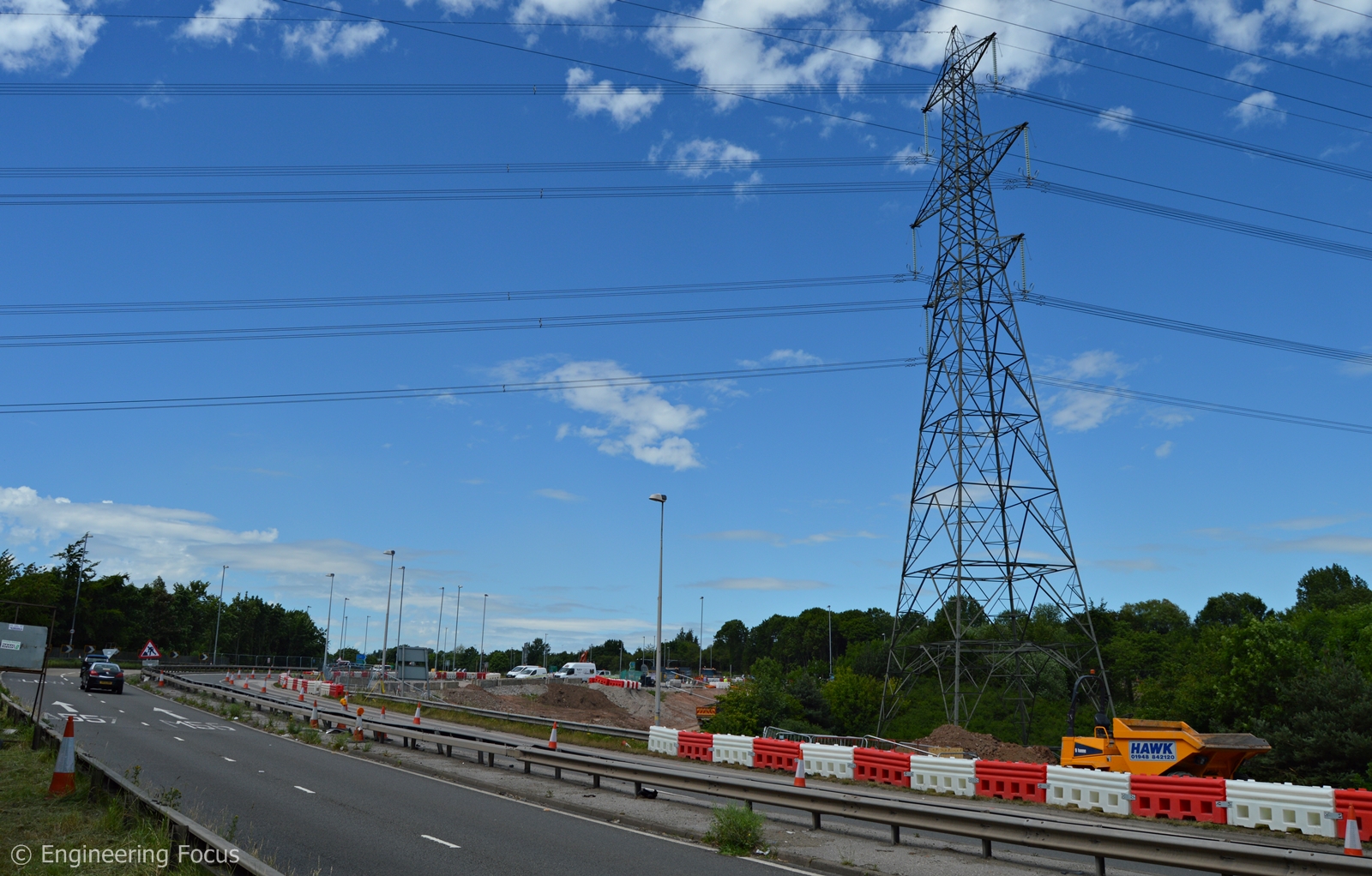
In Widnes work to connect the A562 to the new bridge reached a crucial stage, in March (2016) the link which connects the current Jubilee bridge to the A533 was permanently closed. This closure was to allow engineers to begin demolition of the existing flyover which crossed Ditton Junction. Now work is underway to construct a new flyover which will take traffic over Ditton Junction and onto the new approach viaduct leading to the new bridge.

The images below show some of the progress which has been made to build a new road which will connect the A562 with the new bridge. To the right of the image a new junction will be constructed which will take traffic from the A557 Queensway onto the new connecting road.

To the left of the image the connecting road will join the the A562 Speak Road, in addition Ditton Junction will be remodelled, with the exiting roundabout converted into a flat traffic light junction with the a new flyover which will provide a free flow link between the A5562 and the new bridge.

The new flyover will be opened only when the new bridge is finished, therefore traffic will continue to be diverted from the Jubilee Bridge and on to the Ditton Junction roundabout until Autumn next year when the project is due for completion.  


The image below shows the remnants of the old Ditton Flyover still being crushed


In Runcorn the travelling public will soon benefit from the completion of a major aspect of the project. Work has been underway for the past 11 months to remodel the roundabout which connects the A557 to the M56. This roundabout has been upgraded from a flat roundabout controlled by part timed traffic lights to a 'throughabout' with permanent traffic light control.

The throughabout or 'hamburger roundabout' will allow some traffic to drive through the middle of the roundabout under traffic light control, whilst other traffic navigates the roundabout itself. The new junction with extra approach lanes should vastly increase capacity and cut waiting times without the need to build an expensive grade separated junction.

It should come as relief to many who use the junction frequently that work, at this junction at least should be complete within the next week. 

The images below show the progress on the new throughabout. Road markings have already been painted and large parts of the junction have already had the final road surface applied. 


For more information about the project click here


Follow us on Twitter - Facebook  For more information e-mail Blog@EngineeringFocus.co.uk

Tuesday, 29 March 2016

Mersey Gateway - March 2016 update

Work to construct the new bridge over the River Mersey is progressing well and all indications are the bridge will open on time in autumn 2017. Since our last update in October 2015, visible signs of the bridge construction have begun to appear, most notably the northern and southern pylons which will support the bridge deck are now slowly rising up from their foundations. 

Image taken on 15th of March shows the progress so far of the 3 pylons.


On the Widnes side of the River, progress is being made on the approach viaducts which will take traffic from the A553 toward the new bridge. So far 2 spans have been poured and are now visible, with the MSS (Moveable Scaffold System) in place ready for the 3rd span to be poured.

Construction of the approach viaduct making steady progress.

Close up of the MSS which was in place to construct the 3rd span.


Work in Widnes to connect the existing road network to the new bridge has reached a crucial stage, as of yesterday night (28 March 2015) the vital link which connects the current Jubilee bridge to the A533 was permanently closed. This important but disruptive closure will allow the engineers to construct a new flyover which will take traffic over Ditton junction and onto the new approach viaduct leading to the new bridge.

The closure of the existing flyover will mean that traffic which currently uses the free flow link from the bridge onto the A533 will be diverted onto Ditton junction itself, which has been remodelled to help ease the congestion that will arise from the closure of the flyover. This closure will now remain in place for the remainder of the construction phase until the opening of the new bridge in autumn 2017.

For more information regarding the closure click here

There will also be a number of weekend closures of the roundabout at junction 12 of the M56, this will allow engineers to safely continue to remodel the roundabout, with the majority of the work on the runabout complete by Summer 2016


For more information about the Mersey Gateway project click here


Image of the north pylon with the form travel at the base, which will eventually be lifted into place to construct the bridge deck

Image of the progress so far with Fiddlers Ferry power station in the background.


Follow us on Twitter - Facebook - Instagram For more information e-mailBlog@EngineeringFocus.co.uk

Friday, 23 October 2015

Mersey Gateway project - Autumn update


It has been roughly 4 months since our last update of the Mersey Gateway project and since then quite a lot has happened. For the first time visible structures are emerging from the River Mersey and other important structures are starting to be constructed. 

In September a major milestone was reached when Europe’s longest bridge-building machine was named after a 3 month assembly process. The machine known as a movable scaffolding system (MSS) has been named Trinity.

Trinity will be used to construct the main elevated approach roads leading to the bridge. The machine will act as an enormous mould into which concrete is poured, after each 70 meter section of concrete has set Trinity will then move on to the next section. 

Despite weighing 1700 tonnes and being 75m long Trinity will move from pier to pier in one piece. The machine will do this using 2 175m long rails onto which she sits. There is a video of how the movable scaffolding system works here.

Trinity will initially construct the northern approach road (Widnes side) before being dissembled and then reassembled on the southern side (Runcorn side) to being construction of the southern approach road. 

Trinity Key facts 
  • Total length 175m

  • Casting length 70m

  • Weight 1,700 tonne

  • Number of Components 3,000
  • Number of bolts 60,000


Trinity pictured here in September before starting work on the new approach road. 


After months of preparation work to construct the bridge foundations which has gone on mostly unseen, the first visible signs of work have begun to take shape. 3 cranes have emerged from the river resting on each of the 3 foundations ready to begin construction of the main pylons. 

Each crane will rise steady with the bridge pylons as they are constructed and by the end will sit a few meters higher than the finished pylons. Once finished the cranes will be dissembled to reveal 3 large self supporting pylons from which the bridge deck will be supported. 

Northern pylon site

Middle pylon site

Southern pylon site

The view of all 3 tower cranes from Wigg Island (Runcorn)

The view from the Catalyst Centre (Widnes)

A key element of the Gateway project which will improve the connectivity to the bridge from the M56 has also started to take shape. At the start of October the eastbound exit slip from the M56 which is used to access the expressway leading to the current bridge was closed for 5 weeks.

The closure is to allow work to continue safely on the slip road which currently leads to a roundabout. This section of the route is a major bottleneck which often causes traffic to back up onto the M56. The new junction being constructed will hopefully alleviate the congestion on this busy section.

Looking south toward the M56 from the Weston Point Expressway


[Edit]

It has been announced that sections of the Central and Southern Expressways will close from 07 November 2015 for 7 months.

The Mersey Gateway website states: "The Central Expressway stretching from Halton Lea through to the Lodge Lane Interchange will be closed in both directions. The northbound Southern Expressway – heading from Hallwood Junction to Lodge Lane Interchange – will also be closed. A diversion will be in place via Runcorn Shopping Centre."

A map detailing the diversion can be found here


The map below shows the route drivers will take from the M56 to the new bridge once the project is complete in 2017


Saturday, 1 August 2015

Mersey Gateway - Making connections

The Mersey Gateway project which is currently under construction will provide a second road crossing over the River Mersey, comprising of a 6 lane cable stayed bridge, providing 3 free flowing lanes in each direction.

A key element of the project which isn't quite as well known is the project to upgrade the existing expressway which will connect the new bridge with the M56. When the bridge opens traffic will switch from using the A557 which connects the existing bridge to the M56, to the A533 (Central expressway).

The project involves upgrading and realigning 5 junctions on the Runcorn side of the river and 2 on the Widnes side. 2 of the junctions in the Runcorn area require complete remodelling in order to improve traffic flow and 3 will be realigned and improved.

The A533/A558 interchange will be completely remodelled in order for traffic to be able to access the new bridge. The remodelling will involve constructing an overpass to connect the bridge approach road with the A533.

The A558 will pass under the the A533 and be intersected by a double roundabout which will provide access from the A558 to the southbound A533 and the bridge approach.

The junction which connects the A557 to the M56 will also be completely remodelled with the main connecting roundabout becoming a Hamburger roundabout or throughabout. The section that will cut through the centre of the runabout will connect with the roundabout which connects to the westbound M56 entry and exit slip roads.

Another key junction which will be realigned is the junction which connects the A557 to the Weston Link, which in turn connects to the A533 Central expressway. The new junction layout will provide improved links between the A557 and the A533, upgrading the section of expressway to become the core link road. 

In Widnes the Ditton junction will be completely remodelled so that the A533 Speke Rd/Queensway can be realigned to take traffic toward the new bridge approach road. The existing bridge access will connect with the new alignment at Ditton junction.

Untangling a number of busy junctions and interchanges to provide an upgraded link road is a massive and complex project in itself, one that is disruptive for local commuters and motorists from further afield who wish to use the existing bridge. However the works are essential for the current expressway network to be expected to provide an essential link for the region for decades to come. 

Once the works are complete local commuters and those accessing the new bridge will be able to appreciate the work that has been carried out in order to upgrade the road network. 

Admittedly it has not easy detailing such complex works, however a full list of junction improvements can be found here, the site contains further information and images showing what the new junction will look like once complete.

[update: additional labels have been added to the map]

Map of the route which will connect the M56 to the new bridge.

A557 to the Weston Link looking toward the M56. Vegetation has been cleared in preparation of work to improve the junction to commence.

Machinery and tipper trucks parked in the middle of the existing M56 junction roundabout. 

Looking north toward the M56 roundabout. 

Looking south toward the M56 roundabout.


Saturday, 25 July 2015

Northern - Powerhouse or Powercut?

 Update 30 September 2015

Today it has been announced that the electrification of the TransPennine and Midland Mainline routes will resume.

A review into Network Rail's upgrade programme conducted by Sir Peter Hendy has outlined how the work could continue, in response the Secretary of State has instructed the Chair of Network Rail to un-pause this work.

Network Rail will now work with the DfT and Rail North to develop a new plan for electrification of the TransPennine route between Stalybridge and Leeds and on to York and Selby.

Network Rail will also recommence work to electrify Midland Mainline, with elecitrification north of Bedford to Kettering and Corby complete by 2019 and the line north of Kettering to Leicester, Derby/Nottingham and Sheffield complete by 2023.

Secretary of State for Transport Patrick McLoughlin said:
As a one nation government we are making sure every part of Britain benefits from a growing economy. Connecting up the great cities of the north is at the heart of our plan to build a Northern Powerhouse. This government will see the job through and build a better, faster and more reliable railway for passengers in the north and Midlands.

Chairman of Network Rail Sir Peter Hendy said:
“The temporary pause in the programme has given us the space to develop a better plan for passengers. People can expect more services and faster journeys. We face some difficult challenges, and there is more work still to do, but the Secretary of State’s decision means we can now move forward with our plans to electrify TransPennine and Midland Mainline”.


You can find the full anouncement from the DfT Here


On the 25th of June this year (2015) The secretary of State for Transport Patrick McLoughlin announced in parliament that two key electrification schemes are to be "Paused". To many within the rail industry the news didn't come as much of a surprise, it was widely known that electrification of the Great Western was falling behind schedule and was massively over budget.
The speculation however did not stop the those working within the industry from feeling like the 25th was a dark day. With very little information to go on, the media quickly began announcing that electrification had been cancelled and that Network Rail was in severe trouble.

In a bid to try an reassure the public that action was being taken, Patrick McLoughlin announced that none of Network Rail’s Executive Directors will receive a bonus, in addition the current Chairman, Mr Richard Parry-Jones was to step down to be replaced by the then Transport Commissioner in London Sir Peter Hendy.

Now a month after the announcement the dust has settled somewhat and more information is beginning to come to light. It is clear that GWML electrification has faced many problems and is indeed well over it's original budget, up from to £640m to £1.74b. The project could be as much as 12 months behind schedule which would have huge knock on effects for the deployment of new trains and the cascading of existing trains.

You may be wondering at this point, what problems with GWML electrification has to to with the plan for a "Northern Powerhouse" that was promised by George Osborne during the election? As it turns out, quite a lot.

It has become clear that Britain is lacking the skilled engineers and resources needed to carry out the technically challenging job of electrifying the UK's rail network. It has also highlighted the challenges that Network Rail are facing trying to upgrade the existing network.

With insufficient resources and unexpected challenges it now appears that it has been decided that Network Rail must put it resources into the flagship project to electrify the GWML. If it does not complete this project on time, new trains will be left idle, sat unused in newly constructed depots.

This isn't to say that the Northern Powerhouse has has been shelved or that electrification of the Transpennine route has been cancelled. Far from it.

First of all the £1bn Northern hub project is still underway, this much fought for project has been quickly forgotten by the media and the improvements Network Rail are making across the North are being ignored.

Only four months ago we reported on a major milestone reached in the region, the electrification of the country's first commercial passenger railway. On the 5th of March 2015 electric passenger services began operating between Liverpool and Manchester, 180 years after the line originally opened to the public.

Refurbished electric trains which now operate between Liverpool and Manchester

Also this year the reopening of the Todmorden Curve meant that direct trains could operate between Accrington, Burnley and Manchester for the first time in 40 years. Admittedly there had been a delay in the operating of services but this has a lot to do with a shortage of the trains needed to operate the service.

Another element of the North West electrification project which was completed in at the end of 2013 allowed for electric trains to operate between Manchester and Scotland. in Jan 2014 First Transpennine Express introduced a fleet of brand new electric trains to operate between Manchester Airport - Edinburgh and Glasgow.

The introduction of electric services between Manchester and Scotland allowed for diesel trains to be deployed elsewhere. A key beneficiary were passengers travelling between Liverpool and Newcastle who benefited from an improved hourly services between the two cites. This service also increased the number of fast services between Manchester and Leeds to 6 trains per hour.

Of course the Northern Powerhouse isn't limited to rail improvements, the government is still committed to extending smart motorways westwards along the M62 which it is claimed will help drivers travelling on this infamous motorway connecting East and West.

Planning is also underway to upgrade the last non-motorway section of the A1 in Yorkshire, between Redhouse and Darrington, In addition the government plans to invest £290 million to upgrade the A1 from Morpeth to Ellingham,

Another major project underway which is not specifically part of the Northern PowerHouse proposal is the £600m project to construction a new bridge over the River Mersey. This project will have massive benefits for North West and will further strengthen the regions transport links.

Current progress on the Mersey Gateway Project which is due for completion in 2017

A comprehensive list of all the projects that Network Rail are currently undertaking can be found here

As a last note on the electrification of the Transpennine route, Prime Minister David Cameron has stated that delay to the project is a "pause not a stop" and he was "absolutely committed" to the project.

Despite negative headlines in the press it is becoming apparent that a better and more robust strategy for Transpennine electrification is being drawn up which could it is hoped provide more benefits than the scheme proposed originally..


Watch this space......

[Update]

The Government have today (11/08/15) set out a blueprint for how investment in transport will help create the Northern Powerhouse. Click on the link bellow for more details. 

Tuesday, 30 June 2015

Mersey Gateway (June update)

It has been 4 months since we last posted an update about the Mersey Gateway project which once complete will bridge the River Mersey. From a vantage point on the banks of Wigg Island Community Park (Runcorn) it's difficult to see if much progress has been made, but on further inspection is clear a lot has happened since February.

One of the key milestones that was finished in May 2015 was the completion of Halton's first new bridge over the Mersey in 54 years. The new trestle bridge which crosses the Mersey is a temporary structure which will be used as a platform from which workers will construct the new bridge.

Other work to construct the bridge has been ongoing inside 2 out of the 3 coffer dams constructed in the river, however progress has been out of sight for the most part. Work has been progressing within the walls of the north and south dams in order to excavate an enormous hole into which concrete will be poured. The concrete will act as foundations for the 3 large pylons from which the bridge will hang, the largest of which; the southern pylon will be 125m tall.

The central coffer dam is still under construction, after completion of small island which was built in the middle of the Mersey. The island has allowed for the safe construction of the coffer damn, which like the north and south dams will be excavated and then filled with concrete.

One visible aspect of the project which is taking shape on the northern bank is the construction of a massive 1500 tonne movable scaffold system or MSS, which once complete will construct the approach viaducts. The structure which will attach to the bridge piers will act as a mould into which concrete will be poured to form the approach viaducts. Once each section is complete the system will move along to attach to the next pier to repeat the process.

The actual bridge spans themselves will use separate cantilever system which will move out from each new completed section. Before each section is poured the movable system edges out from the completed section, a stay cable is then installed and attached to an anchor point at the base of the mould. Concrete is then poured into the mould and around the anchor point to form a strong connection between the span section and stay cable.

There is a full 3D fly through which shows how the systems will work.

With work progressing well the latest news from Mersey Gateway is that the project is on programme to have the bridge complete and operational by 2017. We hope to provide plenty of updates before that time. Our next Mersey Gateway blog will focus on the engineering taking place away from the bridge in order to upgrade the expressway which will connect the new bridge to the M56.


Wide shot of the temporary trestle bridge and the 3 coffer dams


Progress on the central coffer dam


Progress on the Southern (Runcorn Side) coffer dam

Progress on the Northern (Widnes Side) coffer dam

Construction of the 1500 tonne movable scaffold system on the Widnes side of the Mersey

Tuesday, 24 February 2015

Mersey Gateway

This blog covers the project in general, but over the coming months I will be covering particular aspects of the project, such as the construction of the bridge itself, work to build access roads to the bridge and improve existing road connections. 

Construction of a second road crossing over the River Mersey commenced on October 2014 after years of discussion and planning dating back some 20 years. 

The Mersey Gateway project will provide a second road crossing over the River Mersey, comprising of a 6 lane cable stayed bridge, providing 3 free flowing lanes in each direction.

The total length of the bridge including approach viaducts will be 2.3km, with a main span over the river of 1km. The bridge will comprise of 3 main towers, the largest of which will reach 125m high. The deck will be supported from the towers by steel cables.

The bridge will be connected to the national motorway network via a 9.5km section of express way which will be upgraded to provide a high quality link with the M56. Currently to reach the Silver Jubilee Bridge from the M56 drivers use the Weston Point Express Way, however when the new bridge opens drivers will use the Central Express Way which is being enhanced.

Both the new bridge and Silver Jubilee bridge will be tolled in order to help finance the Mersey Gateway project and pay towards operation and maintenance of the bridges. The toll has been set at £2 to cross the bridge for a one way trip for a car or small van, it is suggested that this will be in line with the cost to use the Mersey tunnels by 2017.

Unlike the Mersey tunnels the bridges will not have toll booths but will instead use an "open road tolling system" which will utilise smart technology to capture vehicle details. Regular users of the bridge will be able to register their vehicle in order to up to 10% on each trip

The decision to toll the Silver Jubilee bridge was made in order to stop people from trying to avoid paying the toll by driving through Runcorn. However it has been agreed that Halton residents will be able to use the bridges toll free, this was announced on the 25th of July 2014 by Chancellor George Osborne (Residents of Halton will need to register to use the bridges and there will a small charge for this)

Key facts
  • Total length 2130 metres
  • River Span 1000 metres
  • Largest tower 125m high
  • 6 traffic lanes (3 in each direction)
Economics
  • Construction and land costs are estimated to be £600m
  • The project will be 70% funded by the private sector
  • £61.9 million a year in economic benefits from the new jobs by 2030
  • Standard toll charge to use the bridge in 2017 has been set at £2 for a one-way trip.
Benefits 
  • 470 permanent full-time equivalent jobs on site during the construction
  • 4,640 permanent new jobs as a result of the operation of the Mersey Gateway
  • reductions in some journey times of up to 10 minutes in peak periods,
  • increase in journey time reliability
  • less congestion resulting in lower carbon emissions

Progress as of February 2015 on the Runcorn side of the Mersey


Progress as of February 2015 on the Widnes side of the Mersey


These images were captured from Wigg Island, a Local Nature Reserve on the Runcorn side of the Mersey. I couldn't resit capturing this framed shot of the works taking place on the Widnes side of the Mersey. as seen through one of the bird watching stands.


The original Silver Jubilee Bridge constructed in 1961 will be reconfigured to make it more user friendly for pedestrians and cyclists


Latest blog post

HS2 Bridges and Viaducts Engineering Challenges

A version of this article was published in RAIL Magazine issue 1040 Construction of the 220km (140 mile) long HS2 route between London and ...