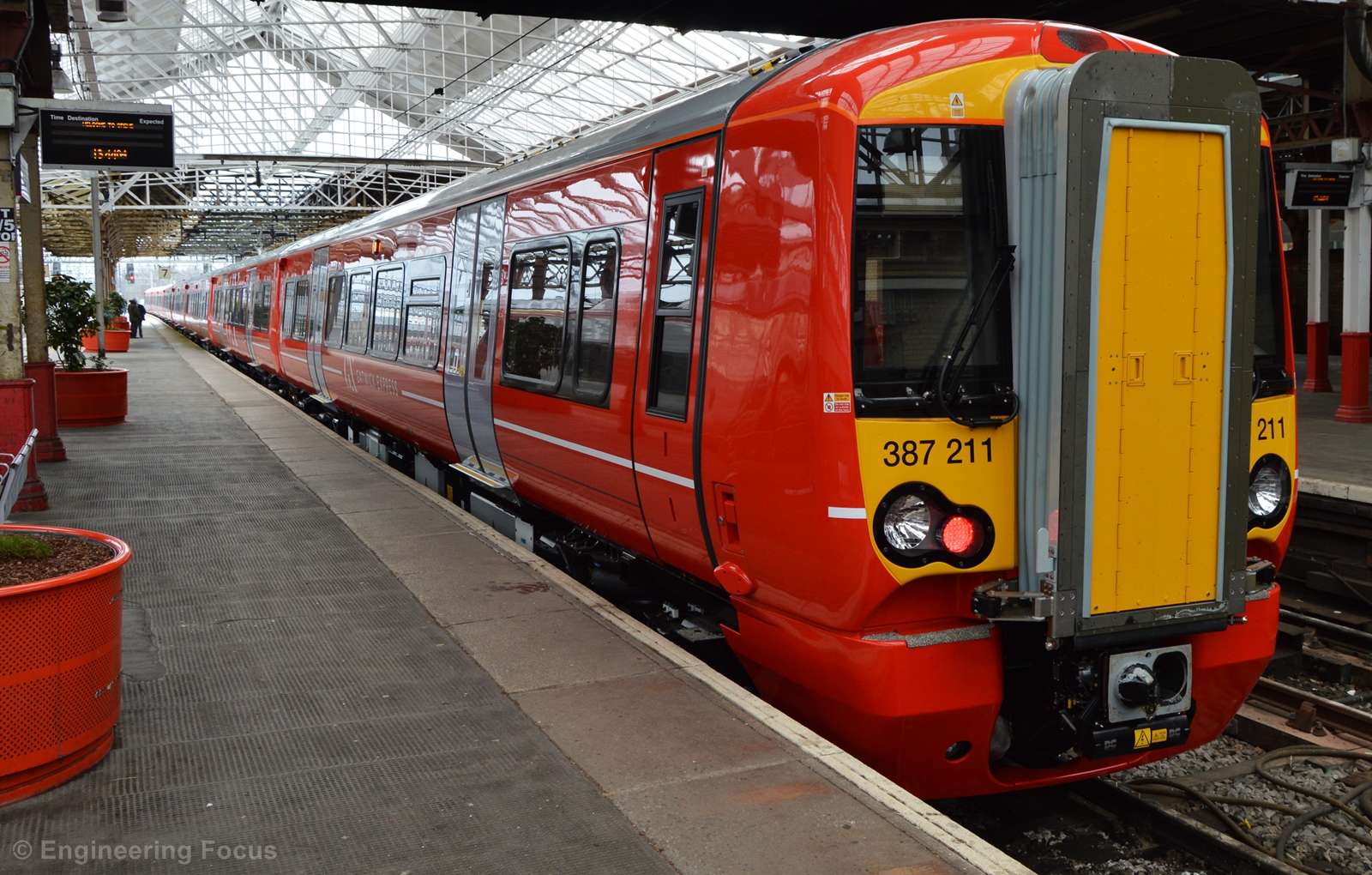
At the time the units (387 211 and 210) were stopped at Crewe after testing on the West Coast Main Line.
Sunday, 6 March 2016
Gatwick Express class 387 on West Coast test
Below are a selection of images from the main line test of a pair of class 387 ElectroStars which will soon be working on the Gatwick Express route between London Victoria and Gatwick Airport.
In all 27 four car Class 387/2s have been ordered to replace the class 442s which currently serve on the Gatwick Express route. The first 387 went into services on the 29th of February 2016.



Tuesday, 9 February 2016
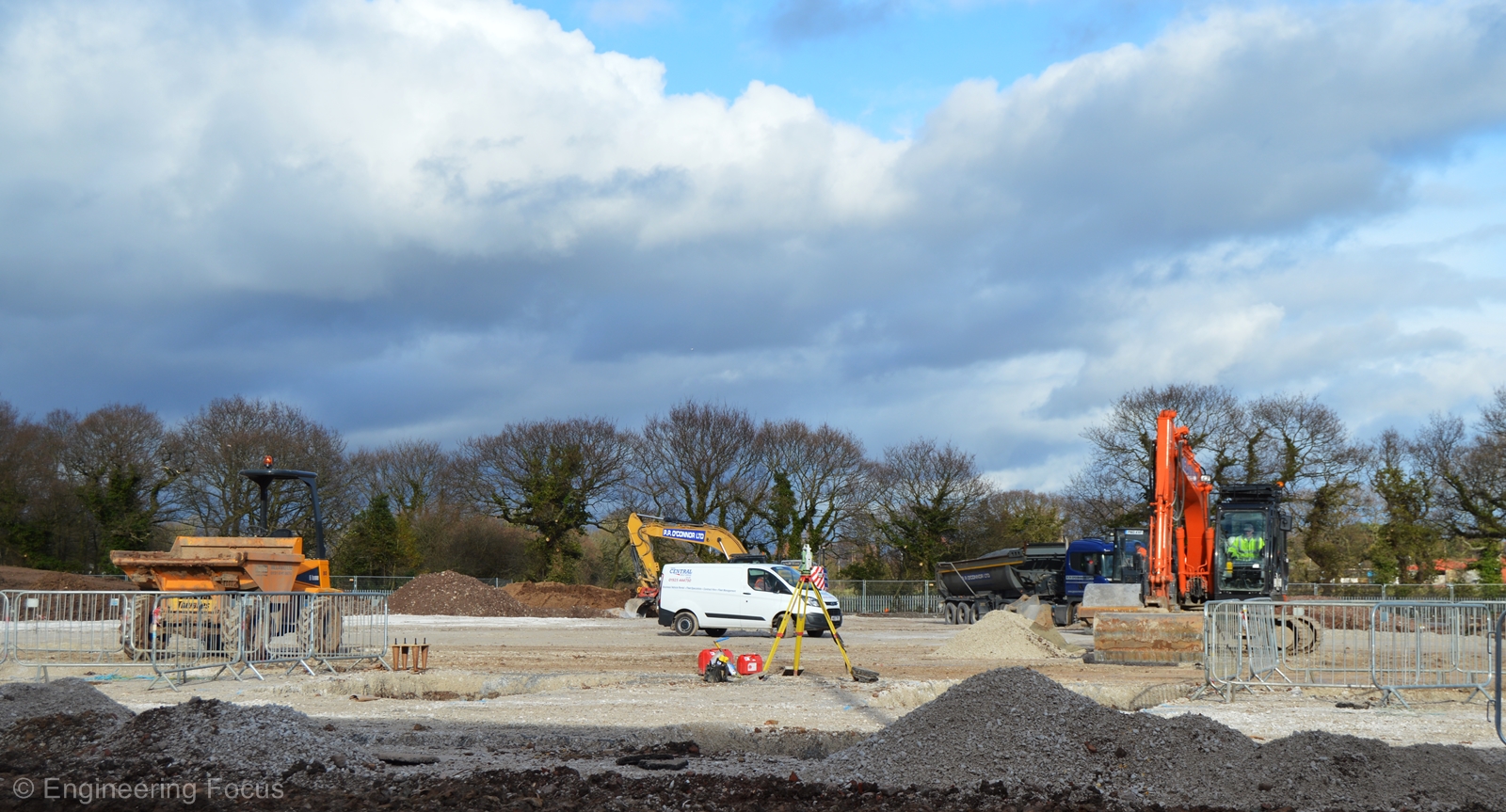
Building a new High School - Neston High
In early January this year (2016) work began on a £25m project to build a new High School in Neston to replace the existing school building, parts of which date back to 1958 when the school first opened.
Planning for the new school began in 2014 when Morgan Sindall was chosen as the main contractor for the Pf2 batch of schools. The batch comprised of 12 schools of which Neston High was one, with a total value of £120m.
The plans for the school which include a new purpose built 3 story structure were first shown to the public at a consultation event held in September 2014. The plans were subsequently approved by the Borough’s strategic planning committee in January 2015.


Planning for the new school began in 2014 when Morgan Sindall was chosen as the main contractor for the Pf2 batch of schools. The batch comprised of 12 schools of which Neston High was one, with a total value of £120m.
The plans for the school which include a new purpose built 3 story structure were first shown to the public at a consultation event held in September 2014. The plans were subsequently approved by the Borough’s strategic planning committee in January 2015.
The plans can be viewed on the local About My Area website for Neston.
The new building will be constructed on land already owned by the school and will not require the closure of or impede on the day to day running of the existing school. Some demolition was required of an old primary school which closed in 2003, it was taken over by Neston High School and become a Sure Start centre and provided space for extra curricular activities.
The only amenity the town will lose for a short while will be a the all weather sports pitch which is situated in between the town's Recreation Centre and the school building which has already been demolished. A new all weather pitch will however be constructed once enough land has been cleared and levelled to allow construction.
The new school building will in fact sit on-top of what was the all weather pitch, which as you will see from the pictures has already been removed ready for ground works to begin. To the rear of the Recreation Centre land is being levelled to make way for the new pitch.
Construction work is scheduled to last 18 months and all being well the new school will open in 2017. Once complete the old school building will be demolished and the land will be used to make up for the sports fields which will be lost to the new building.
View of the all weather pitch and Leonardo Centre in January 2016


Leonardo Centre being demolished in January 2016


How the site looked in February 2016 after a short demolition process

Land being prepared for the new all weather pitch which will eventually be constructed


The old all weather pitch already removed and ground works are well underway.

Monday, 18 January 2016
BBC Television Centre Redevelopment
In September 2010 the BBC made the announcement that they would cease broadcasting from Television Centre in 2013. The building was put onto the property market in November 2011, and was sold to Stanhope PLC on the 16th July 2012; for 200 million.

A year later on the 31st March 2013, Television Centre (As it is now formally known) closed it's doors for the final time, to be redeveloped into housing, offices, restaurants, cafés and shops, along with a new branch of the private members club; Soho House.
Up until February 2015, Stanhope PLC along with the BBC under the joint venture 'Television Centre Developments' worked to clear the building of broadcasting equipment, at a cost of over £60 million. Once completed, demolition began.

The image shows
scaffolding covering Stage 6, along with excavators working on the new
forecourt for the building.

A year later on the 31st March 2013, Television Centre (As it is now formally known) closed it's doors for the final time, to be redeveloped into housing, offices, restaurants, cafés and shops, along with a new branch of the private members club; Soho House.
Up until February 2015, Stanhope PLC along with the BBC under the joint venture 'Television Centre Developments' worked to clear the building of broadcasting equipment, at a cost of over £60 million. Once completed, demolition began.
Television Centre was originally built with 8 studios; as part of a 15 year lease to the BBC, only 3 studios will remain post-demolition, “Three of Television Centre's historic studios are being refurbished for the digital TV age and will be operated by BBC Studios & Post Production, a commercial arm of the corporation” Source: http://televisioncentre.com/
At the time of our visit, BBC worldwide, the BBC's commercial subsidiary, had moved in to their new home in the old BBC news centre. Pictured below.
The former home of BBC News (which moved to BBC Broadcasting house in
March 2013) is now home to BBC Worldwide.

The BBC
originally planned to move back to Television Centre in march of last
year (2015), then the BBC announced that they will not be recommencing
production in studios 1,2 and 3 until 2017, when most of the
groundwork and demolition is complete. The redevelopment of
Television centre follows with a multi-million pound regeneration
within white city, with expansions to Westfield shopping centre,
5,000 new homes and new underground and overground stations within
the area.
The plans
for television centre include:
- 950 new homes in the form of apartments and penthouses, within the listed circular building (more commonly known as the 'Doughnut'), a new tower, and other various locations around the site.
- A 47-bedroom hotel at the front of the building, operated by Soho House
- A mixture of independent cafés and restaurants
- 500,000 sq ft of grade A offices, (with BBC Worldwide already in tenancy as of March 2015)
- Finally, as before mentioned, 3 refurbished television studios operated by BBC Studios & Post Production
We hope to
revisit Television centre in the coming months, and update on the
redevelopment of this world famous building.


Television Centre pictured in April 2015


Tuesday, 12 January 2016
A556 Knutsford to Bowdon - January 2016 update
It has been 4 months since I last visited the project to construct a new dual carriageway connecting the M56 and M6 between Knutsford and Bowden. During my visit in August (2015) a considerable amount of earth works had been carried out, however no structures were yet visible. Over the past few months however several bridge structures have been constructed and now are clearly visible.
Starting at the M6 end of the project, the bridge pictured below will take the new A556 alignment over Old Hall Ln before approaching the junction for the M6.
[Click image to enlarge]

Travelling north, the bridge piers shown below will carry A50 Warrington Road, which will be re-aligned at this point to pass over the A556.
A new roundabout will also be constructed on the A50 to allow traffic to join the northbound A556.

One of the more advanced work sites is located at Millington Lane where a new bridge is being constructed to carry the lane over the A556.
The lane will have to be re-aligned north in order to pass over the A556 on the new bridge.
Below are some pictures taken of the new bridge beams which had been lifted into place that morning. By the afternoon worsening weather conditions meant that the final lifts had to be postponed.


The piers shown below will eventually take take the new A556 alignment under a bridge which will be used to create a new grade separated junction bypassing the roundabout at Bowdon.
The new junction will comprise the existing runabout wich will connect the A56 Dunham Road which heads in the direction of Altrincham, the A56 Lymm Rd, the nortbound exit slip from the A556 and the northbound entry slip which will carry traffic onto the M56
A new round about which will join onto the existing roundabout via a bridge over the A556 will provide a southbound entry slip onto the A556 and the southbound exit slip form the A556/M56. The new roundabout will also provide access for Yarwoodheath Lane.

The map below should help better show the positioning of the new A556 alignment and the several bridge that will have to constructed to carry a number of roads either over or under the new dual carriageway.

The weather remained wet for most of the day during my visit but luckily there were some gaps in the weather so that I could take some pictures. The weather hasn't hampered construction as the main earthworks were wound down over the winter months with work focusing on drainage and the construction of the bridge structures.
Some earth works were taking place during my visit but the majority of the moxys (articulated dump trucks) had been stood down over the winter. It is clear from some some of the images below that operating the moxys in these wet conditions would of been difficult at best.
Large pumps could be seen positioned around the main work sites to keep water out of areas were it was not wanted.
One of the work sites at Old Hall Lane, facing north.


Looking south from the A50, the moxys stood down, a different sight to that witnessed in August when they were busy carrying earth over the A50 under traffic light control.

Looking north from the A50, some work continues but at a less frantic pace than back in the summer.

Looking south from Millington Lane, the alignment for the A556 taking shape,

Work continues on the existing A556 to prepare the road for the new alignment and to strengthen the existing bridge which carries the A556 over the M56,

Work continuing on the construction of the new grade separated junction between the A556 and M56

More information and update can be found on the Facebook page for the project
Tuesday, 15 December 2015
Northern Powerhouse: Rail franchise announcement
On the 9th of December 2015 the DfT finally revealed who will be operating rail services in the North from next year. Prior to the announcement the future of rail services in the North looked uncertain, with a number of trains being moved South with no obvious replacement.
However the DfT's announcement contained a few pleasant surprises. The main surprise being that the North will see the arrival a greater number of new trains by 2019 than originally anticipated. The number of new carriages announced has jumped from 120 prior to this announcement to over 500. The Dft also confirmed that Pacers will be removed all together by 2020
Our previous estimate for carriages in the North up to 2020 with the removal of Pacers gave the region an overall reduction of carriages of 3. However with this announcement the North so far could see a possible overall gain of 378 by 2020.
Services from Liverpool to Glasgow will begin from December 2018 and existing services from Liverpool to Newcastle will be extended to Edinburgh from December 2019.

However the DfT's announcement contained a few pleasant surprises. The main surprise being that the North will see the arrival a greater number of new trains by 2019 than originally anticipated. The number of new carriages announced has jumped from 120 prior to this announcement to over 500. The Dft also confirmed that Pacers will be removed all together by 2020
Our previous estimate for carriages in the North up to 2020 with the removal of Pacers gave the region an overall reduction of carriages of 3. However with this announcement the North so far could see a possible overall gain of 378 by 2020.
Updated carriage assumptions (click to enlarge)

The Transpennine franchise is to be retained by First who will operate the franchise until March 2023. First have promised to introduce 44 new 200km/h trains comprised of 5 cars. With the new trains they will introduce new direct services to Scotland from Liverpool.
Services from Liverpool to Glasgow will begin from December 2018 and existing services from Liverpool to Newcastle will be extended to Edinburgh from December 2019.
The current Northern Rail franchise which is currently operated by a joint venture between Serco and Abellio will from next be operated by Arriva Rail North. Like First, Arriva have promised new trains and say they will introduce a total of 281 new carriages comprised of a mixture of new DMUs and EMUs from 2019.
End of the line for unpopular Pacers

The new trains will help to bolster capacity on busy routes, aid the removal of Pacers and enable the introduction of new services. The new routes which will be launched from 2019 include:
"New direct journeys from Bradford to Wakefield, Sheffield, Nottingham, Liverpool and Hull; from Leeds to Chester and Bridlington; from Lincoln to Leeds; and from Manchester Airport to Warrington, Bradford and Halifax" DfT
Arriva will also introduce a new high-quality ‘Northern Connect’ service, which will provide longer-distance services, with faster journeys and stations staffed daily with catering services and free Wi-Fi.
So is the promised Northern Powerhouse finally beginning to take shape?
So is the promised Northern Powerhouse finally beginning to take shape?
Tuesday, 17 November 2015
Liverpool2: new ship-to-shore cranes arrive
On a incredibly foggy afternoon in November the latest additions to Liverpool's skyline made their way into Liverpool bay. A small group has gathered in New Brighton on the opposite side of the bay in anticipation of their arrival. Unfortunately November 2nd turned out to be one of the foggiest days in recent times, so the expectant onlookers could only glimpse the ghostly silhouette of the enormous structures making their way into the bay.

Ghostly silhouette of the cranes arriving by ship on the 2nd of November (2015)

The structures in question are the first 5 ship-to-shore cranes which will soon take their place on the waterfront as part of the expansion of Liverpool's container terminal. The new river facing terminal will eventually have 7 so called "mega-max" cranes which will be able to load and unload 2 14,000TEU (Twenty-foot equivalent unit) ships at a time.
The cranes themselves stand 92m high and weigh roughly 1600 tonnes each. Given the size of the cranes it seems remarkable that they were transported 30.000km by sea from China, sat atop an ordinary looking cargo ship, all be it sat very low in the water.

The pellets Drax is using are made from waste products from the forestry and milling industry, as well as residual agricultural products, such as straw and energy. The company claims that the CO2 saving of using biomass over coal are 80%, even after harvesting, processing and transportation are taken into account.

The new container terminal and biomass handling facility constitute a £300m investment in the port by the owners Peel Ports, this investment will help to deliver 400 jobs and support the creation of a further 4500 indirect jobs.
The first phase of the new container terminal is due to be complete at the end of the year, with phase 2 to be complete next year with the arrival of a further 3 ship-to-shore cranes.


Follow us on Twitter - Facebook For more information e-mail Blog@EngineeringFocus.co.uk
On my return to New Brighton a week later 2 of the cranes had already been offloaded and were resting on their new tracks ready for commissioning. The unloading process is remarkably straight forward given their size and weight.
2 of the cranes on the far left resting on the new quay

Put simply the cranes are slid off the ship with the use of specially constructed dollys which sit on rail as well as a system of pulleys and winches. Obviously this is a precarious task which relies on precise coordination which must be timed precisely with the ebb and flow of the tide.
There is a video on Youtube which demonstrates the process in action.
Another key milestone for the Port's expansion was reach on the 27th of October when an new biomass handling facility entered service. The new £100m facility will supply wood pellets shipped from America to the Drax power station in North Yorkshire.
The facility will eventually supply 3m tonnes to the power station each year. The pellets will be stored in silos capable of storing up to 100,000 tonnes before being transported 160km by rail to the power station.
The new concrete silos which will store biomass for Drax

The new container terminal and biomass handling facility constitute a £300m investment in the port by the owners Peel Ports, this investment will help to deliver 400 jobs and support the creation of a further 4500 indirect jobs.
The first phase of the new container terminal is due to be complete at the end of the year, with phase 2 to be complete next year with the arrival of a further 3 ship-to-shore cranes.


Follow us on Twitter - Facebook For more information e-mail Blog@EngineeringFocus.co.uk
Friday, 23 October 2015
Mersey Gateway project - Autumn update
It has been roughly 4 months since our last update of the Mersey Gateway project and since then quite a lot has happened. For the first time visible structures are emerging from the River Mersey and other important structures are starting to be constructed.
Trinity will be used to construct the main elevated approach roads leading to the bridge. The machine will act as an enormous mould into which concrete is poured, after each 70 meter section of concrete has set Trinity will then move on to the next section.
Despite weighing 1700 tonnes and being 75m long Trinity will move from pier to pier in one piece. The machine will do this using 2 175m long rails onto which she sits. There is a video of how the movable scaffolding system works here.
Trinity will initially construct the northern approach road (Widnes side) before being dissembled and then reassembled on the southern side (Runcorn side) to being construction of the southern approach road.
Trinity Key facts



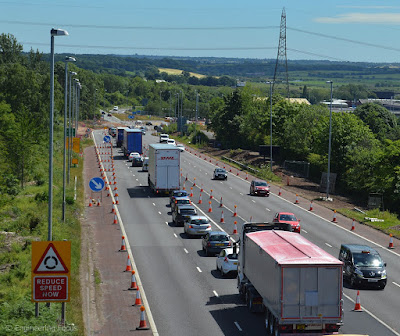
A key element of the Gateway project which will improve the connectivity to the bridge from the M56 has also started to take shape. At the start of October the eastbound exit slip from the M56 which is used to access the expressway leading to the current bridge was closed for 5 weeks.
The closure is to allow work to continue safely on the slip road which currently leads to a roundabout. This section of the route is a major bottleneck which often causes traffic to back up onto the M56. The new junction being constructed will hopefully alleviate the congestion on this busy section.
It has been announced that sections of the Central and Southern Expressways will close from 07 November 2015 for 7 months.
- Total length 175m
- Casting length 70m
- Weight 1,700 tonne
- Number of Components 3,000
- Number of bolts 60,000
Trinity pictured here in September before starting work on the new approach road.

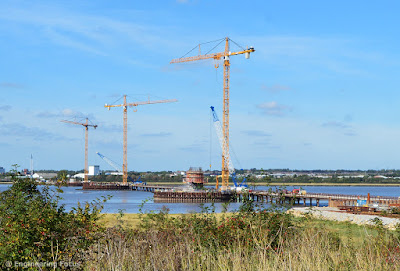
After months of preparation work to construct the bridge foundations which has gone on mostly unseen, the first visible signs of work have begun to take shape. 3 cranes have emerged from the river resting on each of the 3 foundations ready to begin construction of the main pylons.
Each crane will rise steady with the bridge pylons as they are constructed and by the end will sit a few meters higher than the finished pylons. Once finished the cranes will be dissembled to reveal 3 large self supporting pylons from which the bridge deck will be supported.
Northern pylon site

Middle pylon site

Southern pylon site

The view of all 3 tower cranes from Wigg Island (Runcorn)

The view from the Catalyst Centre (Widnes)

A key element of the Gateway project which will improve the connectivity to the bridge from the M56 has also started to take shape. At the start of October the eastbound exit slip from the M56 which is used to access the expressway leading to the current bridge was closed for 5 weeks.
The closure is to allow work to continue safely on the slip road which currently leads to a roundabout. This section of the route is a major bottleneck which often causes traffic to back up onto the M56. The new junction being constructed will hopefully alleviate the congestion on this busy section.
Looking south toward the M56 from the Weston Point Expressway

[Edit]
It has been announced that sections of the Central and Southern Expressways will close from 07 November 2015 for 7 months.
The Mersey Gateway website states: "The Central Expressway stretching from Halton Lea through to the Lodge Lane Interchange will be closed in both directions. The northbound Southern Expressway – heading from Hallwood Junction to Lodge Lane Interchange – will also be closed. A diversion will be in place via Runcorn Shopping Centre."
A map detailing the diversion can be found here
The map below shows the route drivers will take from the M56 to the new bridge once the project is complete in 2017

Subscribe to:
Posts (Atom)
-
 Originally published in Rail Magazine issue 920 The Merseyrail network currently consists of 75 miles of railway, 6.5 miles of which are u...
 -
 A version of this article was published in Rail Magazine in December 2021 As someone who lives on the Wirral and frequently travels to Nort...
 -
 A version of this article was Published in Rail Magazine , issue 999 The small village of Handsacre has recently become the focus of attenti...