Friday, 22 May 2015

Royal Liverpool Hospital development


Royal Liverpool Hospital situated to the east of the city centre is the largest and busiest hospital in Merseyside and Cheshire, it servers as an adult major trauma centre for the two counties. The current building was constructed in 1978 and replaced 3 other hospitals in the area.

The existing 11 story building is typical of 1970s brutalist structures, built largely out of concrete it has an utilitarian and austerer look. Hospitals cannot simply be judged on their appearance however, function has to be the most important aspect.

Only after options to refurbish the existing hospital had been assessed and evaluated was the decision taken to construct a completely new building to house the hospital. The existing structure itself was found to be in a relatively good state, however engineering services were found to be well past their 25 year life.

After assessing the options for refurbishment it was concluded that refurbishing the existing structure would cost considerably more, causing disruption for patients and take a lot longer to complete.

So in 2014 work started on the construction of a new £335m modern hospital, which will house 18 state of the art theatres and 23 wards and units. The 646 bed hospital will provide every patient with a a single bedroom with en-suite facilities.

The new hospital will also be home to a comprehensive cancer centre which willl work in collaboration with the Clatterbridge comprehensive cancer centre on the Wirral.

The new Royal is being funded in part by the Department for Health who are contributing £124m, the remaining funds will be provided by the private sector. The trust will make an annual payment of 6% which it is claimed is "one of the lowest in the NHS"

The Trust will also be investing a further £94m which will fund a multi storey car park, equipment and demolition of the existing structure.

Facts and figures

• The Royal treats 172,000 emergency case and 490,000 out patients each year

• The new Royal will contain 18 state of the art theatres

• 23 Wards and units

• 646 beds

• and cost £335m

• Construction started in 2014 and is expected to be complete by 2017

For more information visit the Liverpool Royal website


The exiting hospital constructed in 1978

Progress on the new hospital April 2015
 

The view from the junction of Edge lane and Low Hill
 

The view from West Derby St

Friday, 15 May 2015

Railtex 2015

On Wednesday (13th May) I visited Railtex which this year was held at the NEC in Birmingham. The event is an excellent opportunity to see what's new within the rail industry and a chance to catch up with how some of the largest rail infrastructure projects the UK are progressing.

On Wednesday there was an opportunity to see how the development of HS2 is progressing. With the passing of the HS2 paving Bill in 2013 ground work for the project can begin as early as next year, with initial preparatory work and detailed surveys taking place. Construction proper is due to begin in 2017, a mere 20 months away.

Unfortunately Andrew McNaughton who was originally billed to speak was unable to attend on the day and instead Jon Kerbey, Director of BIM at HS2 took his place. Although no new announcements were made, we did get an opportunity to see the work HS2 Ltd have been doing with BIM (Building information modelling) in order to design and model the line.

It was fascinating to see the level of detail that HS2 Ltd have gone into with the use of BIM, the audience was shown a detailed 3D fly though of the route modelled in BIM. 


However controversial HS2 may be it was clear to see that train manufacturers from around the world are certainly taking notice of the lines development. Siemens, Hitachi, Bombardier and China CNR corporation were all displaying the latest High-Speed trains that that they had to offer.

CNR had an impressive display of 5 High-Speed train variants on Display, whilst Siemens had a model of it's e320 train on display. it will soon be operating on HS1 between St Pancras and the Continent. Bombardier was displaying its Zefiro High-Speed train which is already in operating in China and Italy. Hitachi also launched its vision for a new High-Speed concept aimed at the UK market, as well as it's class 800 125mph IEP which will begin service in 2017.

China CNR corporation's display of High-Speed train variants


Siemens e320 High-Speed train 

Hitachi's class 800

As well as the latest High-Speed train technology, companies were also displaying their answers to the rolling stock shortage that the UK is facing, the design team behind Vivarail's D Train were in attendance while RVEL were showing their plans to extend the lives of the class 144 Pacers paster 2020 when new rules regarding accessibility come into effect.


The engine manufacturer MTU had their answer to new European emissions limits for non road vehicles on display. Their new hybrid propulsion system promises to provide a compact under floor power pack which can power DMUs whilst adhering to the latest EU IIIB emissions standards.

MTU will be supplying engines for the IEP Bi mode trains, with each power pack producing 940bhp. A smaller version of this could provide the power for new DMUs which the UK government say will replace Pacers in the North by 2020. 


The next Railtex event in 2017 promises to be even more fascinating, as construction of HS2 begins, the government seeks to introduce new rolling stock and decisions to be made regarding what to do with existing rolling stock once accessibility rules come into effect.


Tuesday, 28 April 2015

Western Link HVDC project

The Western Link HVDC (High Voltage Direct Current) project is a joint venture between National Grid and Scottish Power to create a High Voltage electricity transmission link between Scotland, England and Wales.

The link is required in order to increase transmission capacity between Scotland, England and Wales. The link will transmit power from renewable sources in Scotland to Deeside in North Wales, from where it can be distributed via high voltage overhead wires.

This £1bn project involves laying a 385km long High Voltage Direct Current cable under the sea between Scotland and the Wirral in the North West of England. Construction of the Western Link is being carried out by a consortium of Siemens and Prysmian

In Scotland the subsea cable will be connected to a converter station under construction at Hunterston on the Western coast. This is where alternating current will be converted to direct current for transmission along the subsea cable.

From Ardneil Bay in Ayrshire the cable will continue 385km by sea to the Wirral.

The cable will make landfall at Leasowe on the Northern tip of the Wirral peninsular, from there 2 33km long underground cables will transmit current the rest of the way to a converter station under construction in Deeside (North Wales).

The second converter station will convert the direct current back to alternating current. From there the electricity will be transmitted via underground AC cables from the converter station under the River Dee to connect to Deeside substation, from there the power will be distributed across England and Wales via overhead power lines.

Update 2015

Until now construction work on the Wirral has focused on building a 33km long construction corridor (or haul road) and crossing points where the cables must be laid under public roads and footpaths. Building the corridor has been a challenge in itself, requiring the construction of a 20m wide work site fenced on both sides stretching for 33km.

Although the corridor runs primarily though agricultural land, it does intersect with many public roads, some of which are important main roads and many public footpaths. The cable must also cross the main railway line to Wrexham 3 times on it's journey across the Wirral. 

Where the cable has to cross any roads, plastic ducting has been placed through which the cable will be pulled underneath the road. In many cases this was done under traffic light control simply by digging half of the trench at a time, in some cases road closures were required. In each case the process was the same. a trench was dug, ducting was placed, concrete poured over the top and then the road surface reinstated.

After a break over the winter period (2014/15) work has recommenced once again. There are still some sections of the corridor yet to be completed, with work continuing on the section from Mid Wirral to Deeside. The first visible sign of cable laying is currently at a main compound site at Arrowe Park. There it has been possible to see sections of cable being unspooled from large drums.

The underground cable itself will be made up of sections roughly 1km joined together. Each 1km section is transported on it's own drum which due it's weight and size is transported on a specialised low loader.

Cable laying will commence throughout 2015 and is hoped to be completed by mid 2016. Once cable laying has finished the temporary fences will be taken down, land returned to a previous state and any hedges that were removed will be replaced with appropriate species.

For more information visit the Western Link HVDC website 

Work continues on the haul road between the Wirral Way and Mill Lane Ness.


A section of the road between the Wirral Way and A540 Chester High Rd.


Here workmen supervise cable pulling as the cable is unspooled from it's drum seen below. 


Friday, 17 April 2015

Crossrail

Crossrail is currently the largest construction project in Europe, employing over 10,000 engineers working across 40 work sites. Construction began back in 2009 and is expected to be fully complete by 2019.

The £15bn project will provide London with a new 100km East-West route linking Reading and Heathrow to the West, with Shenfield and Abbey Wood to the East. The route is being made possible with the construction of 42km of new tunnels through the centre of the city.

8, 1000 tonne tunnel boring machines (TBMs) have been busy tunnelling 24 hours a day underneath the streets of London since 2012 and now tunnelling is over 90% complete.

There will be 40 stations on the Crossrail route including 10 new stations at Paddington, Bond Street, Tottenham Court Road, Farringdon, Liverpool Street, Whitechapel, Canary Wharf, Custom House, Woolwich and Abbey Wood.

The new route will increase capacity by 10%, provide more connections with underground lines than any other route and reduce journey times between key locations. Crossrail will provide a direct route between Heathrow and Central London, reducing journey times by up to 10 minutes. The journey time from Heathrow to Canary Wharf for example will be reduced from 48 minutes requiring 2 changes, to 40 minutes with no changes.

The new transformational route will be provided with new modern and spacious trains capable of transporting up to 1500 passengers. The 200m long trains to be built by Bombardier will be able to operate at up to 140km/h, they will contain on-train passenger information systems to deliver real-time travel information and be air conditioned.

The trains will be based on Bombarier's Aventra family of electric trains which will be constructed using lightweight materials making them energy efficient. For Crossrail the 345 classification of Electric Multiple Units (EMUs) will be formed of 9 cars each.

In total 65 of the trains will be built at Bombardier's plant in Derby, this will allow up to 24 trains per hour to operate through the central section of the route between Paddington and Whitechapel.

Fact and Figures,
  • Cost £14.8bn
  • Length 118km
  • Tunnel lenght 42km
  • 4.5 million tonnes of material excavated
  • 10% increase in capacity (the largest increase since World War 2)

One of the most visible aspects of the project so far is the construction of a new station at Canary Wharf. Due to the limited space the new station had to be constructed inside the North Dock of West India Quay. 

The 256 metre long station sits 28 meters below the water level, the station consists of 4 above ground floors and 3 below, providing 100,000 square feet of retail space, as well as a public garden housed under a large arched roof.

The public gardens and retail space are expected to open in May this year (2015), a full 3 years before any trains are planned to stop at the station.

For more information about the project visit www.crossrail.co.uk


Wednesday, 15 April 2015

Manchester Metrolink - Second City Crossing

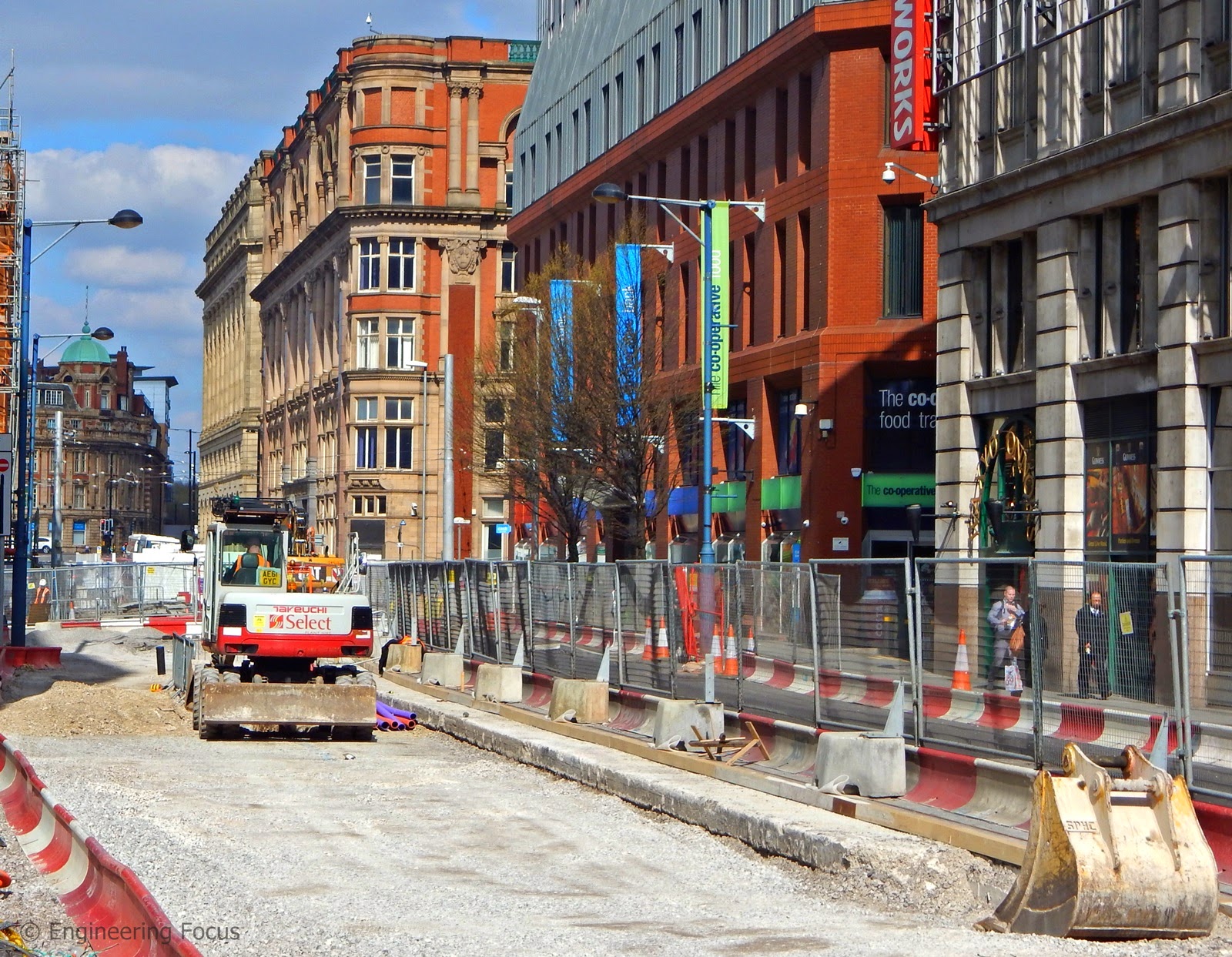
Second City Crossing or 2CC as it is known is a new Metrolink line which is currently under construction. The new line will as the name suggests provide a second crossing through the centre of the city, as well as a new city centre stop and upgraded stop at St Peter's Square.

"The new line will begin in Lower Mosley Street and run through St Peter’s Square, before turning left down Princess Street and then heading along Cross Street and Corporation Street before re-joining the existing Metrolink line just outside Victoria" (1).  A new stop will also be constructed at Exchange Square and a new larger stop at St Peter's Square.

The new crossing will increase the capacity and flexibility of the network and will allow for further expansion of the Metrolink network. The current city centre section is working at capacity which means that trams arriving from the recently completed Airport line currently have to terminate at Cornbrook. When the Second City Crossing is complete trams from Manchester Airport will be able to reach Manchester Victoria through the centre of the city.

Work began on the new line in summer 2014 and is expected to open in 2017. Work is currently focusing on two main work sites, one just outside Manchester Victoria where the new line will join the existing line before heading into the station. 

Complex works are also taking place at a site at St Peter's Square where new sections of track will be laid and the stop upgraded. The new island platforms will each have two platform edges creating a new 4 platform stop. Work St Peter's Square to divert utilities has already been complete and is focusing on preparing the ground for the new lines and platforms.

Work is also currently progressing along Corporation Street, Cross Street and Lower Mosley Street where work is well underway to divert utilities.


Work underway to connect 2CC with the existing line at Victoria


Work  progressing along Corporation St and Cross St


Current works at St Peter's Square


Work progressing along Lower Mosley St


Monday, 13 April 2015

Manchester Victoria - Update

Upon arriving into Manchester Victoria by tram it was difficult to believe that I had only recently visited the station in January this year (2015), the station concourse has been transformed and is now unrecognisable. The most noticeable change for Metro passengers is that you can now alight inside the station, which had not been possible for months prior whilst new Metro platforms were built.

Perhaps the most noticeable difference though is how light the station now is, the concourse is now almost entirely covered by the new arched roof. The roof was constructed using massive steel ribs, in-between which transparent plastic panels were been placed.

The new roof uses the same plastic roofing system which was used to cover the Eden Project in Cornwall. The ETFE* (plastic) panels used are lighter and cheaper than glass, they also have self cleaning properties.

* Ethylene tetrafluoroethylene

Another noticeable change to the concourse area is the installation of ticket gates, which it is said will help to avoid congestion and help to reduce the number of passengers travelling without a ticket. From what I saw it appeared that some passengers were still getting accustomed to the new gates, with some confusion from a small number people, 

As part of the improvement programme existing structures are also being sympathetically renovated. Now that there is so much more light it is now possible to appreciate some of the original features of what remains of the existing station. This does however bring with it it's own challenges, as new modern structures must seamlessly be tied together with existing the structure. Only time will tell how well this can been achieved. 

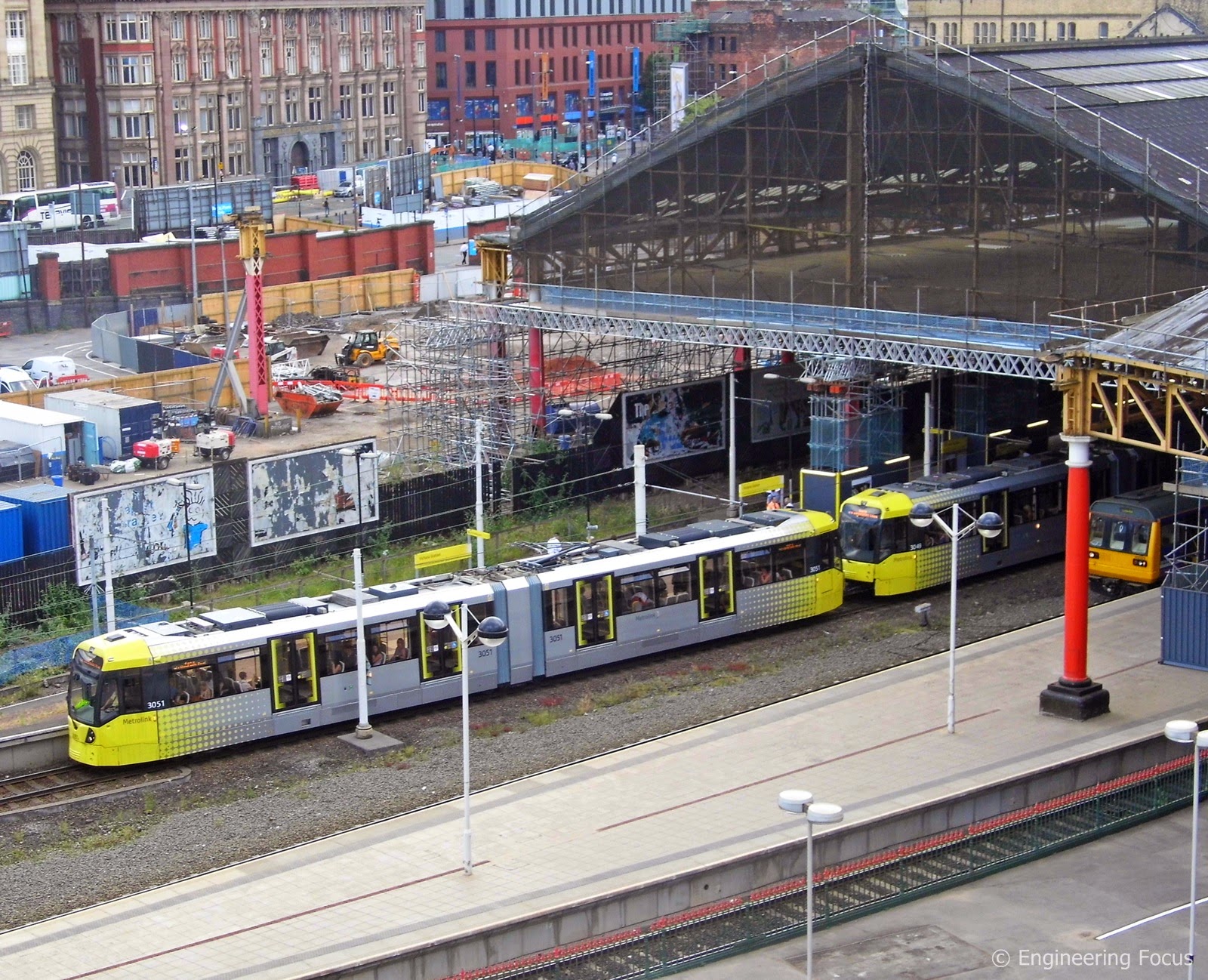
The station is far from finished and teams of workers are visibly carrying out tasks all over the station, from renovation works to installing new features. Work is also progressing on the Metro tracks leading to the city centre. A new cross over and switches have been installed to allow Trams to use the new Second City Crossing once complete. 

There is still some way to go before the station is complete, however it is now clear for passengers to see the benefits of the past 18 months of disruption.


Metrolink Tram passes over the new junction heading toward Rochdale.


New ticket gates 


New Metrolink platforms


The coming together of old and new 


Still a lot of work to be done on Corporation Street for 2CC


The view from the junction of Corporation St and Miller St


Workman working on the roof, not a job for the faint-hearted.


The images below were taking in July 2013. It is clear to see how much the station has changed.


Friday, 27 March 2015

A556 Knutsford to Bowdon Improvement


In November 2014 work began on a £200m project to improve the A556 between the M56 and M6. The project involves constructing a new 7.5km 4 lane dual carriageway between the two motorways in order to relieve congestion on this stretch of the road.

The A556 is a major trunk road which serves north Cheshire and south Manchester. The section of road also provides a connection between the M6 at junction 19 and M56 at junction 7.

The A556 between junction 19 of the M6 and junction 7 of the M56 currently carries 51,000 vehicles per day, 11% of which are HQVs. The road is currently a mixture of single 4-lane carriageway, with sections of dual 2-lane carriageway, along which are several junctions and a number of properties.

As a result of this the road is often severely congested, particularly at peak times. And according to the Highways Agency there were 98 incidents along this stretch, including 1 fatality and 13 serious injuries in the period January 2007 to December 2011.

The project will also involve reconfiguring the junction at Bowdon in order to create a grade separated overpass. The new junction will improve the link between the M56 junction 7, A556 and the turn off for Altrincham.

The original A556 route will be "de-trunked" reducing it to a single carriageway after the new section of road is complete. The existing southbound carriageway will become two lanes and the northbound carriageway will be used to provide a pathway for pedestrians, cyclists and equestrians.

Facts and figures
  • 51,000 vehicles per day currently use the A556
  • Cost of the project is estimated at £165m to £221m 
  • A new 7.5km grade separated dual carriageway will be constructed
  • 130,000 tonnes of tarmac will be layed
  • 300 people employed on site
  • 5 new overpasses will be constructed 
  • The project will take approximately 2 years to complete 
  • The main contractor for the project is Costain
For more information visit the Highways Agency website 

Map of the new A566 by-pass (click to enlarge)


The images below were taken from the site at Bowdon, where work has begun to build a new junction.


Follow us on Twitter - Facebook  For more information e-mail Blog@EngineeringFocus.co.uk

Latest blog post

HS2 Bridges and Viaducts Engineering Challenges

A version of this article was published in RAIL Magazine issue 1040 Construction of the 220km (140 mile) long HS2 route between London and ...