Thursday, 14 June 2018

Manchester Airport Expansion


A £1bn project officially known as the 'Manchester Airport Transformation Programme' (MAN-TP for short) began in July 2017 and since then significant progress has been made. The project will increase passenger capacity by doubling the size of the existing Terminal 2 and vastly improve airport facilities. 3 new piers will be constructed in total with prevision for an additional 4th if required in the future. Airside capacity will also be improved with major changes to the apron and taxiways.

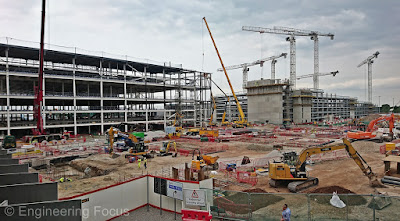
In under 12 months a large area for new structures has been cleared and large sections of the terminal extension and new carpark have been constructed. 6 tower cranes (pictured below) have dominated the Manchester Airport skyline since early 2018. The tightly clustered cranes have been used to lift sections of steel and concrete into place to construct a new carpark which looks to be almost 80% complete.

Significant changes have been made to the passenger drop off and pick-up facilities at terminal 2 in order for work to commence. This includes moving the drop off zone to the ground level and closing off part of the ground level pick-up car park in order to provide parking for staff members. In April 2018 photos were released showing the view from one of the new piers looking through huge glass windows which look out over the airfield.

The terminal is set for completion in 2020 and it is hoped that major "noticeable" changes will take place in 2019. Once the extension is complete, terminal 2 will become the principal terminal with terminal 1 being phased out around 2022 and then later demolished. The entire project including construction of new roads, access ramps and demolition of T1 should be complete by 2023.


The principal contractor for the project Laing O’Rourke is delivering a £570m package of works, including the design and construction of the new T2 extension and the construction of the new 3,800 space multi-story car park. Laing O’Rourke will also undertake significant upgrades to the airport’s landscape and road infrastructure and will construct the initial two new piers for arrivals and departures.


Galliford Try was awarded to contracts totaling £92m, the first £38m phase is to extend the airfield’s west apron which includes construction of new taxiways and aircraft stands. The second £54m phase will increase aircraft stand capacity and aircraft parking. A new ‘Dual E’ taxiway will allow two aircraft such as the Boeing 777 and a Boeing 747 safely to pass each other.

Galliford Try will install more than 79,000m3 of concrete for new taxiways and aircraft stands, they will also reallocating the existing airfield and upgrade a mile-long section of taxiway so that aircraft can be maneuvered more efficiently.


Facts and figures
  • £1bn - Total investment
  • 900,000 sq ft of additional space to be added to Terminal 2
  • 19th busiest airport in Europe 
  • 50 food, beverage and retail outlets to be introduced
  • 3 new piers to be constructed with space and services available to construct a 4th if needed
  • 2023 - Project expected completion date
  • 1962 - The date the original terminal 1 building was constructed
  • 28m - The number of passengers currently using the airport annually

For more information click here

I hope to be able to provide updates as the project progresses


Follow on Twitter and Facebook


 For more information 

e-mail Blog@EngineeringFocus.co.uk
Call: 07393 565 863

Thursday, 1 March 2018

D Trains for Marston Vale Line

Vivarail has today (01 March 2018) announced that it has entered into an agreement with West Midlands Trains to build three new class 230 D-Trains for use on the Marston Vale line between Bedford and Bletchley. The D Trains which will enter service in 2018 will be the first trains to be introduced within the new West Midlands Trains franchise.

Vivarail’s CEO, Adrian Shooter, said “This is a big day for Vivarail. We have invested considerable time and money to bring our innovative D-Train to this point and we are delighted to be working with West Midlands Trains to introduce them into passenger service. As a West Midlands based company it will be extremely gratifying to see our trains running on local lines and we look forward to passenger feedback."

West Midlands Trains’ customer service director, Andrew Conroy, said “We are investing in almost £700 million of new trains for our passengers. The class 230s will be the first of over 400 extra carriages we are adding to our network. These trains are ideal for Bedford to Bletchley route. I am sure our passengers will welcome the new look and feel of the carriages and the extra space. When the new trains come on stream in December we will also be adding extra early morning and late-night services on the Marston Vale line Monday to Saturday.

230 001 at Long Marston back in summer 2017

This welcome news comes less than 2 weeks after Vivarail announced that a battery-powered version of the D Train number 230 002 has entered the production phase. It is hoped that the unit which will have a range of 50 miles after just a 10-minute charge will be ready to go out on the network fully approved for passenger service by the summer (2018)

It is assumed however that the 3 units for the Marston Vale line will be powered by convention diesel-electric traction. Diesel-electric units are fitted with 4 Ford Duratorq engines producing 200hp each, giving a total power output of 800bhp per set which will come in either 2 or 3 car formations.

No specific details were given about the interiors but Each D Train is treated as an empty shell with train operating companies able to specify interiors which suits the particular needs of the route. A pre-production unit which was used for testing and demonstration had a variety of seating options fitted in order to show what is possible. Each train will be fitted with modern amenities such as USB charging points, wifi and will be fully PRM TSI compliant

 Interior layouts, regional on the left high capacity commuter on the right

The order for 3 trains may be relatively small but it proves that Vivarail is able to provide tailored solutions for routes which have specific requirements within a short space of time. There are many more rural lines across the country which require only a small number of units but are desperate for additional capacity and modern rolling stock.

I think we will be hearing more good news from Vivarail this year. 

Written by Chris Howe


Monday, 19 February 2018

The end of Diesel trains?

By Chris Howe


On the 12th of February 2018 the Minister for transport Jo Johnson MP announced that he "would like to see us take all diesel-only trains off the track by 2040". This being the same deadline set by the government to ban the sale of all petrol and diesel cars. The announcement got little press attention considering the Minster had set such an ambitious target, which if it was to be achieved would require a huge investment by the government.

The devil though is in the detail, two little words which water down the announcement from one which could have involved large-scale electrification being put back on the table, to one which simply pays lip service to the environmental debate. The two words being "Diesel-only", very carefully chosen as not to undermine the £5bn investment that is being made in a fleet of new trains to replace the aging HST fleet. Why? Because the new trains which are only now coming into service and are expected to be in service for 30 or 40 years have diesel engines fitted to provide power on non-electrified routes.


A soon to be replaced HST passes Honeybourne station. This route does not fall within the GWML electrification programme, therefore any new trains serving on this route will require diesel power for the foreseeable future. 


If the 2040 deadline had been for all diesel-powered trains it would mean removing the engines from a fleet of trains which by that time will be little over 20 years old, no big deal however because they were designed with this in mind, as/when electrification was extended. BUT, this would mean the government would only have 22 years to fund, plan and complete the electrification of many hundreds of miles more of railway than already planned.

22 years does seem a long time, however Just to remove the engines from the new class 800s and 802s which will be operated by Great Western Railways would mean extending the wires from Cardiff to Swansea, Oxford to Worcester and Bath to Penzance. This alone may be achievable, but it is hard to see how any other routes such as Midland Mainline and TransPennine could be electrified with the time allowed, given that the GWML electrification programme, is billions of pounds over budget, behind schedule and has been de-scoped with electrification between Cardiff and Swansea now cancelled

9 years since GWML electrification was announced and still there's a year to go before trains will be running on electricity only between London and Cardiff, whilst other routes such as Oxford to Didcot Parkway will have to wait a further 2 years. So in all, it will have taken 11 years from go-ahead to completion to electrify 235 miles of railway. Such is the scale of the challenge just to electrify the GWML other schemes have had to be deferred or cancelled altogether.

So we are left with a ban on "diesel-only" trains, this gives a reprieve to bi-mode trains such as the class 800s and others currently on order. But what of the class 195s, yet to enter service are hailed as the much-anticipated replacement for Northern Rail's fleet of loathed Pacers? These new trains will be "diesel-only" and will operate in some cases on lines with no wires for most of their length and for which there are no current plans for wires. By the time we get to 2040 the trains will be little over middle aged and given the cost of rolling stock the owners would surely hope to get 30-35 years out of their investment.


One of the soon to be replaced Pacers sits at Chester station, these trains will be replaced by modern diesel-only DMUs


The 2040 announcement whilst ostensibly sounds like great news for environmentalists and passengers, it could seriously jeopardise investment in new rolling stock in the near future. Who would want to invest in a new fleet of diesel-only trains which may only be in service 20 years or less? The Wales and Border franchise which is soon to be taken over by a new company still has a fleet of 30 Pacers and across the country there are 1000 aging diesel Sprinter units which will have to be replaced within the next 10 years.

Hydrogen fuel cell power is one option being investigated but plans are only now being put in place to test such trains in the UK, so hydrogen-powered trains won't be carrying passengers in the UK for at least 5 to 10 years. This leaves a gap in which time rolling stock owners may choose not to invest in new trains and try to keep trains running which are already well past their best, heck it could mean a few Pacers still being in service well into the late 2020s.

Class 230 "D-Train" being developed could be one answer for the short/medium term, using second-hand aluminium bodies these trains could be pressed into services quickly and provide a return on any investment in well under 20 years. 

I hate to be cynical about the railway but I think setting such a deadline could have a negative impact in the short to medium term, it relies too much on the assumption that unproven technology (at least in the railway sense) such as batteries and/or hydrogen fuel cells will be a viable solution in just a few years time. 


Follow me on Twitter and Facebook - For more information e-mail Blog@EngineeringFocus.co.uk


Tuesday, 22 August 2017

The problem with Crossrail North


In my last blog regarding the subject of Crossrail North I identified potential difficulties in funding and building a new east-west railway and explained how it is very different from Crossrail 2. Another issue which I did not mention however is that London has one combined transport authority known as TfL (Transport for London).

The size of TfL and nature of its centralised organisation means that it has the resources available to develop detailed proposals which it is then able to put forward to the government. The initial route for Crossrail 2 (CR2) was safeguarded in 2008, proposals have since been refined and improved. Whilst here in the North we are still waiting for Transport for the North (which has yet to receive statutory status) to publish its "Strategic transport plan".

TfN states "Transport for the North is developing an integrated, multi-modal Strategic Transport Plan to make it easier for passengers and freight to move throughout the region across all transport modes. This plan will build on the March 2015 Northern Transport Strategy to make a prioritised case for investment in the North of England to 2050." [1]

As far as I can tell the DfT will retain full control over funding for northern transport projects, but TfN will have ultimate responsibility for setting out the future strategy in the North. So that means even if TfN decides a new rail link is needed, it will not have direct access to funding via passenger revenues and taxes, or the recourses available to TfL.

As it stands Crossrail North (CRN) would require the full backing of the DfT and would be entirely funded by central government, unlike  CR2 which would still require the backing of the DfT but will be 50% funded by London though fares, taxes and other means.

In terms of planning CR2 is almost 10 years ahead of CRN, TfL has already prepared a funding and financing study for the line and the route is in the refinement stage. CRN meanwhile isn't even a line on a map, so while CRN should happen we shouldn't fool ourselves into thinking that if CR2 funding were pulled, then CRN would happen tomorrow or anytime soon.

It feels like we in the North are being left in the dark and the lack of information has provided a vacuum which is being filled by speculation by the press and local officials. I believe TfN should be more visible in the North and should be more active in keeping the public apprised of progress it is making in formulating a strategy.  

What is unclear is if TfN will have (or has had) any input regarding electrification of the Trans-Pennine route, is the uncertainty being driven solely by the DfT and the overspend on GWML electrification or did the TfN study have any bearing comments made by Chris Grayling regarding electrification? 

Despite the difficulties and the fact that it does not compare to Crossrail 2 I still feel the North requires and deserves improved rail links. I don't want to sound like a DfT PR man and I wouldn't say that I am a particular fan of Grayling, but I do not think the current rhetoric coming from some northern quarters is particularly helpful.

Two announcements which should provide some answers are the release of TfN's strategy which will not be published until 2018 and the list of schemes (if any beyond renewals) which the government is willing to commit to during control period 6 covering the period 2019 to 2024.

The CP6 HLOS (high-level output specification) which was published on the 20th of July this year (2017) did not set out any priorities for investment other than renewals and maintenance and no formal funding package was agreed. The government is expected to announce the funding available in October, however it is not certain if the DfT will be committing to any rail infrastructure investment during CP6.

All I can say for now is watch this space.....


Written by Chris Howe


Follow on Twitter and Facebook


 For more information 

e-mail Blog@EngineeringFocus.co.uk
Call: 07393 565 863

Thursday, 17 August 2017

Waterloo station upgrade

On the early hours of the 5th of August 2017 a 1000 strong workforce began work to lengthen platforms 1 to 4 at London Waterloo. This work is part of a £800m upgrade of the station which will increase capacity at the UK's busiest railway station.

Platforms 1 to 4 are being lengthened to accommodate 10 car suburban trains which will begin operating from December 2017. In order to undertake the work Netowork Rail has closed platforms 1 - 10 for 24 days. This is to allow engineers to modify platforms 5 - 8 in order to accommodate the new longer trains, track approaching platforms 1 - 8 is also being modified.

The "orange army" hard at work modifying tracks and platforms 

On the day of my visit there happened to be a partial derailment of a South West train which had run into stationary freight wagons. The wagons were being used as a "barrier train" to separate the engineering works from the operational railway. Fortunately none of the 23 passengers or 2 staff members were injured. The incident meant that in addition to platforms 1 - 10 being closed, platforms 10 - 13 were also closed for all of Tuesday and platform 13 remained out of use on Wednesday as Engineers repaired the track.
Matrix sign advising passengers of the platform closures

It appeared that many people heeded advice to avoid the station on Tuesday as it looked quieter than it appeared in other images and news stories that I had seen. Even so the large number of staff that were on hand to assist travellers were kept busy. The ladies in gentlemen in orange and pink hi-vis deserve a lot of credit for the help they are providing under what were and still are difficult circumstances.


The extension of platforms 1 - 4 is part of a wider upgrade of the station which will see the eventual permanent re-opening of the International platforms that served Eurostar trains bound for Europe up until the 13th of November 2007.

During the work to lengthen platforms 1 - 4 platforms, 20 - 24 have been opened temporarily to minimise disruption to passengers. Once work to lengthen 1 - 4 is complete after the August bank holiday platforms 20 - 24 will once again close.

Platforms 20 - 24 will eventually fully reopen in December 2018 and will serve the Windsor line allowing up to up to 60[1] trains per hour at peak times. The task of bringing platforms 20 - 24 back in to use has been no small task, they were designed to accommodate infrequent international trains 400m in length, not a high-frequency suburban/urban timetable. 

In order to accommodate a greater number of passengers, 15m of the old rails will be concreted over to increase the size of the concourse, at the same time the disused passport control desks, information desks and bureau de change will be removed to be replaced with new ticket machines and barriers.


The iconic roof of the International station designed by Grimshaw Architects

Work to bring platforms 20 - 24 back into service actually began in March 2016 and a lot of work has already been undertaken with little impact to the travelling public. The image below shows the scale of the work undertaken, and should help to demonstrate why has taken so long to bring the platforms back into use. 

[click to enlarge]


Waterloo upgrade facts and figures 
  • 99m passengers a year currently pass through London Waterloo
  • 10 car suburban trains will operate from platform 1 - 4 from Dec 2017
  • Upgrade cost £800m
  • 1000 engineering working 24 hours a day between August 5th and 28th
  • 30 brand new trains, providing 150 extra carriages introduced from Dec 2018
  • 30% increase in capacity by Dec 2018
  • Enough extra capacity to cater for 45,000 extra passengers every morning and evening
  • Over 2 years from start to completion
For travel information during the upgrade work click here

Follow us on Twitter and Facebook - For more information e-mail Blog@EngineeringFocus.co.uk


Tuesday, 8 August 2017

Mersey Gateway nears completion


It is hard to believe that I have been following the Mersey Gateway project for over 2 years, it does not feel like that long ago since I took the first pictures of the cofferdams that would eventually contain the foundations for the bridge pylons. 

Two and a half years later and the project has celebrated a historic moment as the final section of the bridge deck was complete. The image below shows the last remaining form-traveller in place just after the completion of the final section. 


The completed main bridge deck now spans 1km over the River Mersey supported by 146 stay cables connected to 3 giant pylons, the tallest of which reaches 125m high.

1 of the 3 tower cranes which were being used to construct the pylons has already been dismantled with the other 2 soon to follow, once scaffolding around the north and south pylons has been removed. Once cranes and scaffolding are gone people will be able to see the final graceful form of the bridge.

[click to enlarge]

The 3 images below provide a close-up view of the pylons as they appeared on the 1st of August 2017.

South pylon

Central pylon

North pylon

As the final section of the main bridge deck was being finished, the wing-traveller widening the Runcorn approach viaduct was just one section away from completing its task. The viaducts on each side of the Mersey, when combined with the bridge span, take the total length of the bridge up to 2.1km

Wing-traveller working on the southern approach viaduct

One of the more contentious issues surrounding the project is the fact that the bridge will be tolled. Halton residents will be able to cross the bridge for free but will have to pay a £10 annual administration fee to do so. All other motorists will have to pay £2 (correct as of Aug 2017) each way to cross the bridge. 

The existing Silver Jubilee bridge will also be tolled in order to stop people from using it to avoid the charge. 

Unlike the Mersey Tunnels, the bridges will not have any toll booths, instead it will rely on a an automated system utilising ANPR (automatic number plate recognition). Registrations for the Merseyflow system opened on the 17th July, the Merseyflow website will allow people to register their vehicles and set up various payment methods one of which can provide a discount of up to 10% (correct as of Aug 2017).

If you do not register on the site you have until "midnight the day after" to pay the toll or you will face a penalty charge. You can pay online at merseyflow.co.uk, by phone, in person at a local walk-in centre or by using Payzone.

Regardless of discussions over whether the bridge should be tolled or not, there is no doubt that the new bridge is needed and will help reduce congestion and peak time journey times between Cheshire, Halton and Merseyside. 

( The information above is not intended as official advice, for further information, up-to-date pricing and terms please use the official website)

The image below shows part of the system on the bridge for capturing number plate information


The bridge is still on course to open in Autumn 2017 which will give me with time for 1 last update before my final blog which will provide coverage of the opening of the bridge.

Before then why not check out some of the posts I have written over the past 2 and a half years which detail many aspects of the project. 


Follow us on Twitter and Facebook - For more information e-mail Blog@EngineeringFocus.co.uk


Wednesday, 2 August 2017

Trans-Pennine electrification and Crossrail North


I feel that I should begin this post with a disclaimer as I know investment in the North is a contentious issue, however I do believe there needs to be some balance brought to the debate. So to begin, I am based in the North and I wholeheartedly agree that at the very least the Trans-Pennine rail route between Manchester, Leeds, York and Selby should be electrified, in addition the government should be investigating options for a new Trans-Pennine rail route.

However, with no decision yet made regarding electrification other than to say it has not been cancelled (to date Aug 2017), I feel I should point out that electrification is just one part of the project to upgrade east-west rail links otherwise known (currently) as the Great Northern Rail Project.

The only 2 statements from the government which provides any indication of their position on electrification are the following:

"Major upgrades to the Manchester – Leeds – York route are currently being designed and developed, to enable us to deliver better journeys for passengers from 2022", DfT spokesperson told Railway Gazette 24th of July 2017.

and

If there are bits of the TransPennine network that are complicated to do and we have a bi-mode train, we can say: ‘Here is a section we can have a diesel.’ We will be electrifying TransPennine but we can do it in a smarter way" Chris Grayling Financial Times 21st of July 2017.

I have already covered the cancellation of Swansea - Cardiff and MML electrification in detail, which helps to explain some of the reasons why it is not possible to simply throw money at a project. Instead this post will focus on the Trans-Pennine route, the challenges ahead and what is being done to improve services. I will also examine the differences between Trans-Pennine links and potential investment in Crossrail 2


New Trains

First of all, there are big changes on the way for both Northern and TransPennine Express which will vastly improve services for passengers without the need for further electrification.

Northern will begin to introduce brand new diesel and electric trains from Dec 2019 and in the meantime will introduce 8 "Flex" bi-mode trains converted from electric class 319s to diesel-electric class 769s. The new Flex trains will be able to operate solely on electric power on the parts of the network already electrified, but will also be able to operate off of the electrified network to places such as Windermere.

Northern already has 20 electric class 319s in service, operating between, Liverpool, Manchester and Preston and from May 2018 will be in operation between Preston and Blackpool. 

TransPennine Express have already begun to fully refurbish their fleet of 51 class 185 trains which will feature plug and USB sockets at each pair of seats, bigger tables, refitted toilets, wifi and LED lighting.

From 2018 brand new five car trains will be introduced to operate between Liverpool, Manchester, Huddersfield, Leeds, York, Scarborough and Newcastle. From 2019 the new trains will also begin operating to Middlesbrough. 

New trains will also allow the introduction of direct links between Liverpool and Glasgow from 2018. In addition from 2019 the Liverpool to Newcastle service will be extended to Edinburgh.

Between 2018 and 2020 a total of 44 brand new trains will be introduced on the TransPennine Express network which will provide 20,000 addition peak time seats per day.


Infrastructure upgrades

To facilitate new services and increased capacity Network Rail have already been busy upgrading the Network between Liverpool - Manchester and Leeds. The projects listed below are just some of the key improvements that are underway, planned or already complete.

The projects listed below are ones that are underway, completed or planned and will provide tangible benefits for passengers. I have tried to focus on upgrades that will improve capacity and or journey times rather than just like for like renewals.
  • Liverpool Lime Street Improvement Programme is part of a £340m package of upgrades and renewals across the Liverpool City Region. This complex phase will be vital in order improve capacity and service reliability. Once complete the upgrade will allow for 3 new services an hour to operate from the station.
  • Huyton Roby 4th track will be complete later this year and will allow intercity services to overtake local stopping services along the route which will improve journey times between Liverpool and key northern towns.
  • Weaver to Wavertree re-signalling works will take place over the summer and will result in improved reliability.
  • Halton Curve which will be complete by Dec 2018 will allow new services to operate initially between Chester and Liverpool Lime St via Helsby, Frodsham, Runcorn, Liverpool South Parkway. In the future it is hoped that services will be extended to serve North Wales.
  • Ordsall Chord will connect Manchester Victoria and Piccadilly stations for the first time. The new chord will allow direct trains to operate between Manchester Airport and the North of England and will reduce congestion at Manchester Piccadilly.
  • Calder Valley upgrade phase 1 which was completed in 2016 saw the renewal of track and signalling between Manchester Victoria and Littleborough which will lead to improved journey times and reliability. In December 2016 a new bay platform at Bradford was also delivered, the new platform removed a conflict between trains to and from Manchester and other onward services.
  • Phase 2 will see further renewals of track and signalling between Littleborough and Bradford Interchange. The upgrade once complete will "paving the way for faster journeys between Manchester Victoria and Bradford interchange" Network Rail
  • North West electrification which has already transformed journeys between Liverpool - Manchester and Scotland will be fully completed in early 2018 when the final section between Preston and Blackpool is finished. The £300m project has increase capacity and reliability between Liverpool and Manchester and between Manchester and Scotland. 
Smaller renewal projects, upgrades and vegetation management schemes are underway across the Network with some work already underway or planned to support future electrification of the Pennine route,  

The problem with new rolling stock and rail upgrades is that they take time to be delivered. New franchises for Northern and Transpennine Express were let in April 2016, yet passengers will not begin to benefit from New trains until 2018. Until the new trains arrive passengers will not fully benefit from work being undertaken by Network Rail, so it is easy for passengers to feel as though nothing is being done to improve services, which is far from the truth.


Crossrail North ("HS3", "Northern Powerhouse Rail")

People in the North have always felt as if we get a rough deal when it comes to transport investment, a feeling which has been recently exacerbated with growing uncertain about Trans-Pennine electrification and the Transport Sectary's apparent support for Crossrail 2, although the project has yet to gain funding.

Having followed a number of projects in the North recently I can't say I fully support the view that we are hard done to, however I know that if the North is to grow and thrive east-west rail links must be improved and believe that proposals for a new line should be explored in detail.

In order to examine the potential causes for the discrepancy between spending in the North and in London I have explored 3 potential proposals for Crossrail North (CRN) and compared them with the proposals for Crossrail 2. In order to do this I have estimated distances for CRN and CR2 so that they may be compared.

As we do not yet know what a "Crossrail North" would look like I have calculated some approximate distances for 3 potential routes.

  • Liverpool to the ECML at the junction with the Leeds and Selby railway via Manchester, Halifax, Bradford and Leeds. Potential distance 135km with 25-30km of mountainous or hilly terrain.
  • Liverpool to the ECML at the junction with the Leeds and Selby railway via Manchester, Huddersfield and Leeds. Potential distance 125km with 20-25km of mountainous or hilly terrain.
  • Manchester West to a junction with HS2 North of Garforth via Leeds, bypassing Halifax, Huddersfield and Bradford. Potential distance 72km with 25-30km of mountainous or hilly terrain.
A true east-west railway should span from Liverpool to Hull, a distance of approximately 190km, this could include new sections of track, upgrades to the existing infrastructure and further electrification. E-W journey times could potentially be improved with infrastructure improvements between Manchester and Leeds, but would people living in Liverpool and Hull argue that they are missing out on investment in favour of Manchester and Leeds?

Would CRN have to be a high-speed line (say 200 to 225 km/h)? With a potential line distance of 60km or more between Manchester and Leeds, trains would have to travel at an average speed of 120km/h non-stop to achieve the 30 minute journey time which IPPR are campaigning for.

120km/h (75mph) is easily achievable however that is simply the average speed and does not factor in acceleration or additional stops at or close to Halifax, Huddersfield or Bradford. The terrain between Manchester and Leeds is also challenging which could require sections of track with a maxim speed lower than 120km/h.

IPPR North currently has a petition running calling for "More money for transport in the North", whilst I do not fully support the Crossrail 2 vs Crossrail North argument I would urge people to show support for improved transport in the North.


Crossrail 2

The route from Broxbourne to Epsom and Shepperton would be approximately 60km in length with approximately 30km of tunnelling underneath central London between Tottenham Hale and Wimbledon with a spur between Severn Sister and Alexandra Palace. The tunneled sections would constitute the only genuinely new sections of railway that would be constructed. As with the Elizabeth Line (Crossrail) the above ground sections of the line would use existing lines, with upgrades, renewals and improved stations. 

The estimated cost for CR2 is said to be £30bn of which 50% would be paid for by London itself through fares and by other means.

CR2 if built to the same standard as the Elizabeth Line would have a maximum speed of 140km/h and be designed to handle 24 trains per hour.

Comparison

It is difficult to compare CR2 and CRN as they are completely different types of railway, CRN would be a regional railway linking distant population centres spanning 180km, whereas CR2 connects suburban lines through a densely populated region to central London spanning just 50km

Looking at population and GVA (Gross Value Added) of the North vs London also demonstrates difficulty in comparing CR2 to CRN.

The combined GVA of the North West, North East and Yorkshire and Humber regions combined in 2015 was £316bn, whereas the GVA for London alone was £378bn, generating 22% of the UK's entire wealth.

At first glance, the £316bn generated by the North seems comparable to the £378bn generated by London, but when you compare the "North" as described above which spans an area of 37,000 km² compared with London just 1,500 km² you see that providing transport connectivity over such a large area is not straight forward. Building a "Crossrail North" on its own would not unlock the potential of the North as a whole.

If we look at population spread also, we find that combined population of the 6 city regions spanning 180km east to west which could potentially benefit from improved east-west links has a combined population of 8.4m, whilst the population of Greater London spanning just 50km north to south is 8.5m.


Conclusion?

Can a satisfactory conclusion be drawn from all this? It's difficult to say, but I do know that whilst investment is vital, simply securing funding is only the beginning. As we have witnessed with electrification, providing fully costed proposals, robust plans and the skilled workforce required are the first hurdles to overcome before work can begin. Construction of course brings its own set of challenges and if not planned correctly can fall foul of unforeseen complications which can add to the cost and delay completion.

Would the £59 billion ‘catch-up cash’ demanded by IPPR North solve all of the North's transport problems? That all depends on how it is spent and over what period, it is all well and good having funding available, but are there £59bn worth of costed 'shovel ready' transport proposals in the pipeline and is there a large enough skilled workforce available to undertake the work? 

Perhaps as the Glasgow-Edinburgh and GWML electrification programmes come to an end the government can reassess its position on electrification and which lines to prioritise next. I doubt Network rail will want its new multi million point electrification trains sitting idle once the GWML is complete.

The only thing that I feel certain of is that improving transport links in the North will not be simple and any comparison between spending on improvements in the North vs investment in Crossrail 2 are unproductive.


Follow us on Twitter and Facebook - For more information e-mail Blog@EngineeringFocus.co.uk


Latest blog post

HS2 Bridges and Viaducts Engineering Challenges

A version of this article was published in RAIL Magazine issue 1040 Construction of the 220km (140 mile) long HS2 route between London and ...