Monday, 31 August 2020

Work begins on Chester's Northgate development

In 2016 it appeared as if the redevelopment of Chester's Northgate quarter was finally going to get underway, after years in the planning, false starts, and a number of major re-designs. The redevelopment of the area was originally supposed to begin in 2010, but the financial crisis saw funding withdrawn, which lead the company behind the plans to revise the proposal in order to reduce the scale and therefore the cost of the development.

However Cheshire West and Chester Council and the developer were unable to agree on a way forward, therefore the authority took the decision to develop it's own plans and to seek ways in which it could fund any future development itself. 


In 2015 work got underway to transform the old Odean Cinema into a cultural centre, which now includes a theatre,  cinema, restaurant and library. Then in 2016 work got underway to construct a new bus station on George Street, which, once complete would allow for the construction of the Northgate development on the site of the old bus station.


The image above is probably what most people imagine when picturing Chester, black and white mock Tudor rows, complete with Roman Centurion.

Cheshire West and Chester Council continued to develop and redraw plans over a number of years as shopping habits changed and high streets across the country continued to struggle. The original plans put forward included a large department store and were much large in scale. However, the final plans look much smaller in scale and will not include any new shops. The emphasis has instead been on providing a new indoor market space, new 6 screen cinema and a new multi-story car park. The new car park will not however lead to a net increase in city centre parking, as Trinity St and Market St car parks will eventually be closed and demolished in the future to make way for the next phase of the development.

The reduced scale of the development is highlighted by the expected cost for phase 1, which is estimated to be just £72m. Compared to the cost of the original 2010 redevelopment which had a budget of £460m. Unlike the original proposals which were drawn up by a private developer, the cost for the new proposal will be borne by the local authority. The development website states the development will be funded on a "traditional public sector ‘payback’ basis which will ensure that the capital expenditure is written down over a period of 25 years and is factored into the Council’s annual budget"


Part of the development site, with the modern extension to the Storyhouse pictured to the left in the background.

The original proposals which were much larger in scope would have encompassed the old bus station, market building, Forum shopping centre and Crowne Plaza hotel. Whereas the proposals for phase 1 only include the site of the old bus station. A decision is yet to be made on the future of the existing market building and Forum shopping centre, but CWaC says that plans will be drawn up in late 2020 and that work cannot begin on the existing market hall until the new one is complete.

The proposals for phase 1 may be modest in comparison to the original plans, but they still have the potential to transform the area, which for a long time has been neglected. This despite the site sitting within the heart of the city, close to Chester Cathedral and behind the striking Town hall which was built in the Gothic Revival style in 1869. The site is also next to the grade II listed building which now houses the Storyhouse, which is an art deco brick building, built in 1930s, albeit with a modern, but complementary extension. The terracotta façade which formed the entrance to the former library is also grade II listed.


The Grade II listed facade of the former library, which will act as the entrance to the new inclosed market

Thankfully the face of the former library will be retained and will in fact form a key part of the development. The main structure of the building will be largely removed, it had no architectural merit and was a relatively recent development. The faced itself however will serve as a striking entrance to the new indoor market and cinema leading people through into a new modern development. One which the authority hopes will sit well within its surroundings, unlike the concrete and brick building which currently sits at the rear of the town hall and houses the existing market.


The image above shows work taking place to clear the site, in the distance is the clock tower of the Town hall and to the far right, part of the building which houses the existing market.

Work on the Northgate development officially got underway in June 2020, when a modest socially distanced sod-cutting ceremony was held. The main contractor Vinci Construction has now taken possession of the site which is currently in the process of being cleared. The steel and glass bus shelters have already been removed so there was little in the way of demolition required. But that still left the not unsubstantial job of clearing the huge brick paved area which formed the old bus station. A small amount of careful deconstruction is also taking place to remove the building which housed the former library, whilst keeping the facade intact. 


As well as site clearance, work is also underway to redirect utilities and to construct a new drainage tunnel. In addition, archaeological work is also taking place, with several Roman artifacts already discovered.


The image above shows the remaining structure of the former library as of Augst 2020

Work is also taking place on the A5628 St Martin's way to remodel the junction, with Hunters St now closed to traffic. Eventually, a new junction will be constructed to replace the existing Sens Cl junction which will connect to the new Hunters St alignment, leading to Northgate St.

The dual carriageway has temporarily been reduced from 4 lanes to just 2, which is causing congestion, this despite the overall reduction in traffic volume brought about by Covid-19. With work expected to take until Summer 2021 to complete, and schools set to re-open in September it is possible that congestion could start to become more of an issue over the next few months. It's probably advisable to avoid that section of the A5628 all together if possible. 

Whilst the upheaval will undoubtedly be frustrating for motorists and local residents, it will only be temporary, it is hoped, transform a large part of the city centre, helping the city to attract more visitors and secure the future for the city's independent market traders.


There is a video on Youtube which shows the scale and the development and progress on site clearance as of August 2020. [see below]


https://www.redbubble.com/people/engphotography/shop

Tuesday, 18 August 2020

End of the line nearing for Merseyrail's 508s and 507s

On Sunday 16th of August, a pair of Merseyrail class 508s left Birkenhead North depot for the last time. The units were hauled by a class 57 operated by Rail Operations Group over the Wrexham-Bidston line, then on to Craven Arms, there they would remain overnight before being taken to Newport docks, where they are to be scrapped.

The scrapping of Merseyrail's fleet of class 508 and 507 units has been on the cards for some time, as they are to be replaced by new class 777 units built by Stadler. However, 110 and 134 have been retired much earlier than their classmates and months before the expected introduction of the first class 777.

It appears 110 and 134 had reached their mileage limit and were in need of an overhaul, therefore with new units on the way it wasn't deemed cost-effective to keep them in service. Space at Metseyrail's Birkenhead North and Kirkdale depots will also start to become limited as more class 777s arrive. 6 have arrived so far and are being stabled at the recently rebuilt Kirkdale depot. There is space for overnight stabling at some stations for 508/7s, but it is likely that depot space will still start to become constrained soon.

  
508 115 at Liverpool Lime Street

It is however unlikely that we will see more 508 or 507s being sent off-lease just yet, at least not until the first class 777s begin to enter service later this year. Before Covid-19, 52 class 508/7s were required to be in service each day. With 110 and 134 now sent for scrap, that leaves a total of 57 class 508s and 507s remaining in service. With the fleet approaching 40 years old it can be assumed that a number of the units will be out of service for maintenance or repair at any given time. 134 hadn't been used since January 2020, however 110 was in service as recently as Wednesday the 12th of August. 

507 003 at Chester Station

Merseyrail has ordered just 52 class 777s, with only 50 being required each day. This reduction in the requirement will be achieved through the speeding up of the timetable, which will reduce the number of diagrams. The new units should also be much more reliable and therefore fewer will be out of service each day for maintenance or repairs. Merseyrail does have the option to purchase a further 60 units, but this is on the basis that services are extended in future to places such as Helsby, Skelmersdale or Wrexham. With extension dependant on the success of a battery trial and or further electrification. One class 777 is to be fitted with batteries and tested on the Merseyrail network, this will be to test the feasibility of future extensions without the need for costly electrification. 


 507 001 alongside a Network Rail measurement train at Hooton Station

I posted a video to Youtube of the move on Sunday night and was surprised by the number of people who were saying that they will be sad to see the 508/7s go. I assumed that people would be glad to see the old making way for the new, but thinking about it, it is easy to see why people may think fondly of the old class 508s and 507s. They have served the Merseyrail network well for almost 40 years, with Merseyrail as an operator regularly sitting at or near the top of National Rail Passenger Survey. The refurbishment carried out between 2002 to 2004 also means that the units still look fairly modern to this day, both inside and out.


However, their days are numbered, so if you want to experience a Merseyrail class 508 or 507 you probably have about 18 months left in which to do so, before they're all sent off for scrap.


In 2019 I wrote about how Merseyrail are adapting station platforms to provide step-free access once the new 777s enter services, find out more: Paving the way for new trains


https://www.redbubble.com/people/engphotography/shop


Tuesday, 4 August 2020

HS2 connecting the Northern Powerhouse to the Midlands Engine

Many proponents of HS2, myself included have over the years tried to ensure that the benefits of building HS2 are focused mainly on capacity, which is the most important reason for building the new railway. The journey time improvements that will be brought about by the introduction of HS2 services are welcome, and are indeed also important, but in terms of absolute need for the project, cutting journey times is secondary.

This is undeniably true for phase 1 between London and the West Midlands, which serves to alleviate the chronic capacity shortage on the existing southern section of the West Coast Mainline. Even heading further North, between the West Midlands and Crewe there is limited to no remaining capacity available on the WCML, this despite upgrades to the existing infrastructure, such at the £250m Stafford AreaImprovement Programme, which involved grade separation of Norton Bridge junction.

The East Coast Main Line is also nearing capacity and will benefit from construction of the eastern arm of HS2. The eastern section will benefit both the ECML and MML by releasing capacity on those lines for more local and regional services. With express services from Edinburgh, Newcastle, Leeds, Sheffield and others transferred onto HS2.

It seems however that the debate about whether or not to build the eastern section has resurfaced once again. There are those who ague; that the section from the West Midlands to Leeds and the ECML should not be built at all. They argue that it isn't required and capacity could be increased more cost effectively on the existing Midland and East Coast Main Lines.

I for one think this argument is nonsense and that the capacity argument which is true for the WCML is equally true for the ECML and MML. However I also think that a massive benefit of HS2 from the West Midlands to Leeds and Manchester is often overlooked.

That benefit being; the slashing of journey times from Leeds to Birmingham and from Manchester to Birmingham. A phrase which I often use (which is yet catch on) is "HS2 connects the Northern Powerhouse to the Midlands Engine". It's corny I know, but it does say simply what the northern section of HS2 is capable of delivering. Connecting regions covered by the Northern Powerhouse partnership with regions covered by the Midlands Engine partnership.
 
HS2 Ltd map showing phases 2a and 2b

Currently to get from Manchester to Birmingham takes 1 hour 30 minutes. To get from Leeds to Birmingham takes up to 2 hours! In this day and age it seems crazy that it takes so long. But it does highlight the fact that there simply isn't space on the existing infrastructure to improve services which connect 3 of the UK's largest cities.

If HS2 is delivered in full these journey times will be dramatically reduced. Manchester to Birmingham slashed to just 40 minutes, with Leeds to Manchester cut by over a half, to just 49 minutes. Journey time reductions such as these simply would not be possible without the construction of HS2.

HS2 Manchester to Birmingham - 40 minutes

HS2 Leeds to Birmingham - 49 minutes


Currently the fastest services from Leeds and Manchester to Birmingham are also some of the most crowded. The problem being that the Cross Country services which currently connect Leeds and Manchester to Birmingham also serve other routes, continuing south from Birmingham to Plymouth and Bournemouth. In effect Cross Country services serve two different markets, long distance to the south coast and regional to Birmingham. As vital as these sorts of long distance routes are, it does mean that passengers end up with busy, suboptimal regional links.

So whilst I agree it is absolutely critical that proponents of HS2 continue to push the message that HS2 is needed for capacity, I also think not enough emphasis is given to Leeds - Manchester - Birmingham connectivity. The connection of which with fast and frequent rail services could boost the economies of the Midlands and the North and shift the balance the UK economy north of Watford Gap.

I must point out however, that I do not subscribe to the argument that we should be building the northern sections first. Building the section between London and the West Midlands is needed to unlock capacity on the southern section of WCML. Providing extra capacity into London still remains vital and in addition unlocks the potential for even greater connectivity with other parts of the south via Old Oak Common.


I would like to discus Old Oak Common in more detail in a future blog.....

 
Twitter    Facebook    Youtube   


Wednesday, 22 July 2020

UK first, class 230 hybrid train arrives at Wrexham

It was 3years ago when I first took a ride on the first prototype class 230, since then things have certainly moved on. The diesel powered 3 car unit which shuttled people between Honeybourne and Rail Live in 2017 has been developed into a diesel electric hybrid with advanced power systems and has also had a striking facelift.

The new hybrid units, which are a first for the UK, are very much like self charging hybrid cars. The 4 diesel engines housed underneath the centre vehicle charge 4 battery rafts, 2 under each driving vehicle. Power to drive the traction motors is taken directly from the batteries, with the motors able to return power back to the batteries using a regenerative braking system.

[update] I was made aware that the traction motors can take power directly from the engines, this is something didn't know before. But thought it is an important piece of information to share. I wasn't informed when the traction motors would likely need to take power directly from the engines, but the ability is there if needed, perhaps if the unit was full and making its way up the steep incline from Shotton towards Hawarden, or in the event one class 230 is required to rescue another.

 Class 230 006 at Wrexham General

The class 230s which have been built for Transport for Wales Rail are fitted with a 2 stage wheel slip protection system, with 1 stage able to precisely control the power being delivered to the wheels in order to prevent the wheels from slipping. This system will prove useful on the Wrexham Bidston line for which the units are intended. The line has many station stops, some spaced closely together along the 30 miles route, with a steep incline from Shotton up to Buckley which provides a challenge for train and the driver in wet conditions and during the autumn leaf fall season.

So far only 230 006 has made the journey north from Long Marston (where it was constructed and tested) to Wrexham. 006 is due to commence line specific testing once a second class 230 becomes available. Having 2 units stabled locally will mean that should a unit fail whilst out on the line for whatever reason, either one could recover the other.

007 is currently undergoing mileage accumulation on the Cotswolds line, as is 008, with 009 nearing completion. In total Transport for Wales Rail has ordered 5 units from Vivarail which, once delivered and sufficient drivers have been trained, will enable TfW to increase the service frequency on the Wrexham Bidston line from hourly to half hourly, starting from December 2021.

Having supported the D Train project from the very beginning and being part of the campaign for them to operate on the Wrexham Bidston (Borderlands) line, I must admit to being more than a little excited to hear 006 was making the journey to Wrexham on Monday (20th July). Having only seen pictures of the unit on the Cotswolds line it was good to finally get a chance to see the unit up close. It really does look fantastic, almost completely unrecognisable from the D 78 stock on which it is based.

The best bits of the stock such as aluminium body shells and recently replaced bogies have been kept, but almost all of the rest of the unit is brand new. The insides have been completely striped back to metal and new fixtures and fittings installed. Heavy structural work has taken place to reinforce the drivers cab and the gangways between carriages have been widened.

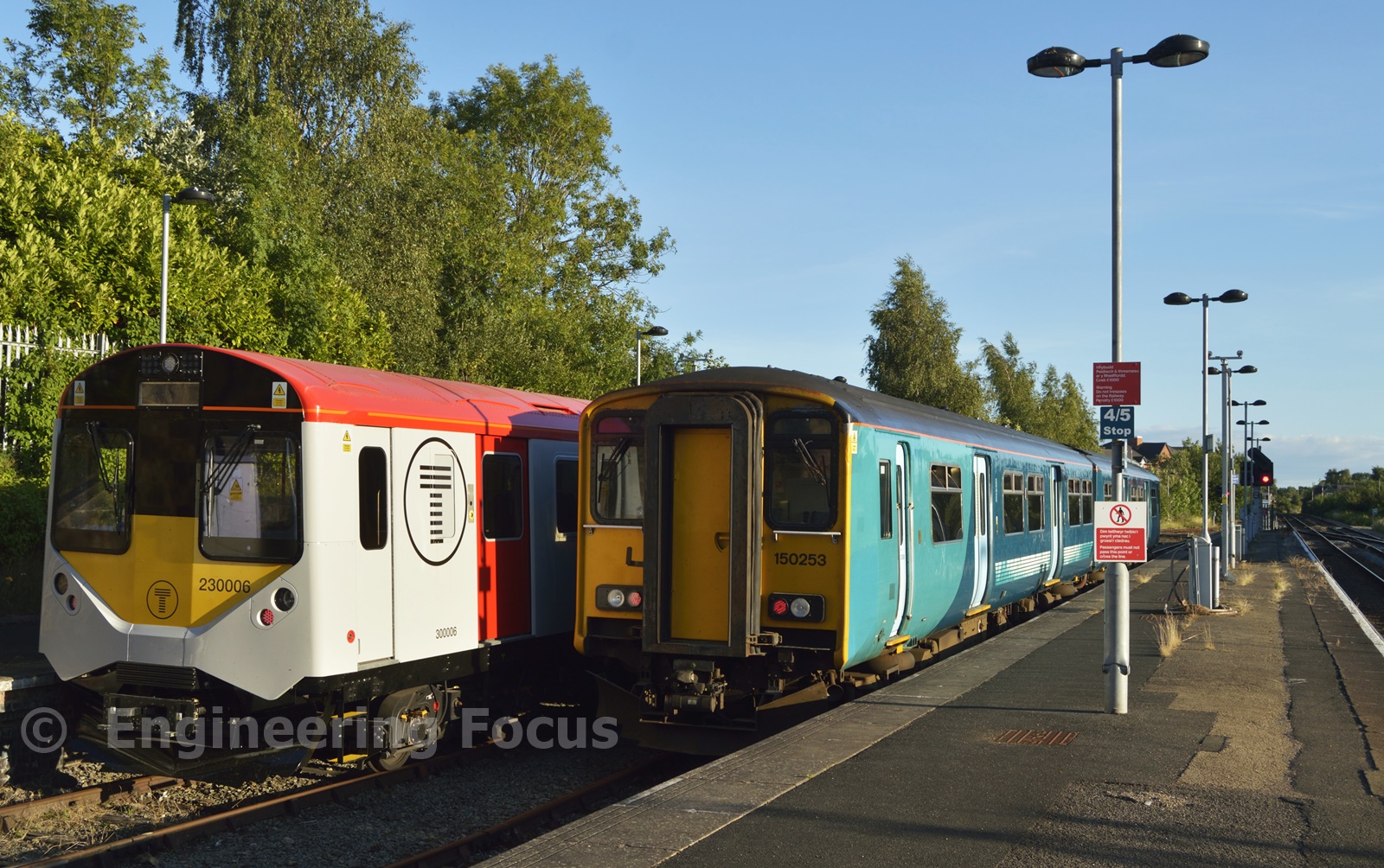
 Class 230 006 along side a class 150 which are set to be replaced on the Borderlands Line.

A small minority bemoan the use of the word "new" to describe the 230s, but given the work that has been carried out I think it's fair to call them new. The D78 stock on which the class 230 is based may
technically be older than the class 150s they're set to replace, but the difference in look and passenger facilities between the 2 units is night and day. Hopefully passengers will be able to judge for themselves soon, but I'm certain when the the 230s do enter service, the average passenger will have no idea that the train they are traveling on has its basis on a train dating from 1978.

[update] Since this blog was published, 230 006 has completed a number of test runs from Wrexham to Bidston and back again. During each run the unit has stopped briefly at each station along the line. Below is a video which compares the class 230 to the class 150 from a standing start, departing Neston station.


Update: side by side class 230 vs class 150 from a standing start.

More videos of 230 006 available here.


Sponsored link
https://www.redbubble.com/people/engphotography/shop/?collections=723725
 

Friday, 19 July 2019

Smart motorways, do they work?

The short answer, in my experience, no. That's not to say that I think “smart” or “managed” motorways are an inherently bad idea. The theory is sound and a study of a section of the M42 which was upgraded in 2006 showed that journey time savings of between 1 and 4 minutes could be achieved during rush hour. 1 minuted saved using variable speed limits alone and 4 minutes with variable speeds and opening of the hard shoulder. Highways England also say that “personal injury accidents reduced by more than half” and “where accidents did occur, severity was much lower overall with zero fatalities and fewer seriously injured”.

So if the data suggests that smart motorways can reduce journey times and make motorways safer, why do I think that they do not work in practice? The main factor which I believe means they do not work to their full potential is the human factor. But I also believe there are other issues which hinder drivers and the ability for smart motorways to smooth traffic flow effectively.

Smart motorways if you haven't driven on one already, are motorways which are designed to control traffic flow through the use of variable speed limits and increase capacity through the use of hard shoulder running. Gantries which are spaced at regular intervals and span the entire motorway width, provide drivers with information governing the speed limit and which lanes are open. An LED matrix mounted on the gantry above each lane indicates the speed drivers should stick to and whether or not the hard shoulder is open to traffic. Live CCTV and traffic information is fed back to a control room from where controllers can set the speed limits for individual gantries and open and close lanes as required. Controllers can also indicate that lanes other than the hard shoulder are closed in case of incidents or breakdowns.

The video below shows one of the UK's newest sections of smart motorway in action. The M6 between junction 16 for Crewe and junction 19 for Knutsford.


In many cases speed limits are enforced by speed cameras located on each gantry, although it is not clear if the speed cameras are always turned on, or if cameras are selectively turned off and on.  The issue of speed and enforcement brings me to my first complaint about smart motorways. Whilst I fully agree that in order to maintain a set speed, that enforcement is necessary, as many drivers would simply otherwise ignore the speed limit, I find that the speed limit drops are too steep. For example, I was travelling along the M6 through Birmingham and the gantries were displaying a speed limit of 60mph, then the speed limit changed to 40mph at the next gantry. The gantry had a sign indicating that there was a speed camera facing directly behind it, so drivers had to slow from 60mph to 40mph from the point of seeing the gantry to passing under the gantry itself. In most cases this caused drivers to apply the brakes in order to slow down to 40mph and avoid potential points and a fine.

Highways England argues that it should be possible to slow down without needing to apply the brakes. But I would argue that slowing from 60mph to 40mph from the point of seeing the gantry, to passing under the gantry is not always possible without applying the brakes, especially if travelling down hill. Forcing drivers to apply the brakes on a motorway is just about the worst thing you can do if want to smooth traffic flow. There is an excellent video which shows the impact braking can have on creating phantom traffic jams.


Forcing drivers to brake can cause the above phenomenon, which can, in turn, lead to drivers responding as shown in the video below, further interrupting traffic flow.


In my opinion, the simple solution is to graduate speed decreases, 60mph to 50mph at the next gantry and then the gantry after that 40mph, for example.

The problem with speed limits is something that the Highways England controllers have direct control over, however, there are human factors which come into play over which Highways England has little control.

One of the issues for the affective use of hard shoulder running is middle lane hogging drivers. They are drivers who refuse to change lane even if the left-most lane is clear. For the purposes of this explanation, I will use lane numbers, with lane 1 the leftmost and lane 4 rightmost lane. I have witnessed on multiple occasions drivers who are sat in the middle lane (lane 2) continue to sit in that lane, even after it is indicated that the hard shoulder is now open. This means drivers who were in lane 2 are now in lane 3, yet still do not move over to the left, despite lane 1 (hard shoulder) and lane 2 being clear. Sometimes gantries can direct drivers to keep in lane and not to change lane, but on the journeys that I witnessed middle lane or lane 3 hogging, no such directions were indicated.

In 2013 police were given the power to hand out on-the-spot fines of £100 and 3 penalty points, as middle lane hogging is classed as careless driving.

Theoretically speaking if all drivers are were driving at the same speed, as indicated by the gantry, then middle lane hogging should not be a real issue, although still against the law. However I have witnessed drivers in lanes 2 and 3 of 4 sitting at 50-60mph when there were no speed restrictions in place. There were also HGVs in lane 2 who were unsure of the rules or simply refusing to use the hard shoulder despite it being open to traffic.

The situation as described above becomes a problem when faster-moving traffic travelling in lane 1 wishes to pass slower-moving traffic sat in lanes 2 and 3. In order not to undertake, the driver would be forced to cross 3 lanes of traffic and then back again. Changing lanes if done properly should not be inherently risky, but add in slower moving traffic and speeding traffic, then moving across 3 lanes can increase the level of risk.

In my opinion, if the police are unable to clamp down on middle lane hogging, then the government should clarify the rules on undertaking. If there are vehicles in lanes 2 and 3 travelling below the indicated speed limit despite lane 1 being clear, then it leaves drivers who do wish to obey the law but wish to travel at the speed limit with a dilemma. Do they cross 3 lanes of traffic, or pass vehicles on the left which despite having plenty of opportunity have not moved over. In Germany it is common for drivers to flash their headlights whilst travelling on the Autobahn, which means the driver behind wishes you to move over. Flashing your headlights at a car in front in the UK would probably be seen as an aggressive act, or the driver in front may think you are trying to warn them that something is wrong, so probably best avoided. But personally, I do think it would be a perfectly reasonable way of indicating that perhaps a driver should move over to the left.

Undertaking isn't strictly illegal, however it can be considered as careless driving and as such drivers caught undertaking can receive penalty points and a fine. However the Highway Code (Clause 268) states: “In congested conditions, where adjacent lanes of traffic are moving at similar speeds, traffic in left-hand lanes may sometimes be moving faster than traffic to the right. In these conditions you may keep up with the traffic in your lane even if this means passing traffic in the lane to your right. Do not weave in and out of lanes to overtake.” So while it is not advisable to undertake there are certain situations when it is permissible.

Middle lane hogging mostly becomes and issue when traffic is flowing freely, undertaking on the other hand can have negative impacts during periods of congestion. I have come across situations where the hard shoulder was suddenly opened to traffic which was travelling slowly or at a standstill. In this instance a small number of cars would enter the hard should and then get up to speed (what ever the speed restriction was at the time) straight away, undertaking drivers at a much high speed than those in lane 2, this would make it difficult for other vehicles to safely move over to the hard shoulder. In this instance the hard shoulder is being used by only a relatively small number of vehicles.

The situation is made more complex by lane drops, this is when a section of hard shoulder which is open to traffic is strictly for vehicles leaving at the next junction. Drivers who may not have seen the matrix message saying that the hard shoulder is exit only, can be forced to leave the motorway, or come to standstill in an otherwise clear lane whilst they wait for an opening to get back onto to motorway. There are also those who use the circumstances to deliberately undertake slow-moving traffic and then just before the junction exit force their way back onto the motorway.

Highways England say that studies show that smart motorways do cut congestion and reduce accidents, but from my experience I don't think that the system is being used to its full potential. One issue is eduction, a large number of motorists have yet to experience driving on a smart motorway and would perhaps not fully understanding how they work. So currently we have a mix of experienced and inexperienced drivers, complicated by drivers who even on normal motorways refuse to move over to the left-most lane and aggressive drivers who use whichever lane is free to make as much headway as possible, as quickly as possible.

It took me a few trips over the M6 through Birmingham to know to look out for matrix notices which say if the hard shoulder is to be used for exiting the motorway only and to look as far ahead to next gantry as possible in order to slow down if necessary. But I do believe there are changes Highways England could do make, such as graduating speed decreases and there should be a widespread campaign to inform motorists of how to drive on smart motorways.

The theory of controlling speeds during periods of congestion is sound, but the human element sometimes means that theory doesn't always work out completely as intended. And then there is the adage that by increasing capacity on the roads you just created more congestion down the line.


Follow me on Twitter and Facebook

 For more information 
e-mail info@EngineeringBlog.co.uk

Monday, 24 June 2019

Rail Live 2019: Highlights - IEPs, battery trains and induction welding

In my first RailLive 2019 post I wrote about the UK's first hydrogen powered train which caused quite a stir at this year's event. In this post I wanted to cover some of my highlights from the event. The site on which RailLive is held is enormous and there is a huge amount to see, so I chose before hand what I wanted to try to see in the limited time that I had

Mirage Rail induction welding

One of the first displays that I set time aside for was that of Mirage Rail who were demonstrating their mobile induction welding system. Using electromagnetic induction to weld sections of rail together is nothing new, however the mobile system developed by Mirage is unique.

The whole system which includes a generator, HIAB and induction welder can be mounted on a single rail trailer and towed by an RRV to wherever it may be required. The image below shows the entire system mounted on a rail trailer.


The induction welder which is manoeuvred over the rail using the HIAB, houses an induction coil which generates high-frequency electromagnetic fields to heat 2 sections of rail to 1300°C, the rails are then forced together using hydraulic rams which are clamped to the rails. As well as joining the rail, the system also has stressing capabilities built in. Some of the other benefits listed by Mirage rail include; “no operator exposure to molten metals, Reduced Operator risk, Automatic Shearing, No gas cylinders or hoses required for pre-heating and Low energy consumption (150KVa)”

The video below shows the induction welder in action, from start to finish.


 LNER class 800 AZUMA

RailLive 2019 like previous years had a massive array of rail plant on display and I hope to cover more of that in a future blog.  The event isn't solely focused on rail engineering or rail plant however, it also provides train manufactures, ROSCOS and train operating companies (TOCs) the opportunity to show off the latest trains which are being delivered to the UK network.

This year LNER brought along one of their new class 800 AZUMAs and invited visitors to come on-board and take a look around. I didn't want to give this opportunity a miss as it's unlikely I'll be able to ride one any time soon. As someone who lives and works in the North West I don't often get the chance to head over to the east of England, or South West where class 800s are also in service.


Passengers who live along the west coast corridor had up until now benefited from  some of most modern intercity trains on the network. The class 390 Pendolinos which were introduced between 2001 and 2004 revolutionised intercity travel along the WCML and were in part responsible for the doubling of rail passenger numbers on the WCML. The sleek, modern and fast trains cut journey times and introduced passengers to a whole new world in terms of rail travel.

It is hoped that the class 800s will have a similar affect on ECML routes to London. The AZUMAs will provide more capacity, with an additional 100 seats per train and it is hoped that there will be journey time improvements with the new timetable in 2021. The journey time savings probably wont be as dramatic as those achieved on the WCML with the Pendolinos, however new more spacious trains with modern features is bound (hopefully) to persuade even more people living along the ECML corridor to take the train.

There is one subject that does keep cropping up, and that is the standard class seating. Having read and heard that the standard class seats are not particularly comfortable I had to try one out for myself. Straight away I understood what people have been saying, the seats are firm, very firm. On the plus side there is plenty of legroom, not something you get very much of in a Pendolino in standard class, believe me. So there are some pluses and minuses, and if you want to get the maximum number of seats in a train, all while providing good legroom, PRM toilets, luggage and bike storage and a cafe, then something does have to give (or not give, if you're talking about the seat padding) to make extra space. Reducing the thickens of each seat by a few centimetres soon adds up to a lot of space saved.


Innovation Hub


Over in the Innovation HUB there were seating solutions which did seem to save space but were actually comfortable to sit on. No I'm not talking about the ones pictured directly below, they are seating solutions for high capacity trains and are designed for short journeys. More of a perch than a seat, they offer maximum capacity whilst providing something which should be a lot more comfortable than just standing and the ones on the right had USB charging points. I'm not sure how popular they would be here in the UK, but I'm sure if people were given the choice between standing or perching on a metro or underground train, they would choose perching.


The picture below shows standard class (left) and first class (right) seating configurations fitted to the class 319 which was home to the Innovation Hub. I quipped we could do with some first class seating in Northern's class 319s, I don't think I was the first person to say that. More interesting though, keeping the AZUMA seating in mind, was the standard class seating arrangement. The seats appear to be light-weight and have minimal foam padding just like the AZUMAs, but these seats seemed so much more comfortable. So perhaps it is possible to design a space saving seat that isn't rock hard!


Class 230 D Train fast charging

Porterbrook with their HydroFLEX unit aren't the only company providing solutions to the 2040 deadline for the banning of diesel-only trains. Vivarail have been working on number of solutions which includes diesel electric hybrids, which will hopefully enter service with TfW Rail this year. Last year they also showcased a battery version of the class 230 D Train, the 2 car unit had 4 battery rafts each providing 106kw. This year Vivarail had a single car battery vehicle on display. The unit was at the event to promote a fast charging system developed by Vivarail which can charge a battery powered train in as little as 7 minutes, providing enough charge for a range of 60 miles.


The system comes in 2 part, first the static section which can be located at a terminus, consisting of short sections of 3rd and 4th rail which provides the charge. The other part is the carbon ceramic shoe gear which has been designed specifically to be able handle the high currents involved.

As well as providing hybrid and full battery versions of their class 230 D Train, Vivarial also announced in May this year that they have teamed up with Arcola to develop a hydrogen fuel cell variant. The hydrogen powered unit is still in the development stage, but Vivarail say the first prototype should enter the testing phase in early 2020.


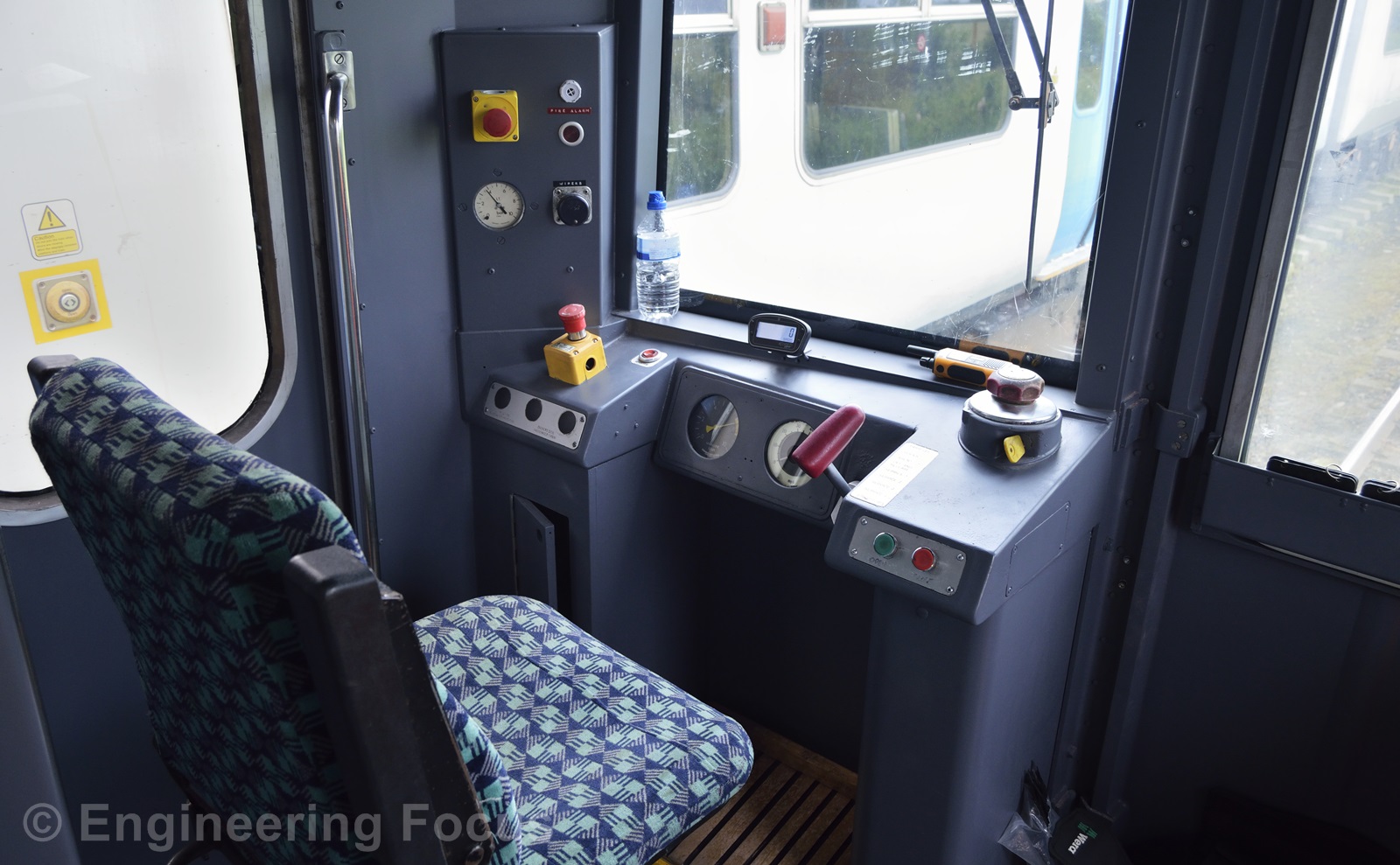
On a final note, I thought it was interesting being able to see inside the cabs of both the class 230, pictured below and the class 800, bottom image. The cabs are worlds apart, with the class 800 looking more like the controls of the Star Ship Enterprise. But the simple yet functional cab of the class 230 still gets the job done.


Thursday, 20 June 2019

RailLive 2019: UK's first passenger carrying hydrogen train

In 2018 the UK Government announced its intention to phase out “diesel-only” trains from the UK rail network by 2040. An ambitious target which would be nearly impossible to achieve through electrification of the rail network alone. According to the DfT in 2009 just over 5000km [1] or roughly 33% of the UK's rail network was electrified, since then, and despite a wide spread programme of electrification between 2014 and 2019, that figure has only increased by an estimated 1000km. Given that the length of the UK rail Network is 16,000km, Network Rail would have to electrify 500km of railway every year for the next 20 years to electrify the remaining network by 2040. Considering it has taken 5 years and cost in the region of £4-5bn to electrify just 1000km of railway you can see how this would be a challenge to say the least.

This means then, that the challenge to phase out diesel-only trains by 2040 has been passed to train manufacturers and rolling stock leasing companies (ROSCOs). I'm fairly certain there will be some diesel-only trains still in operation after 2040, as Northern's class 195s which are being delivered now and Transport for Wales' new units which wont be delivered until 2021 will be powered solely by diesel. It is inconceivable that the government would force ROSCOs to scrap or re-engineer rolling stock which will be 20 years old or less by 2040, that would be wasteful and expensive. However the challenge faced by ROSCOs and manufactures is to develop new ways to power trains between now and 2040.

Luckily it seems that companies and organisations in the UK are well on the way to developing new power technologies which will eventually put an end to diesel-only trains, whilst not requiring the electrification of the entire UK rail network. Vivarial displayed a battery version of their D-Train at RailLive last year and has since gone on to develop a fast charging solution, which can charge a set of batteries in 8 minutes, providing a range of 60 miles. I will be writing more about that in a future blog.

Porterbrook Leasing have also been developing their own upcycled, re-engineered rolling stock based on the class 319 of which 84 were built. Porterbrook already has orders for a tri-mode class 769 variant of what they call their “Flex” units, which are currently having diesel engines fitted, allowing them to switch between DC, overhead and no-electrified lines. Transport for Wales, Northern and Great Western Railway are expecting units, with a total of 38 units on order.

Not content with converting 319s to tri-modes, Porterbrook, working in collaboration with The University of Birmingham’s Centre for Railway Research and Education (BCRRE) have developed the UK's first hydrogen powered train. The first “HydroFLEX” unit was demonstrated at this year's RailLive event, taking passengers gingerly along a section of track at the Quinton Rail Technology Centre.

You can see a short video of the HydroFLEX in action below
 
The unit on display was powered by a singe 100kw hydrogen fuel cell combined with a 100kw battery and was carrying 20kg of hydrogen. The next step is to fit the unit with 2, 100kw fuel cells and 2, 100kw batteries, before beginning testing on the mainline. The unit will be able to hold 200kg of hydrogen in total, which it is estimated should be enough to power the unit for 1600km. The fuel cells and tanks, as well as the control systems are all housed in 1 of the 4 carriages.

Fuel delivery system

The first public outing for the HydroFLEX has caused quite a stir, with the BBC attending to film the train in action and to interview those involved. The team from Porterbrook, BCRRE and Fuel Cells Systems who supplied the hydrogen were busy ensuring that everything ran smoothly and were on hand to answer any questions.

Alex Burrows, Director at Birmingham Centre for Railway Research and Education, commented: “This is a great success story for the UK Rail Industry, which shows our capability and commitment to helping the government meet decarbonisation targets. Key to this success is the close partnership between academia and industry which has enabled us to pool the expertise needed to rapidly progress this technology from concept to full-scale working demonstrator.”


The demonstration seems to have been a real boon for the UK rail industry, generating positive news for the industry which doesn't always get an easy ride from the mainstream media. The HydroFLEX demonstrates that the UK rail industry can deliver innovative solutions to looming challenges, and that the UK can be a world leader in the development of alternative power systems for rail vehicles.

The fuel cells and batteries themselves are based on tried and tested technology, and have been sourced from around the world. What makes the HydroFLEX innovative is the control system being developed by BCRRE. The complex control system must work seamlessly to balance fuel delivery and energy output, whilst monitoring the battery and energy recovery through regenerative breaking. The system is what brings everything together to make the HyrdoFLEX a unique and world leading train.

Although powering trains with hydrogen fuel cells may not be the only answer to removing diesel-only trains from the UK rail network, it is one solution that could help the government deliver its 2040 promise. Apart from the remaining class 195s and Civity based DMUs to be delivered to TfW, which should end their service some time around 2050. 

[1] https://webarchive.nationalarchives.gov.uk/20090805225151/http:/www.dft.gov.uk/pgr/rail/pi/rail-electrification.pdf 

Follow me on Twitter and Facebook

 For more information 
e-mail info@EngineeringBlog.co.uk


Latest blog post

HS2 Bridges and Viaducts Engineering Challenges

A version of this article was published in RAIL Magazine issue 1040 Construction of the 220km (140 mile) long HS2 route between London and ...